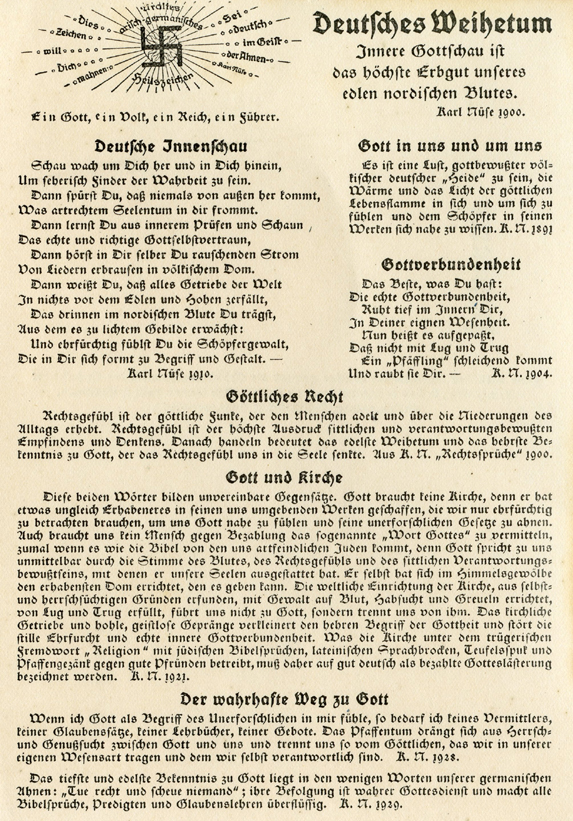
'The rejection of Christianity is stringent antisemitism.
Jew and Freemason both know that the Christian world religion is paving the way for Jewish world domination.
• What a good way to start off a new page than with one of Germany's greatest sons, Erich Ludendorff, one of the most incredible personalities to come out of the Great War, and one of the strongest early supporters of Adolf Hitler. The victories Hindenberg and he delivered Germany in World War One were staggering. Hindenberg and Ludendorff defeated the Russians, closing the Eastern Front, and very likely would have defeated their enemies on the Western Front as well, had not traitors at home stopped them. In the days when the NSDAP was simply called the 'Hitler Movement' in Germany and Austria, Ludendorff lent his prestige and fame to the Party. Ludendorff even put his life on the line and went with Adolf Hitler during the Putsch, and after its failure, he and the others were charged with treason, however his celebrity status and legion of admirers led to his immediate acquittal at his trial. One cannot overstate how important his support was to Adolf Hitler and his movement in those early, bloody days. Like Hitler was to become, Ludendorff was larger than life. His frowning, harsh face represented the ideal of Prussian discipline and no compromise patriotism.
[Above: Hindenburg (left) and Ludendorff (right) with Kaiser Wilhelm II, January 1917.]
[Above: Adolf Hitler with Ludendorff, April 1924.]
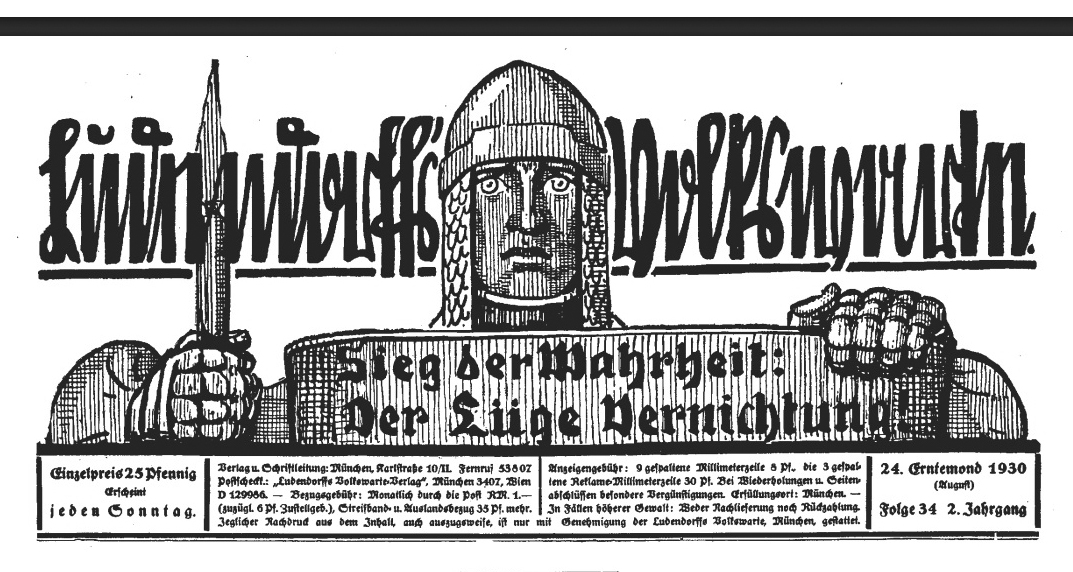
[Above: Title of 'Ludendorffs Volkswarte - Sieg der Wahrheit: Der Lüge Vernichtung!' (Ludendorff's People's Viewpoint - Victory of Truth: The Destruction of Lies!). This was Ludendorff's magazine which ran from 1929-1933.]
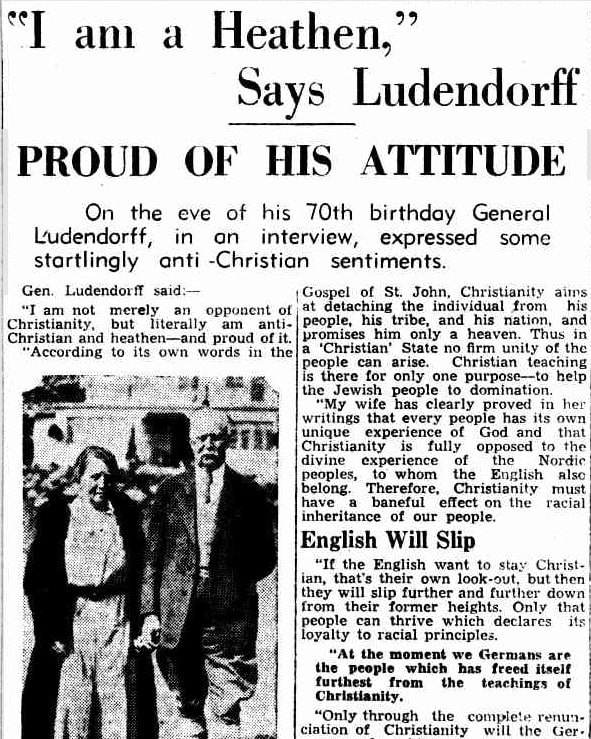
[Above: Period English newspaper article.]
[Above: The caption on this says:
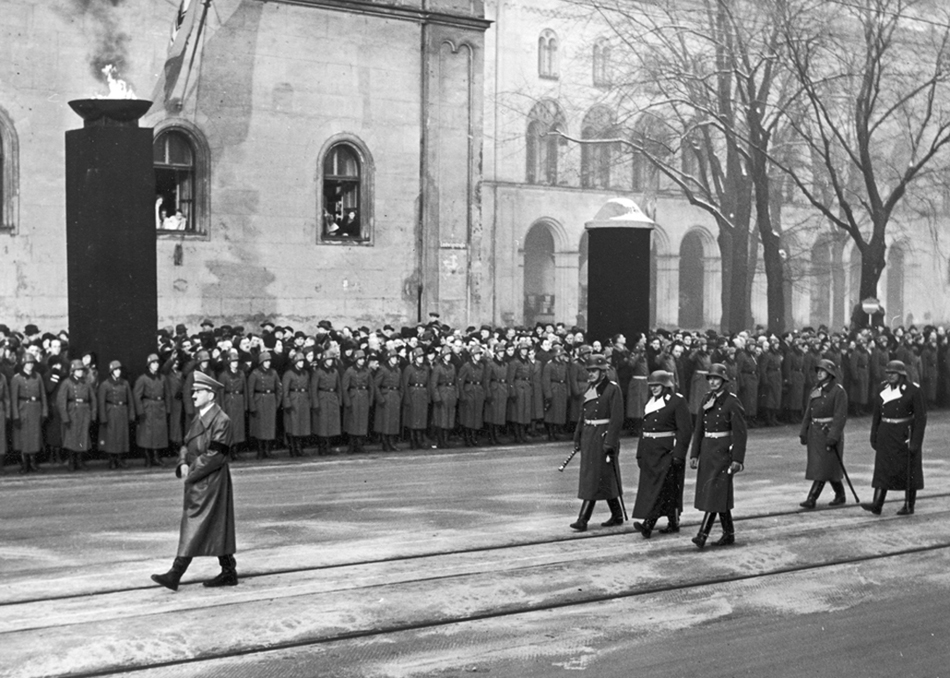
[Above: Ludendorff's deeply solemn state funeral on December 22, 1937 in Munich.]
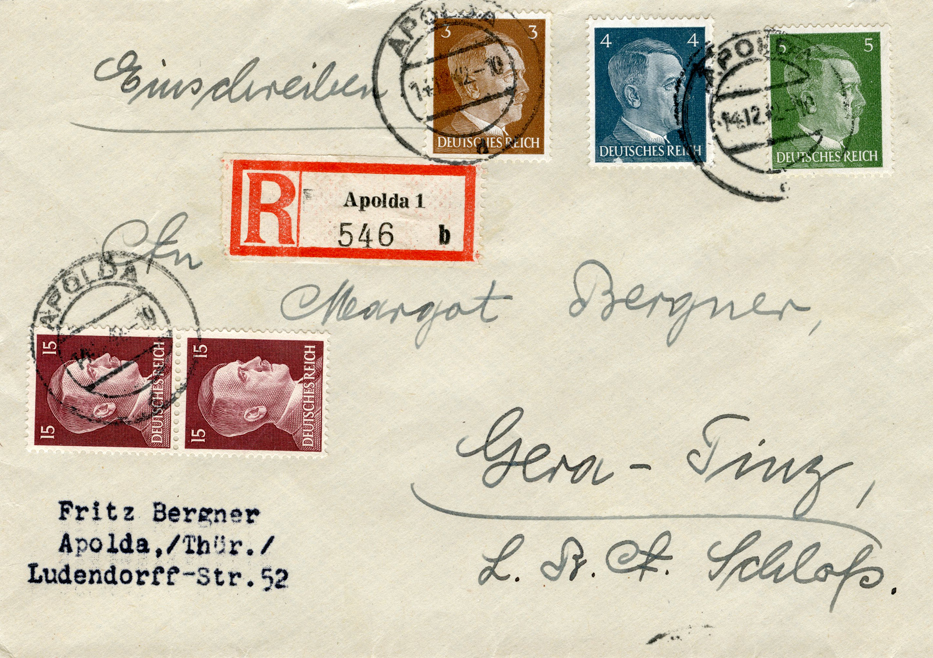
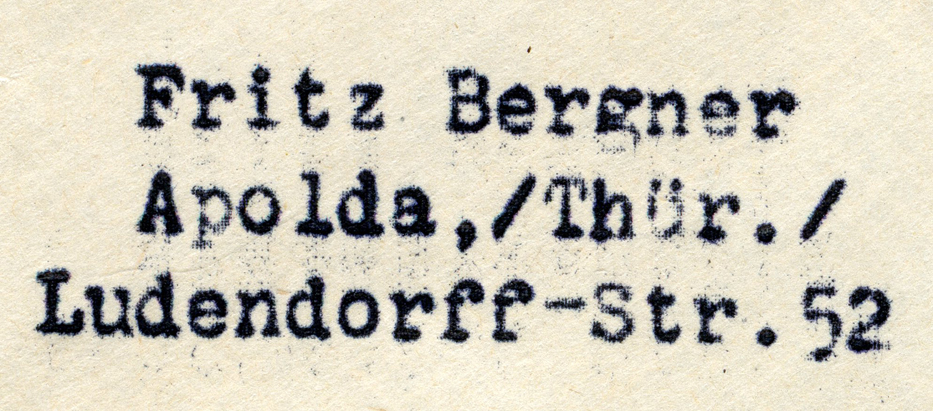
[Above: Envelope postmarked December 14, 1942 and registered in Apolda, Germany. It's interesting to note that this was sent from Ludendorff Street! There were in fact many streets named after the great general. Odd that they paid such homage to him even though Adolf Hitler and he hated one another. Yet another lie, they in fact had great respect for one another.]
[Above: Close-up.]
'The Jews are our enemies because they distilled the poison of the Christ myth out of the story of Jesus.
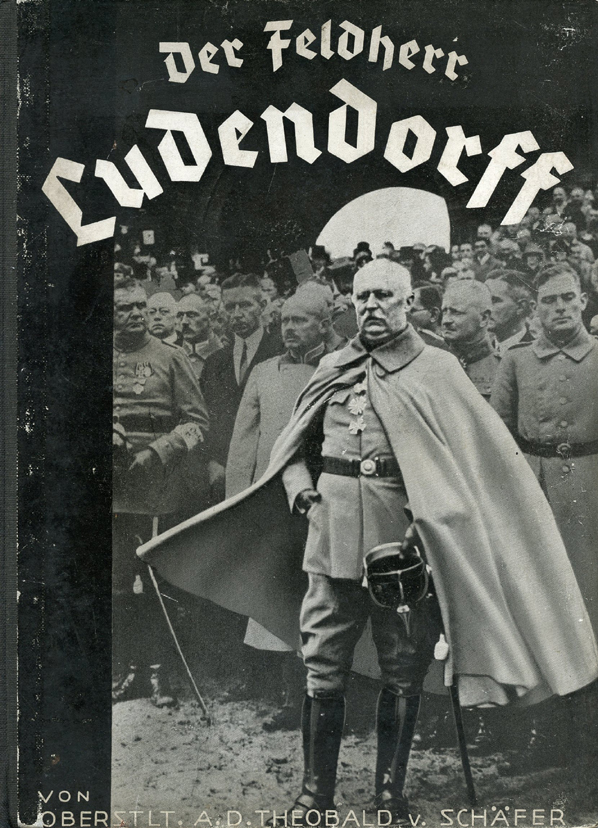
[Above: 1935 book 'Ludendorff - Der Feldherr der Deutschen im Weltkriege' (Ludendorff — The German Commander in the World War). Click to see inside. This copy is very special for the reason you'll see directly below...]
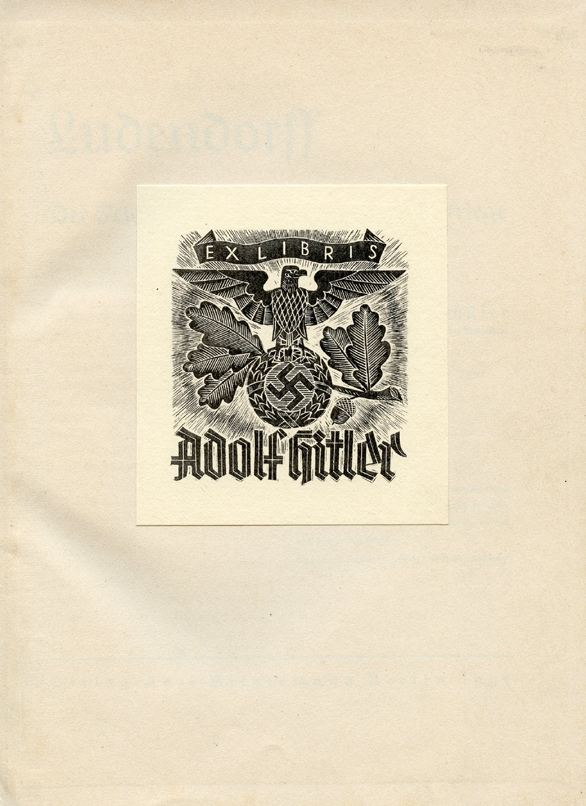
[Above: Library of Adolf Hitler bookplate! Strange that Hitler would have a book about someone he supposedly hated, huh?]
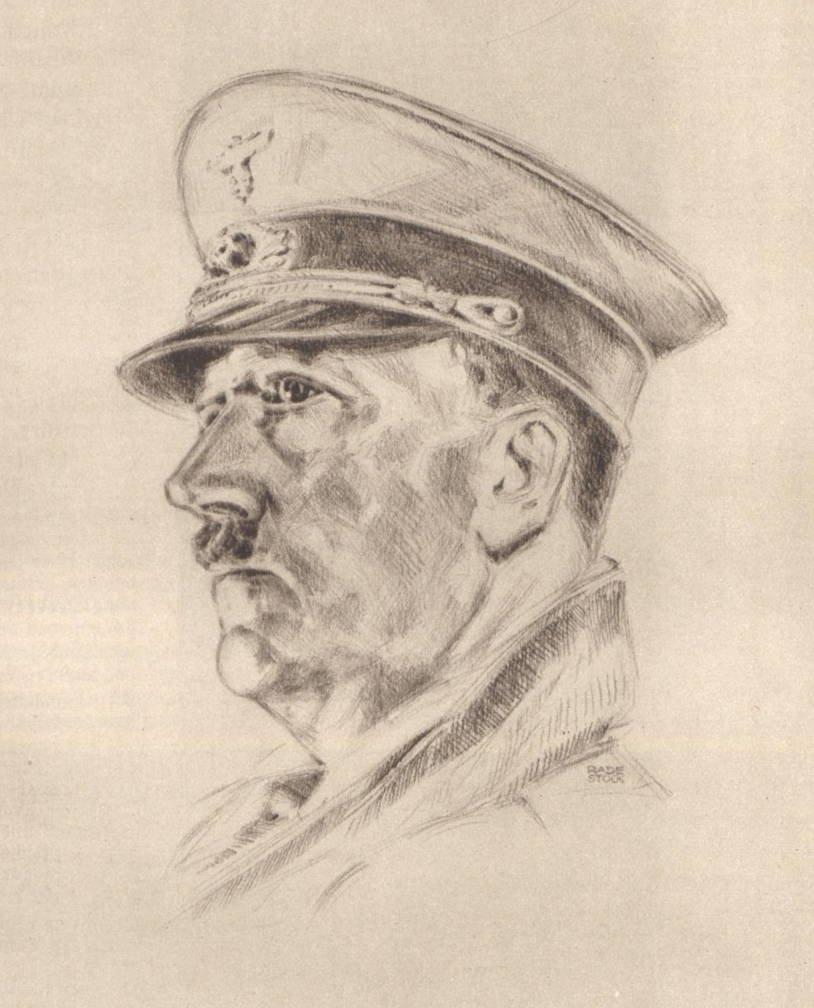
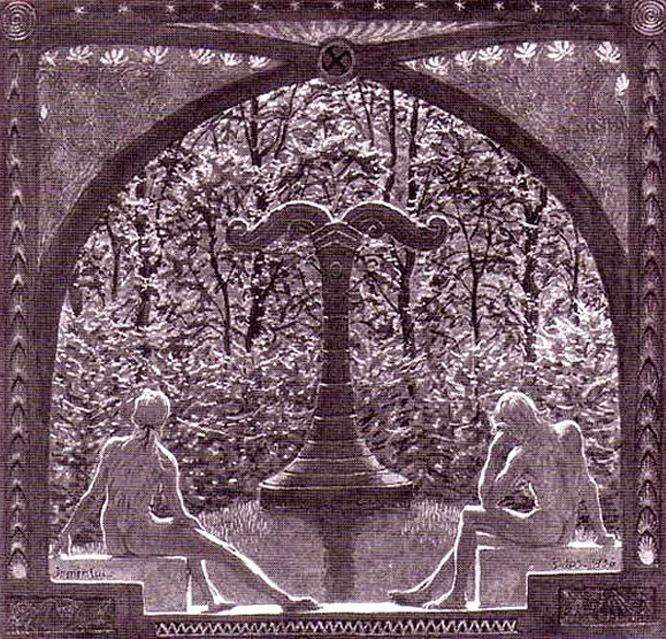
[Above: Here is a drawing by Helmuth Nadeftock found in none other than Erich Ludendorff's own magazine 'Am Heiligen Quell Deutscher Kraft' (At the Sacred Source of German Strength,
Issue 23, February 24, 1939). Again, it makes no sense that Ludendorff and Hitler hated one another. The same issue also talks about the great achievements of the Third Reich.]
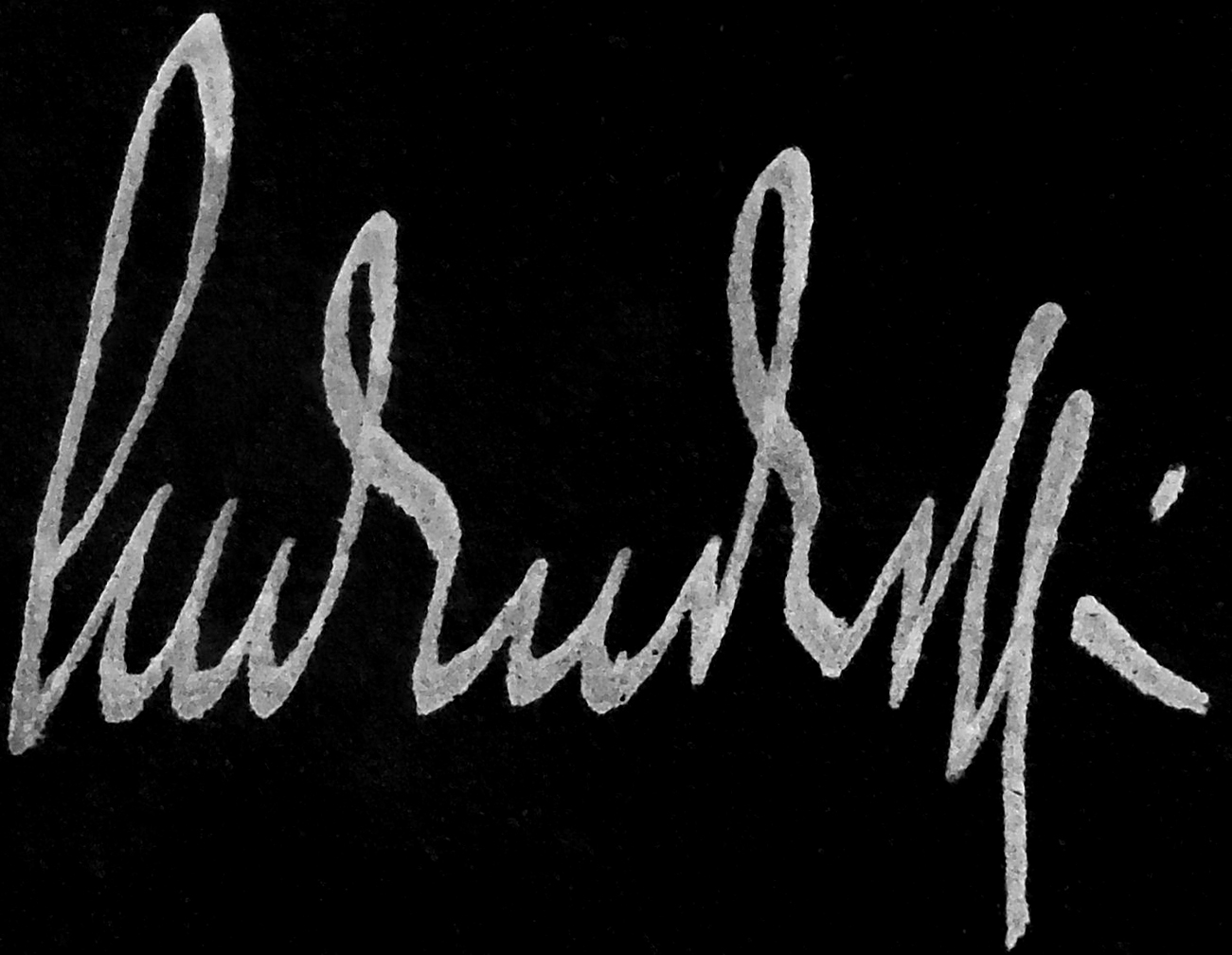
[Above: Erich Ludendorff's signature.]
'I decline Christianity because it is Jewish, because it is international, and because, in cowardly fashion, it preaches peace on Earth.'
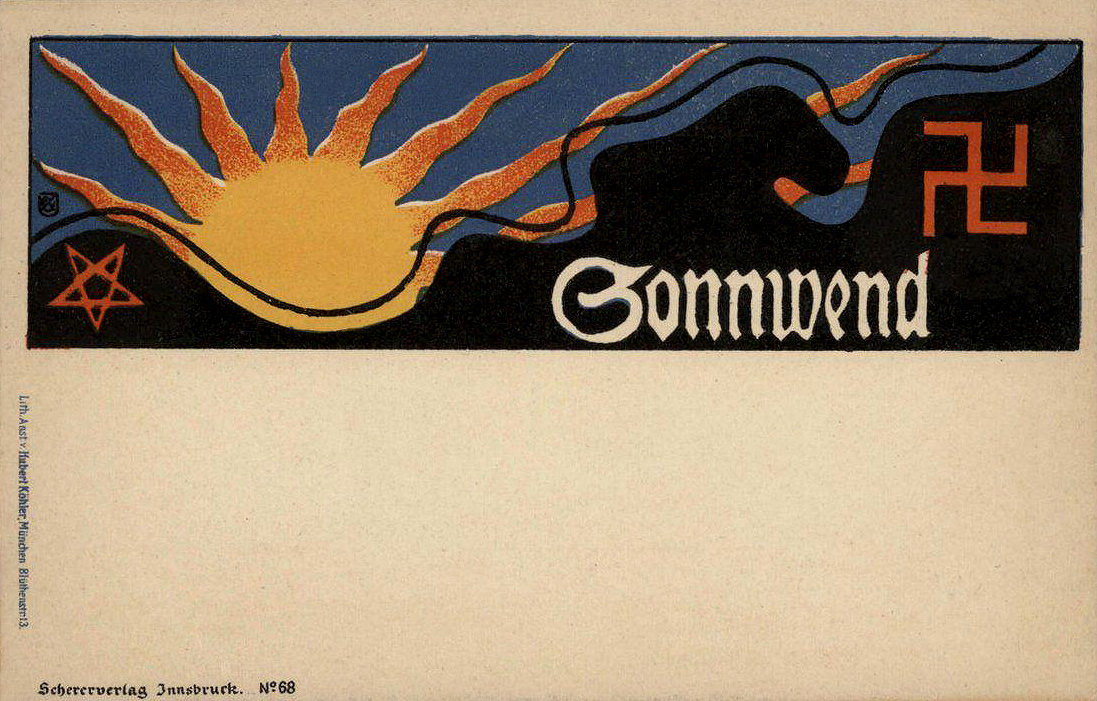
[Above: The top of an early German winter equinox festival postcard from Schererverlag, publisher of indigenous European religious-themed postcards.
'Germany has always dared to oppose the crucifix of humiliation with the solar symbol of victory.'
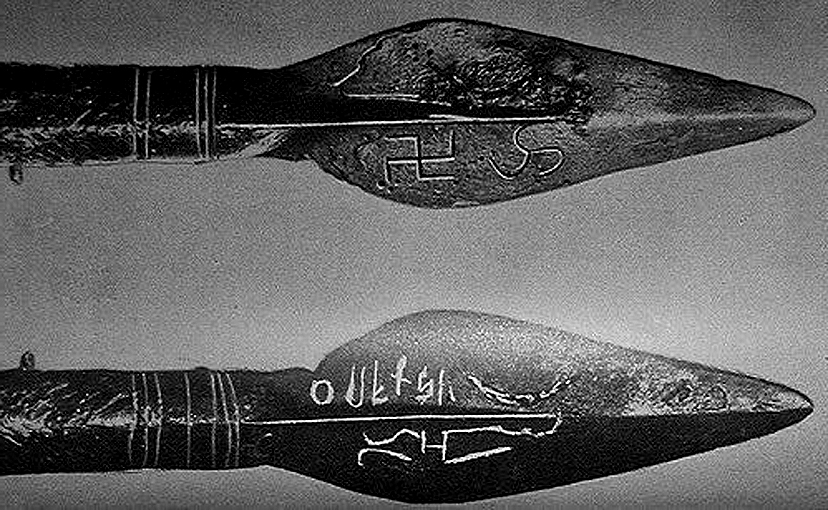
[Above: Ancient spear head bearing several examples of the solar symbol -- the swastika -- first century, Germany.]
[Above: A very interesting postcard from Volksdeutsche Gemeinschaft, Göttingen, Germany. On the right is a translation. Click to enlarge and see the reverse of the postcard.]
[Above: This is a Feldpost card, that is also a pop-up card. I'm not sure why this is called a 'pentagram', but in modern times we call it a 'pentacle'. First let's look at what it says:
'Das Pentagramm (Der Drudenfuß)
dessen Schnittpunkte im Goldenen Schnitt liegen.
Aus 10 Dreiechen als Fenster herzustellen.'
(The Pentagram (The Druid's Foot)
whose intersections lie in the golden section.
To be made of 10 triangles as a window.)
It's very interesting that they would call this the 'Druid's Foot'! Way back in the day when we were looking for a symbol to represent Mourning the Ancient we found out that the pentagram represented truth in ancient cultures. That it didn't represent 'the devil' as popular culture depicted. But so many indigenous European religious symbols were perverted by early Christianity into something evil. But anyway, back to the Druid's Foot. Way back in the late nineties I remember one of the guys from ...the Soil Bleeds Black (a superb band of ambient music) told me after we were discussing the true meaning of the pentagram that in ancient times the druids would draw the pentagram on the soles of their feet, thus they would be 'walking with truth'. I never heard about that from anyone else, nor have I ever read about it, but I trusted the source, and always remembered it. Well, here it comes full circle, all these years later, on a soldier's postcard from the 3rd Reich.]
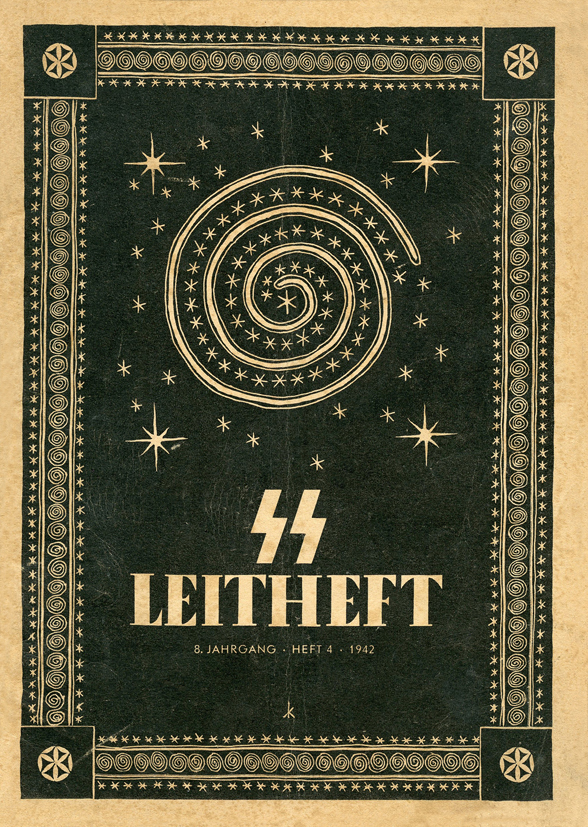
[Below: This beauty is 'SS Leitheft 8. Jahrgang heft 4, 1942' (SS Leadership Magazine, 8th year, issue 4, 1942). Like everything produced by the SS, these magazines are rare to find, so it is cool to be able to scan it for you. Click to see inside.]
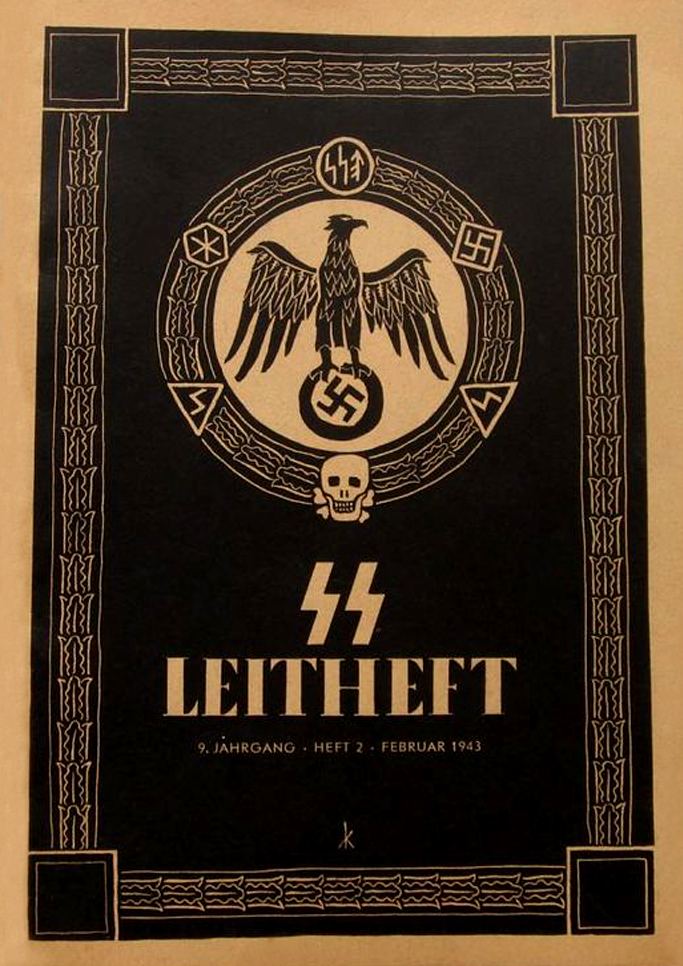
[Below: Cover of SS Leitheft 9. Jahrgang heft 2, 1943. (SS Leadership Magazine, 9th year, issue 2, 1943).]
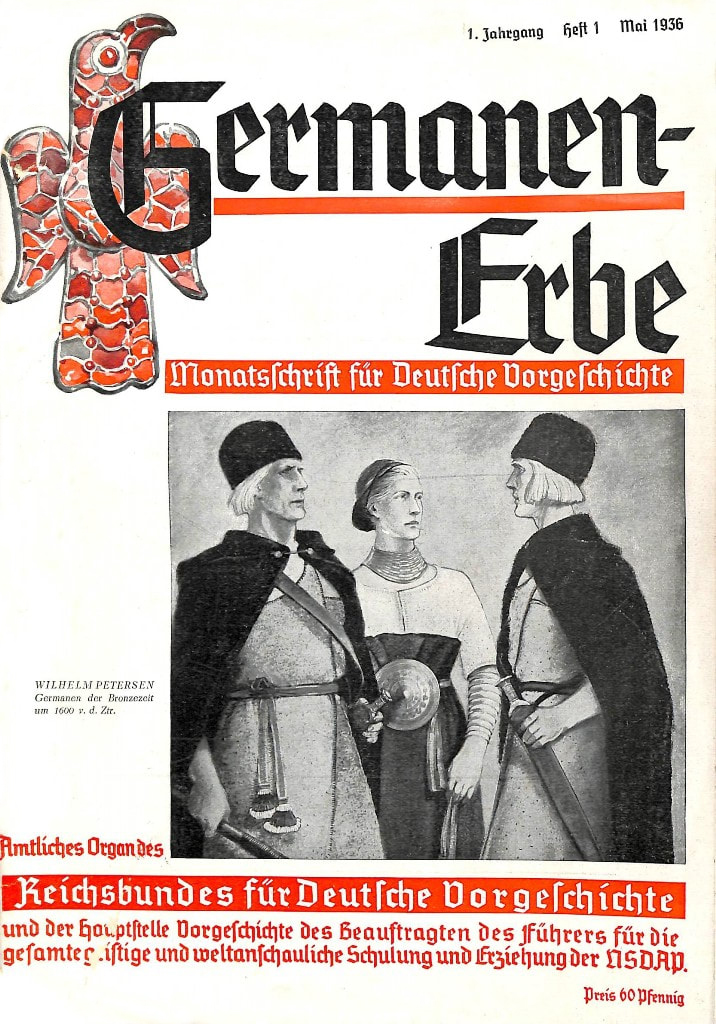
[Below: Cover of Germanen-Erbe 1. Jahrgang heft 1, Mai 1936. (German Heritage, 1st year, issue 1, May 1936).]
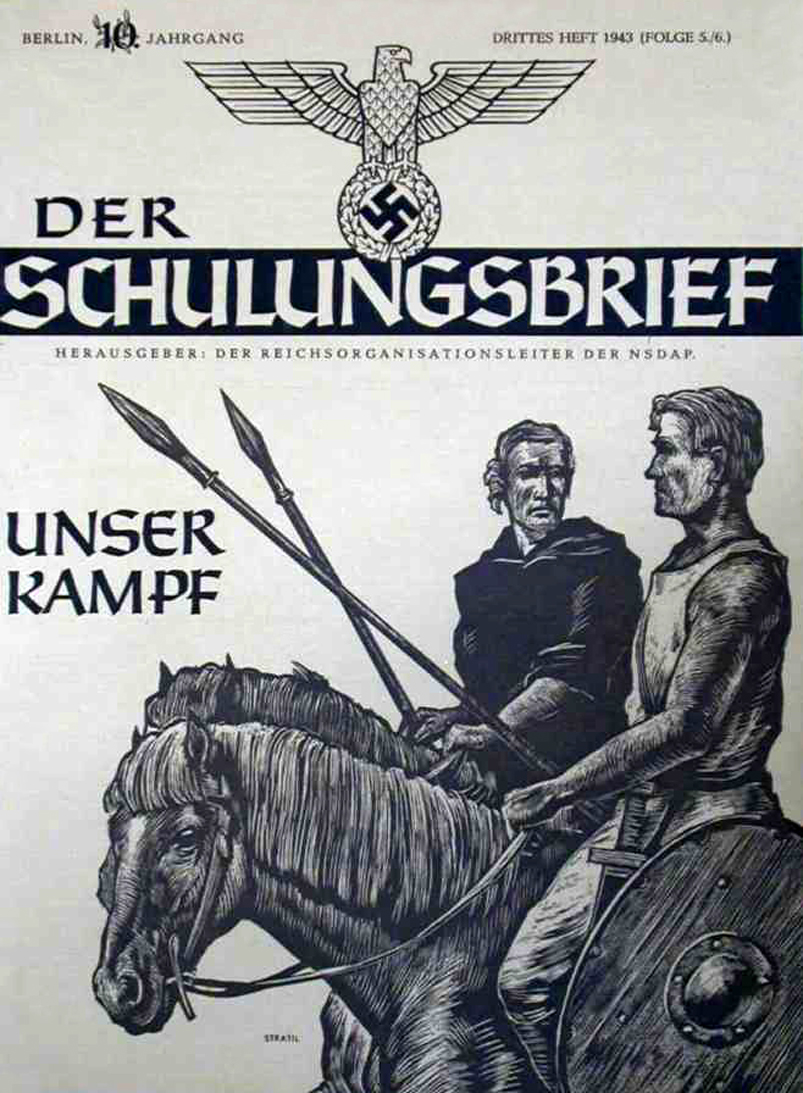
[Below: Cover of NSDAP published Der Schulungsbrief, 1943 (Training magazine). Although this was not a history publication, like most things National Socialist, indigenous European religious symbolism and art permeated it.]
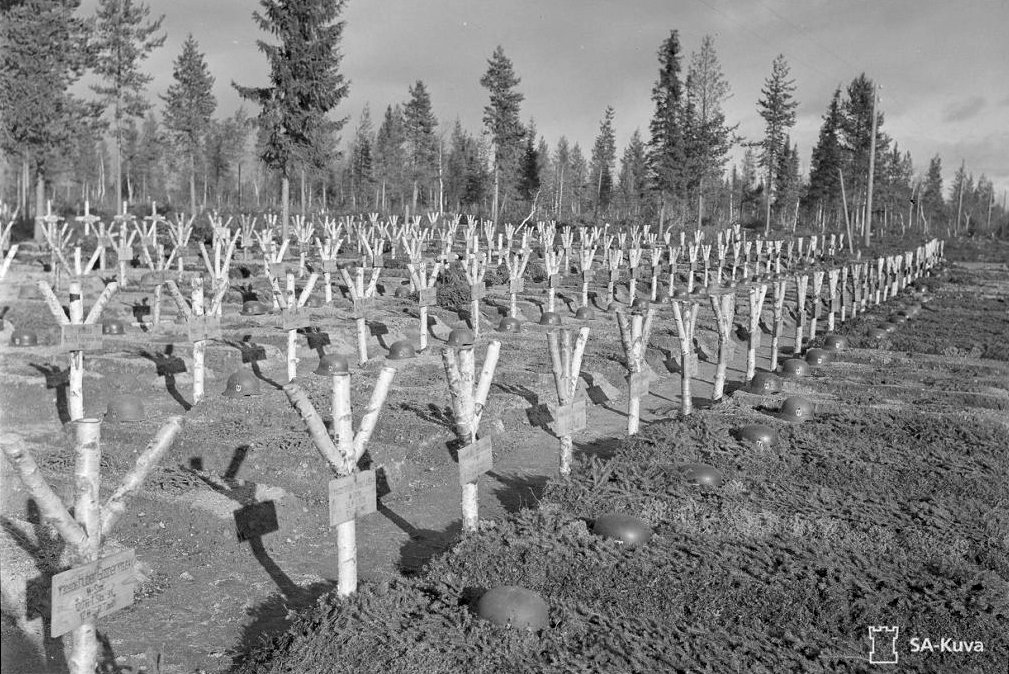
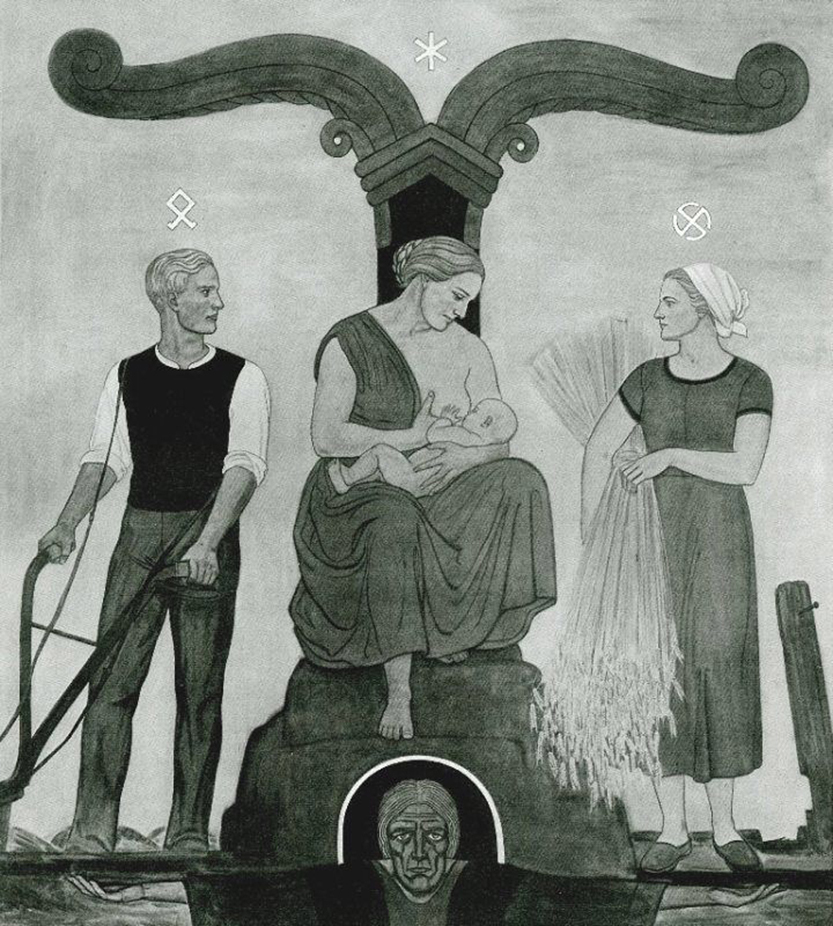
[Below: The indigenous European religious symbol for life, the Algiz rune, was used for non-Christian grave markers (you can see crosses in the very back).]
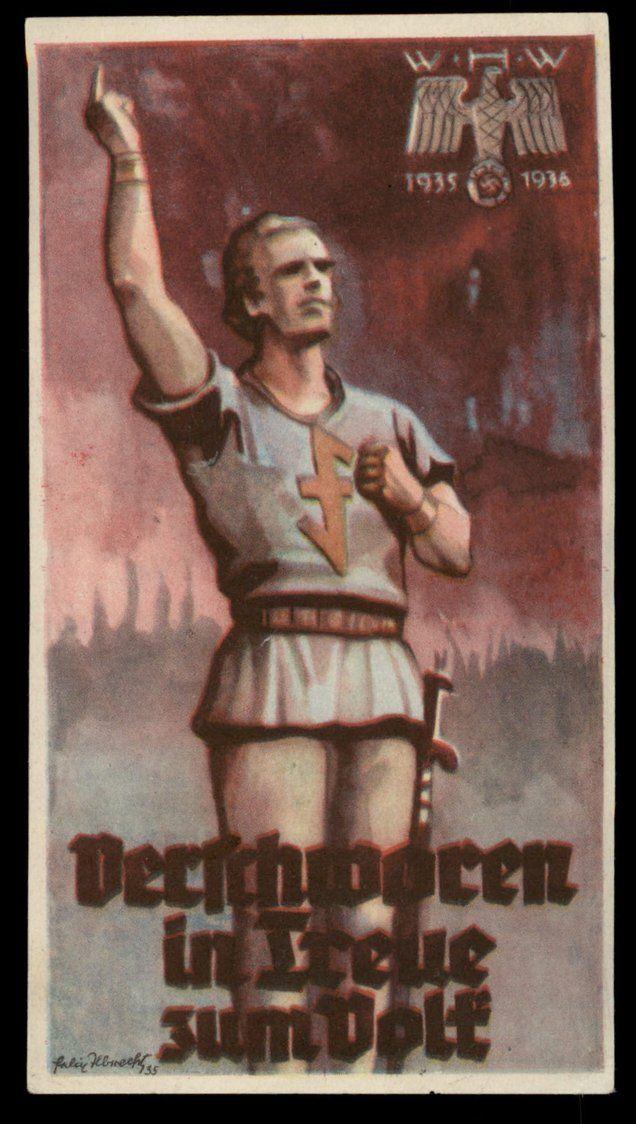
[Below: This paper was given for 1935/1936 Winterhilfswerk donations. It has the Wolfsangel rune on the warrior's chest.]
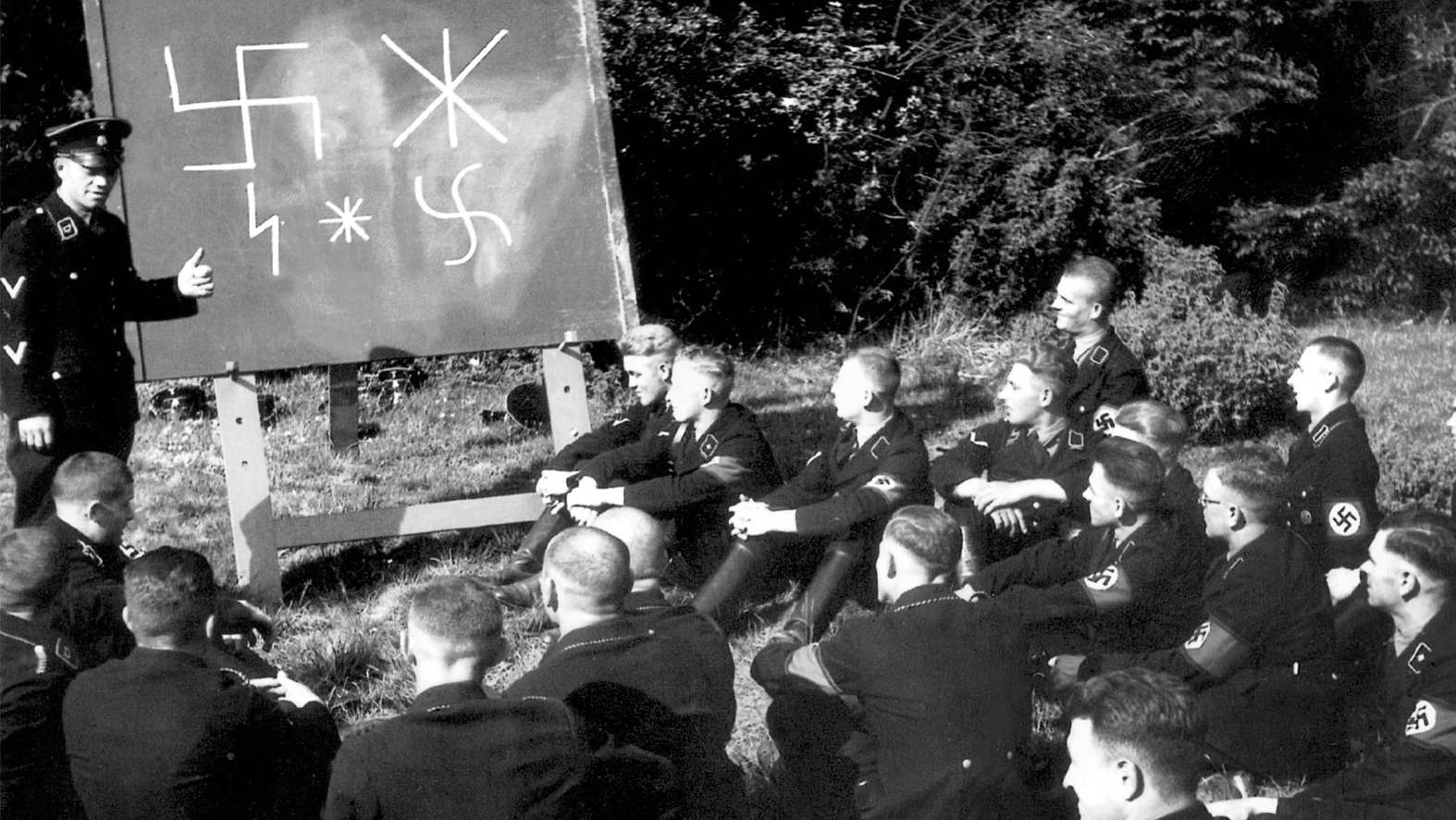
[Below: SS men learn the meanings of runes in an outdoor classroom.]
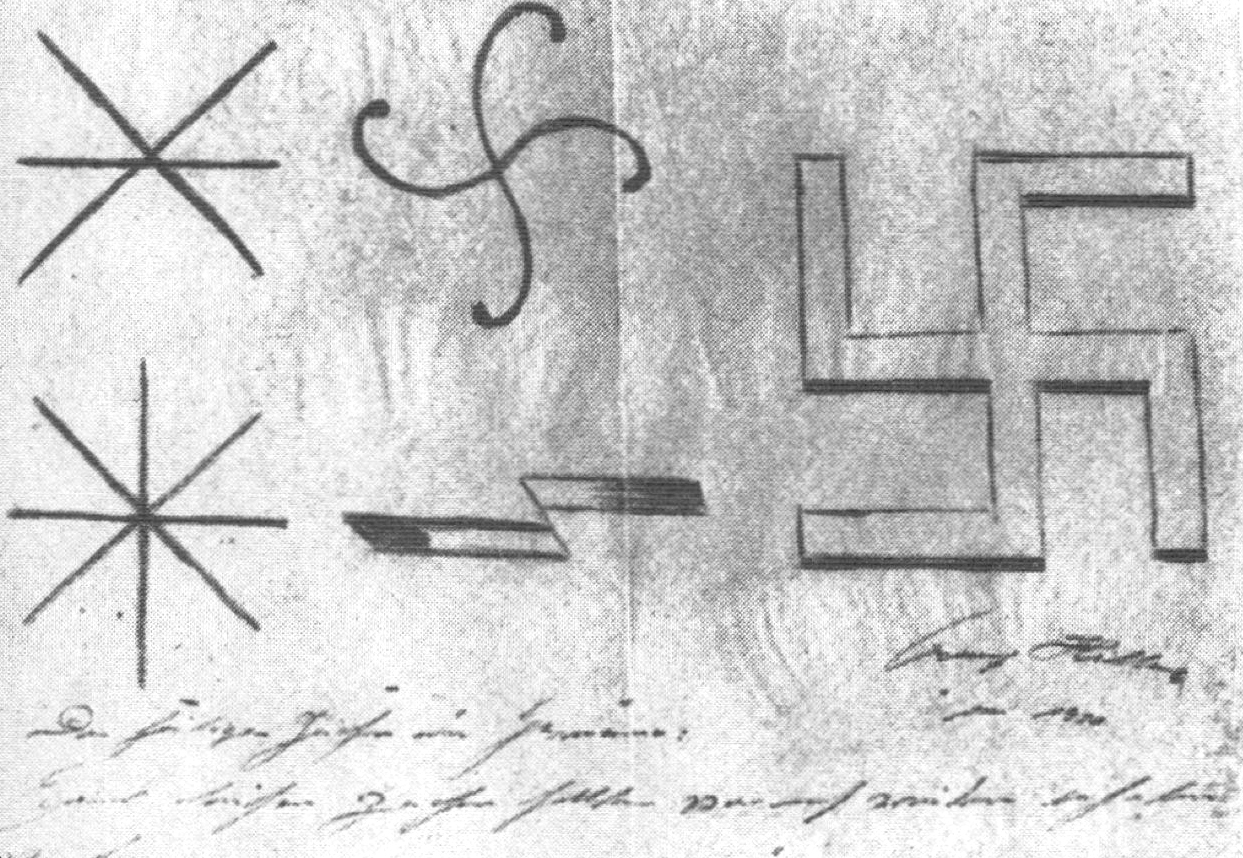
[Below: Adolf Hitler himself drew these runes in May 1920, and wrote 'The holy sign of the Germanic people. One of these symbols should be resurrected again by us.' Pretty incredible.]
[Below: The Irminsul was a sacred, ancient Germanic pillar (until destroyed by Charlemagne in 772 CE). It represented a bridge connecting the afterworld and earth.]
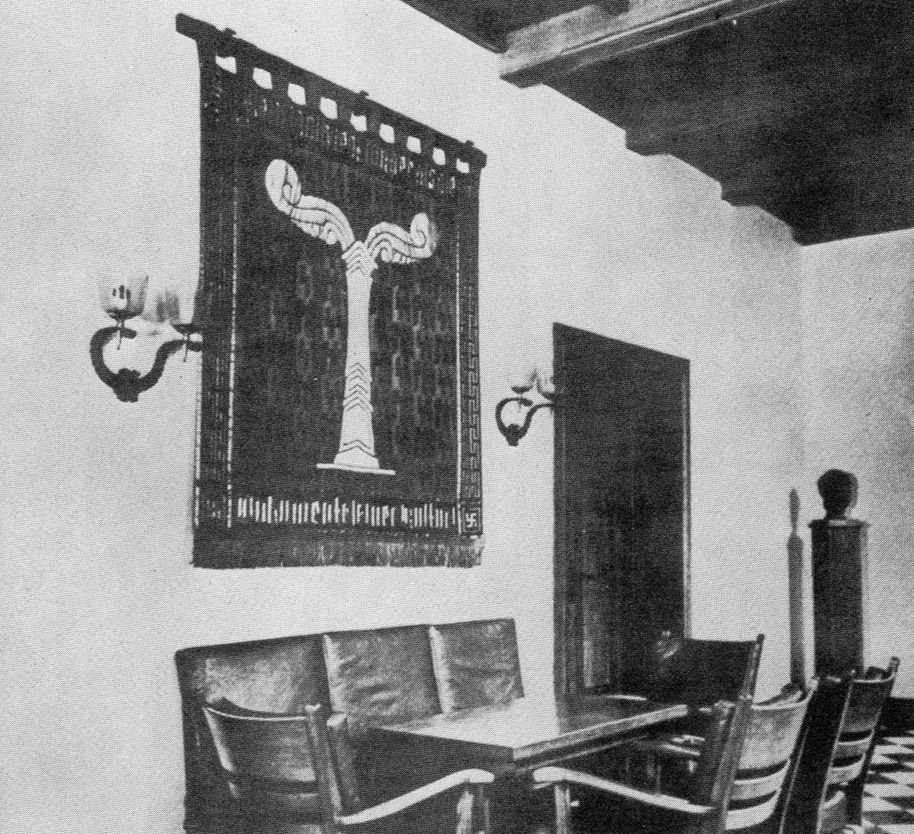
[Below: The entrance to Walther Darré's headquarters -- note the tapestry with the Irminsul symbol -- it says: 'No people lives longer than the documents of its culture'.]
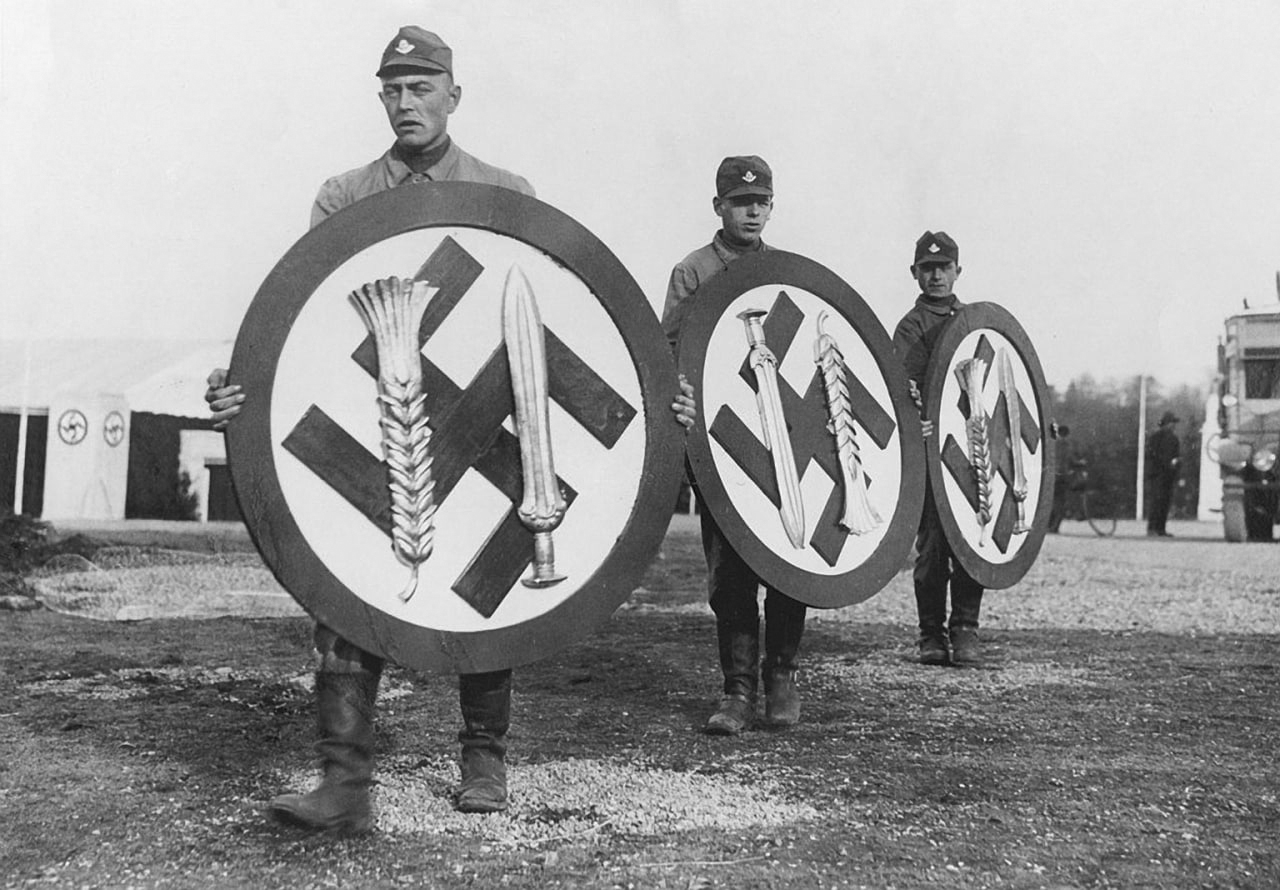
[Below: RAD men lend a hand preparing for a Blood and Soil festival.]
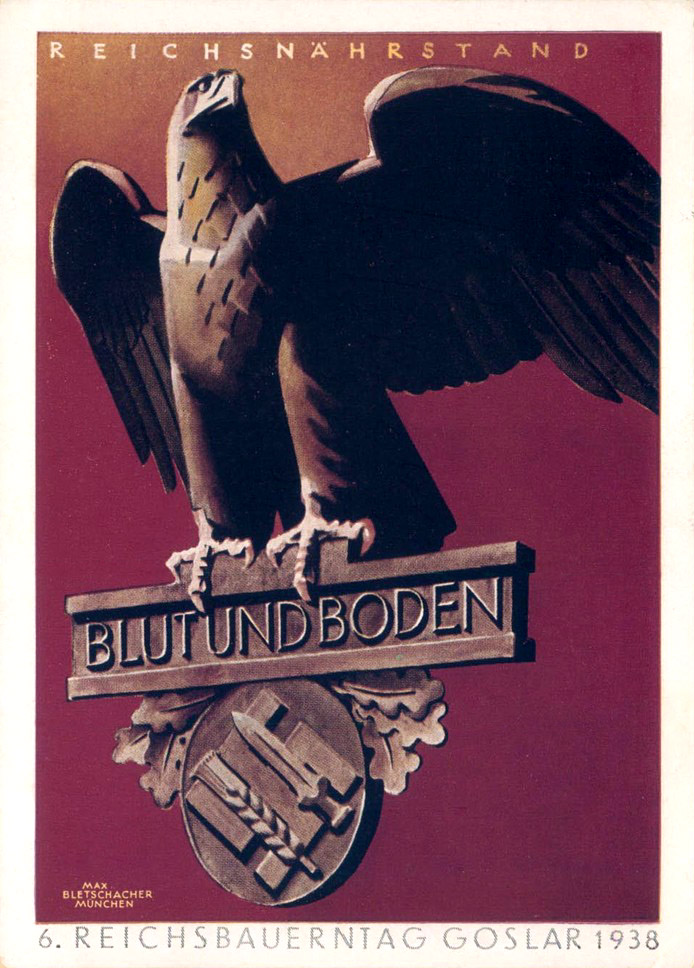
[Below: 1938 Blood and Soil postcard.]
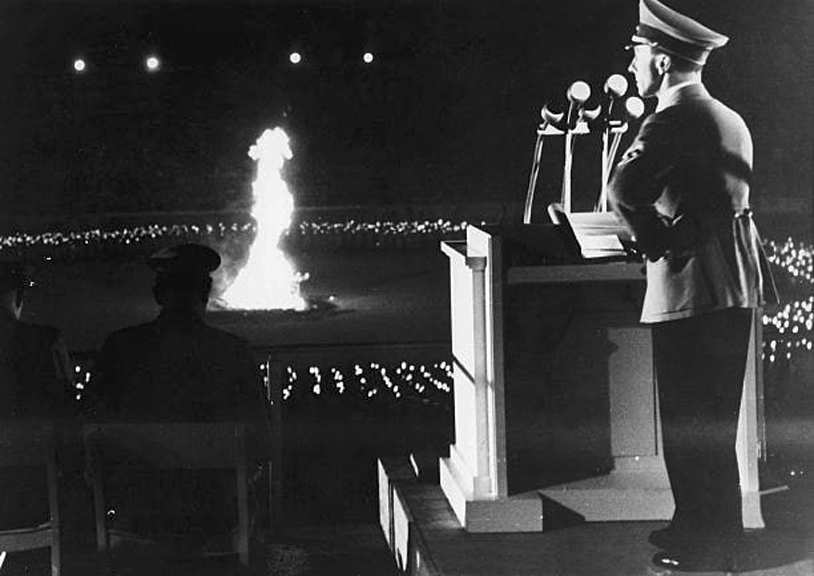
[Below: Large bonfires were often seen at National Socialist night rallies. These were rooted in indigenous European religious bonfire traditions, central to several festivals like Beltane (May 1) and Samhain (Oct 31). They symbolized purification, fertility, and honoring the ancestors. In this picture Goebbels gives a speech in Berlin to a ring of torch-bearing National Socialists, circa 1938.]
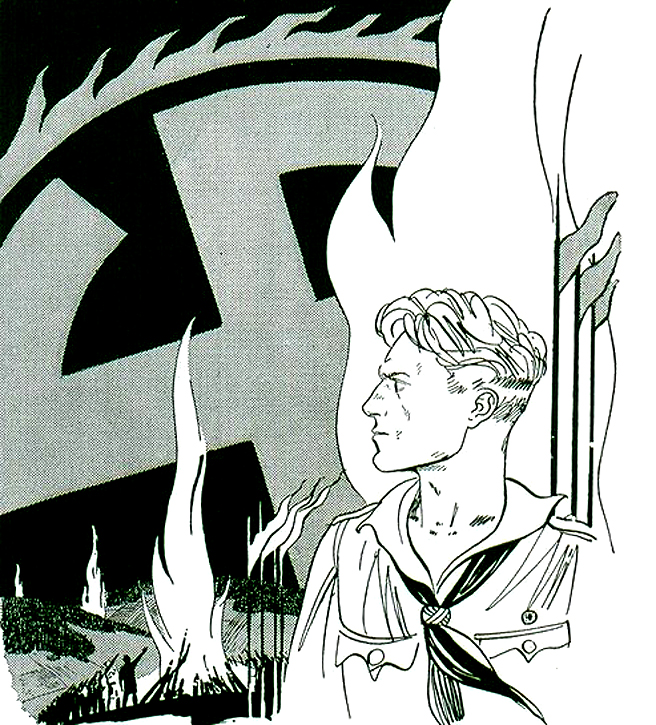
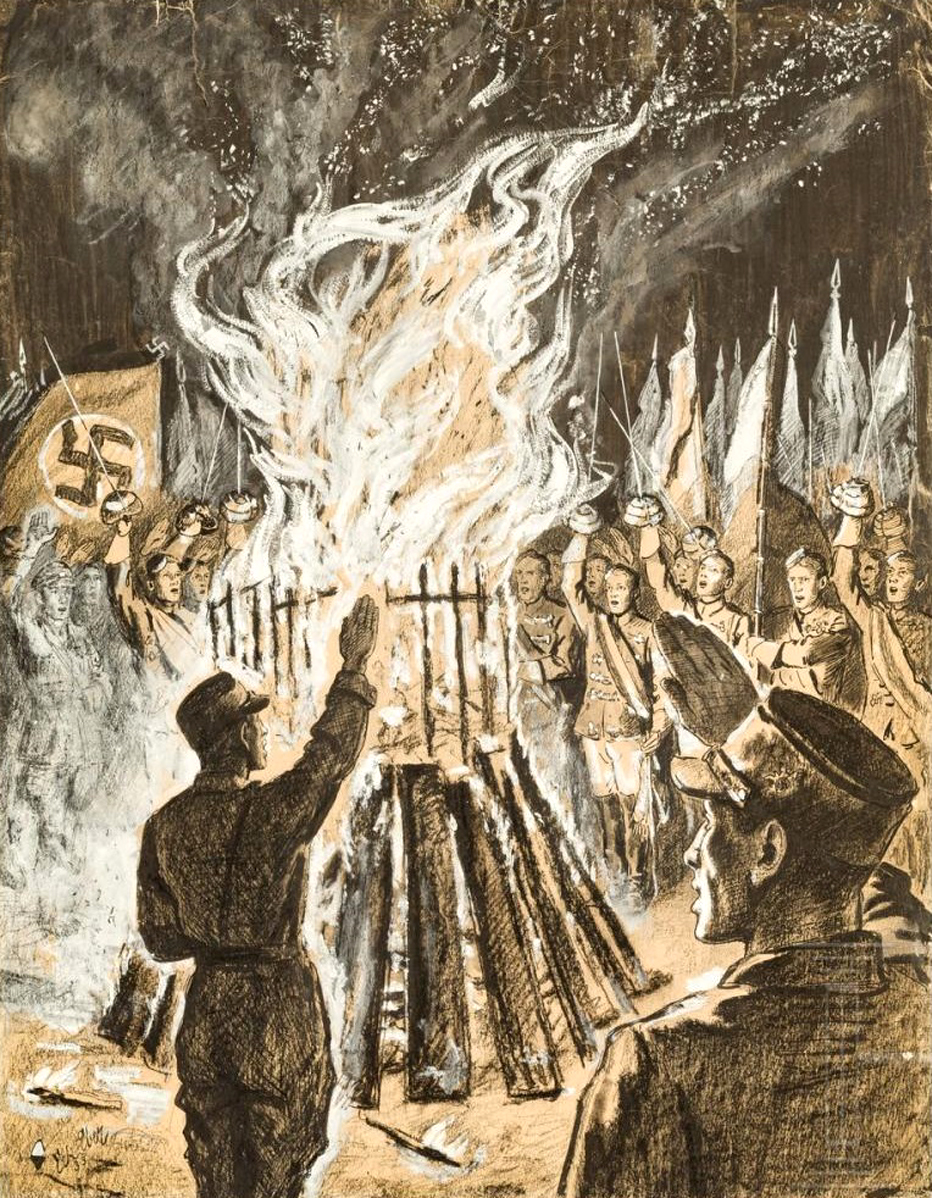
[Below: Large bonfires illuminate the 'pagan' night.]
[Below: SA men salute a large bonfire.]
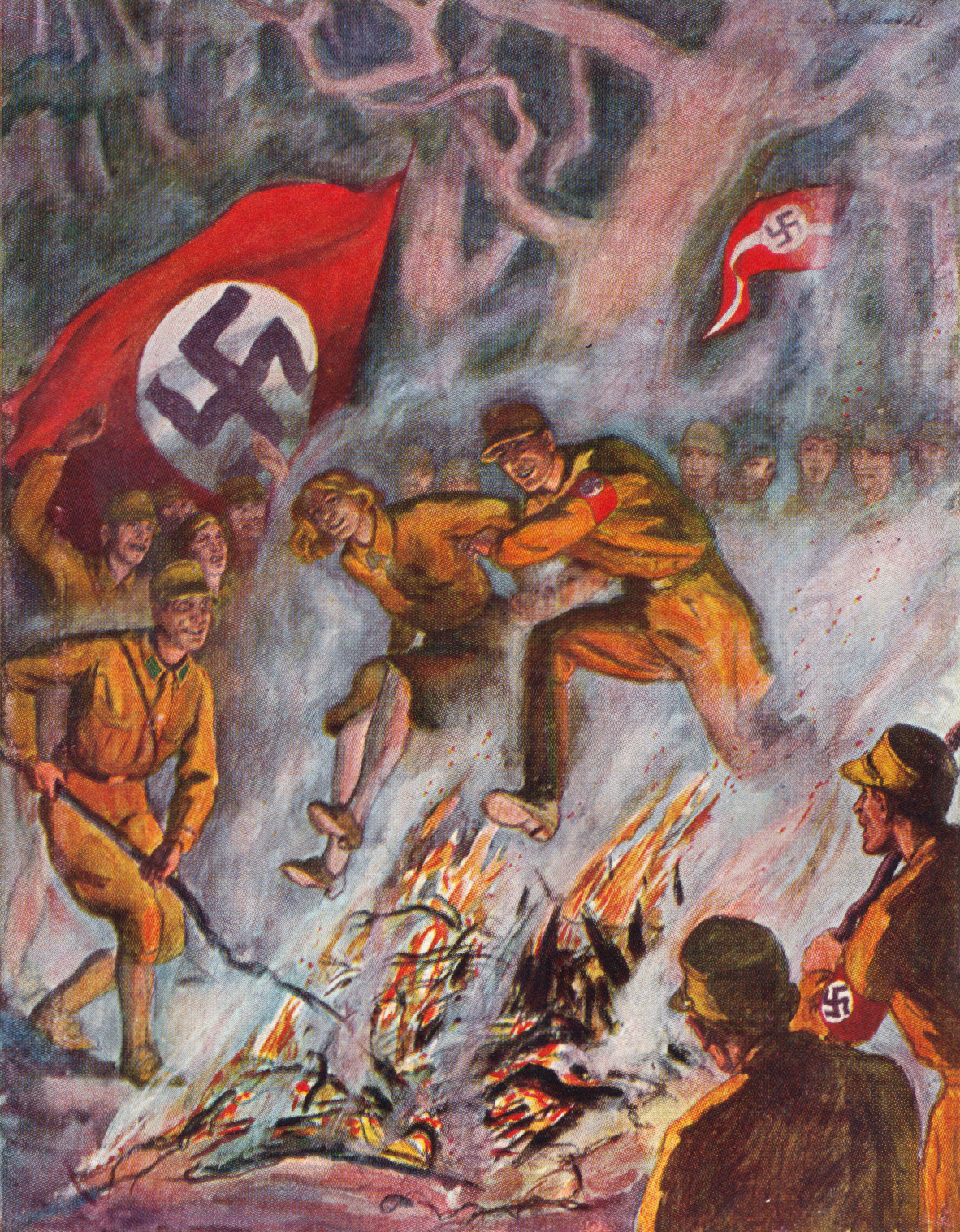
[Below: Jumping over a bonfire is an ancient indigenous European religious tradition symbolizing purification, fertility, protection, and renewal, often marking new beginnings.]
• Click here to see more pictures of fire rituals
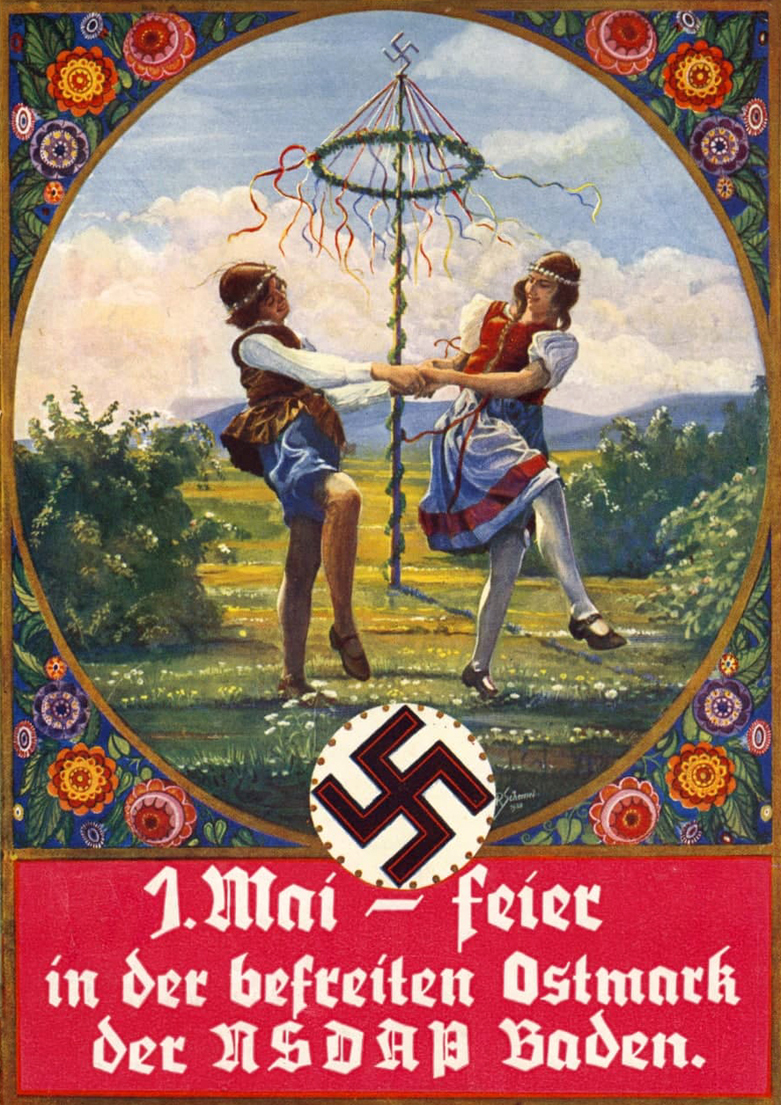
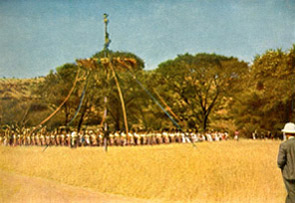
[Below: The maypole tradition 'is a centuries-old European spring ritual, often held on May Day (May 1st) to celebrate fertility, growth, and the return of summer. Participants dance around a tall, decorated pole—traditionally a tree—weaving ribbons to symbolize the union of life, light, and nature's renewal.' This tradition was widely celebrated in the Third Reich. Click the image to see more.]
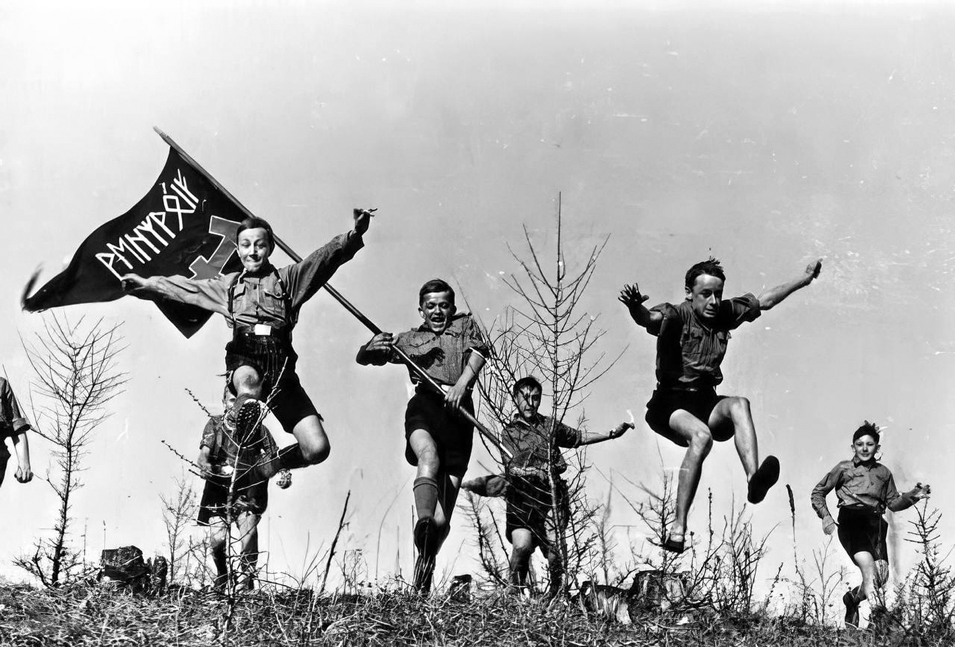
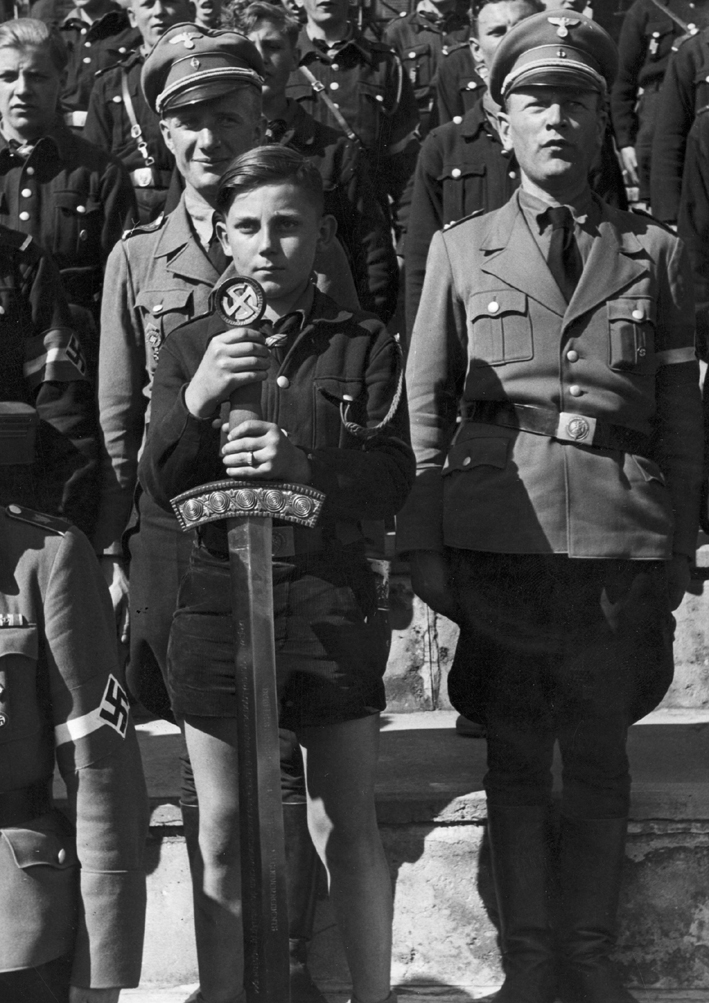
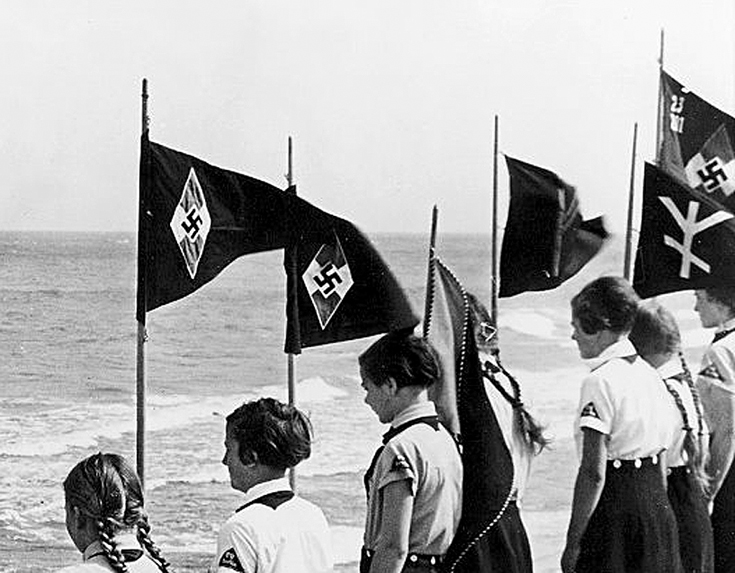
[Below: The Hitler Youth and The League of German Girls used runes extensively. Click the images below to see a small sampling.]
[Below: A Hitler Youth rally where a boy holds a magnificant engraved sword. Click to see more.]
[Below: League of German Girls staring into the ocean. Click to see more.]
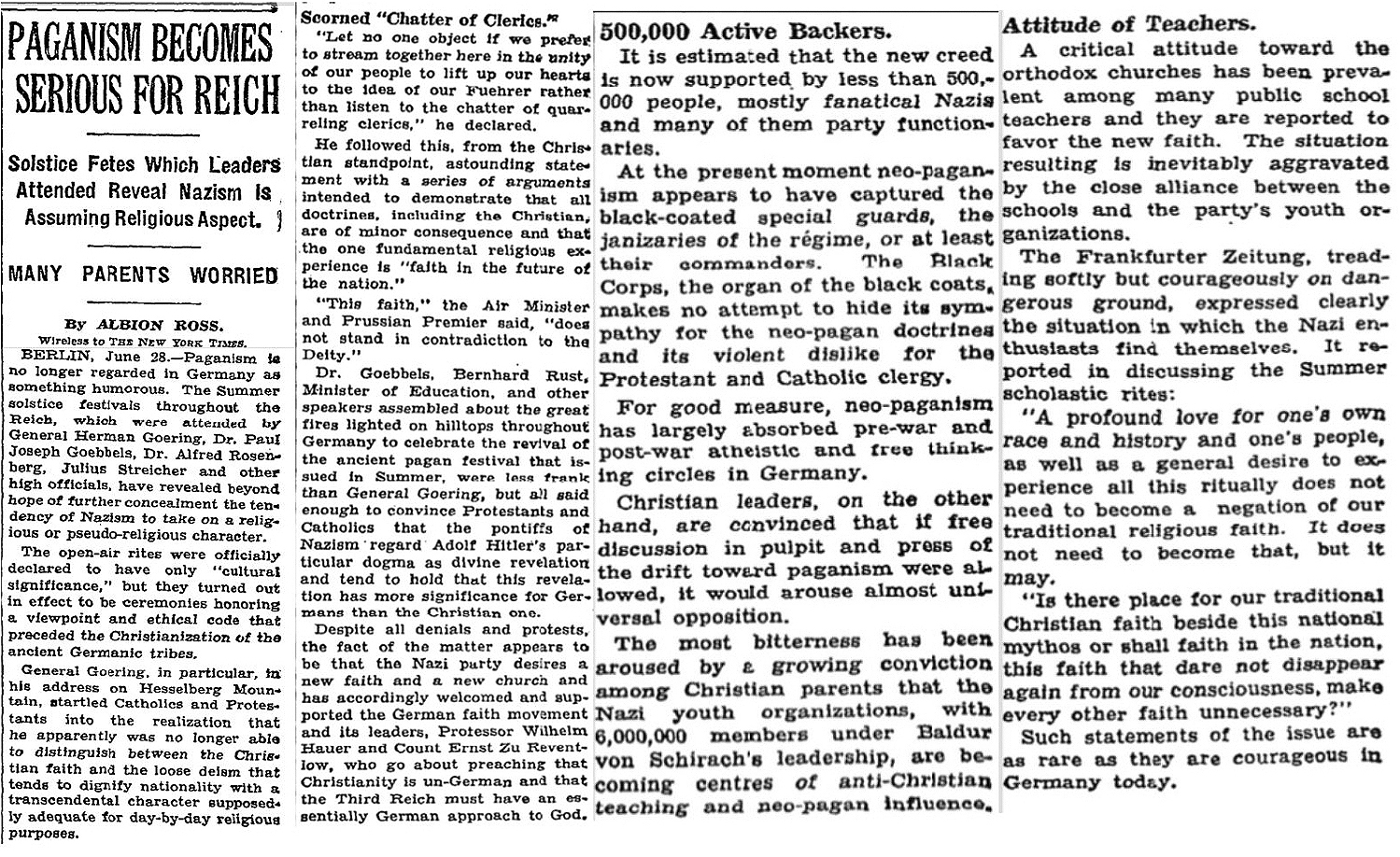
[Below: 1930s newspaper article from the New York Times.]
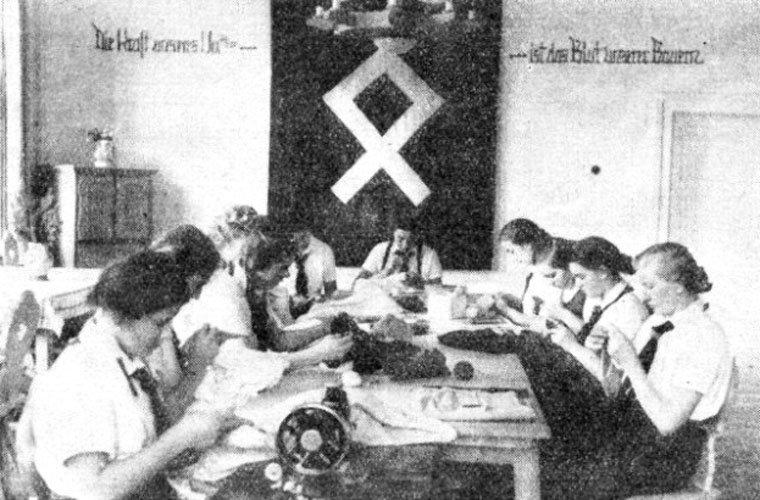
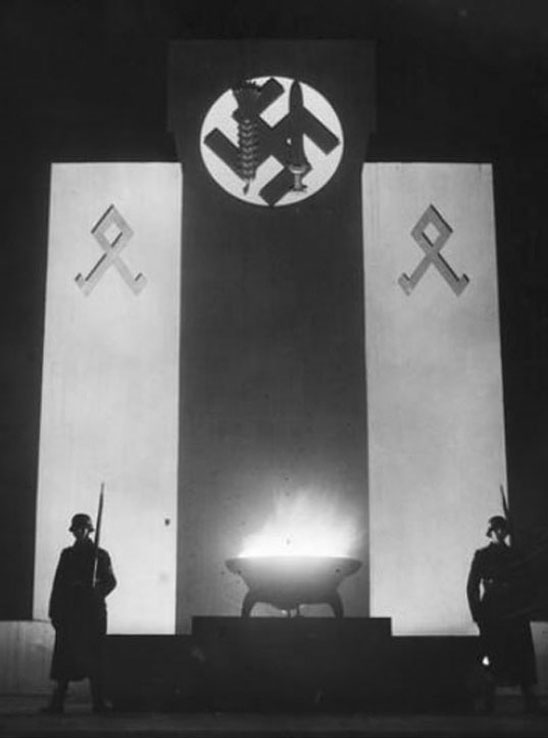
[Below: The Odal rune was an important symbol for the Third Reich, representing heritage, home, kinship, and family. In this picture, The League of German Girls sew uniforms while a large tapestry with the Odal rune hangs on the wall.]
[Below: Silent sentinels guard the fire at a harvest festival.]
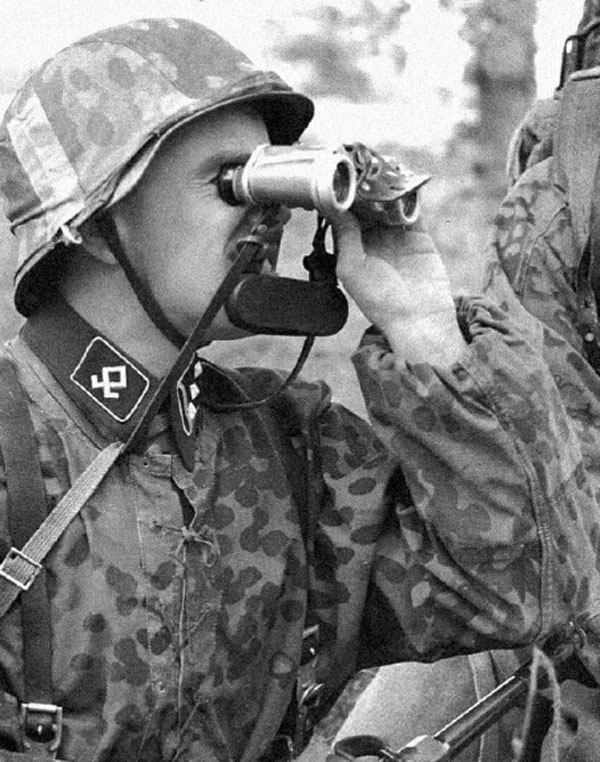
[Below: A soldier from the 7th SS Volunteer Mountain Division 'Prinz Eugen'. The division symbol was a modified version of the Odal rune (with 'feet').]
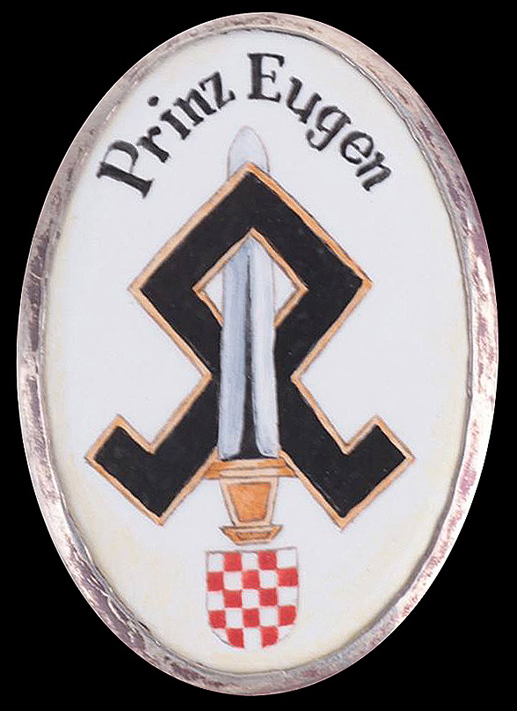
[Below: An enameled pin from the 'Prinz Eugen' Division. Note the Croatian symbol on the bottom, since the division took recruits from Croatia, Serbia, and Romania.]
• Click here to see other pictures of the Odal rune in the Third Reich
[Below: There were other runes used in the Third Reich, this one, which looks like an arrow pointing upward, is Tiwaz, representing duty.]
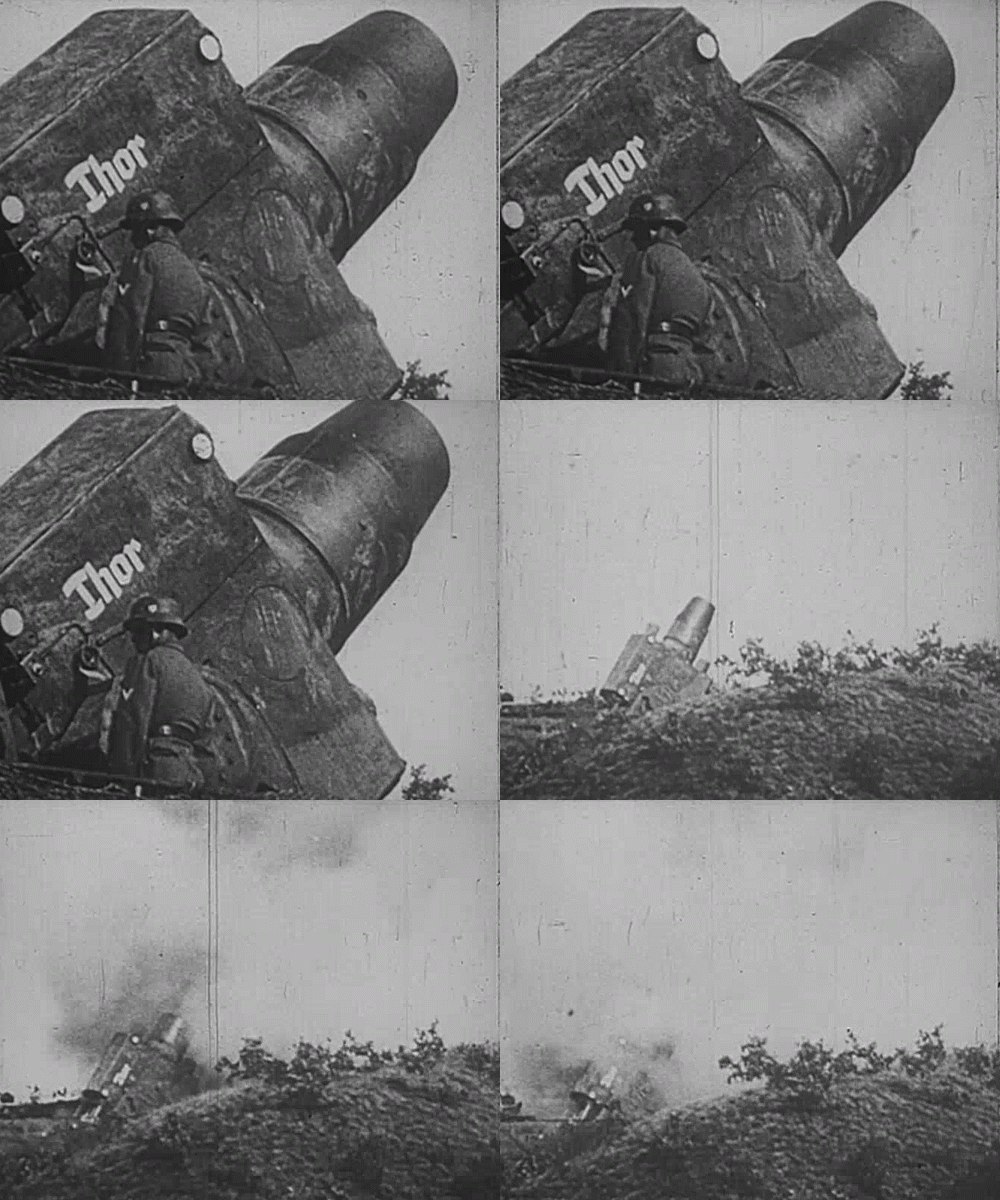
[Below: The Karl-Gerät, or 'Thor', the largest mortar ever used in war.]
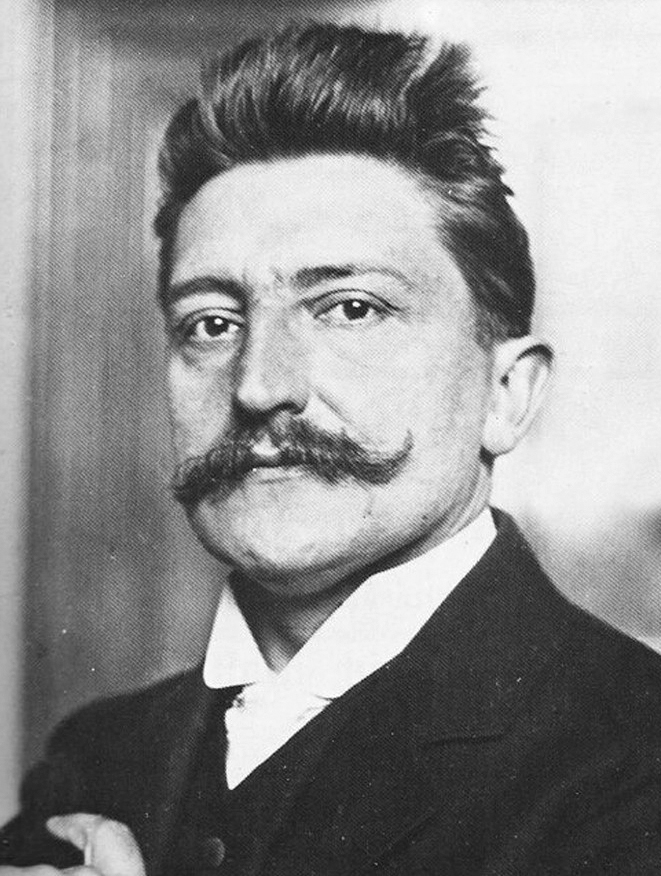
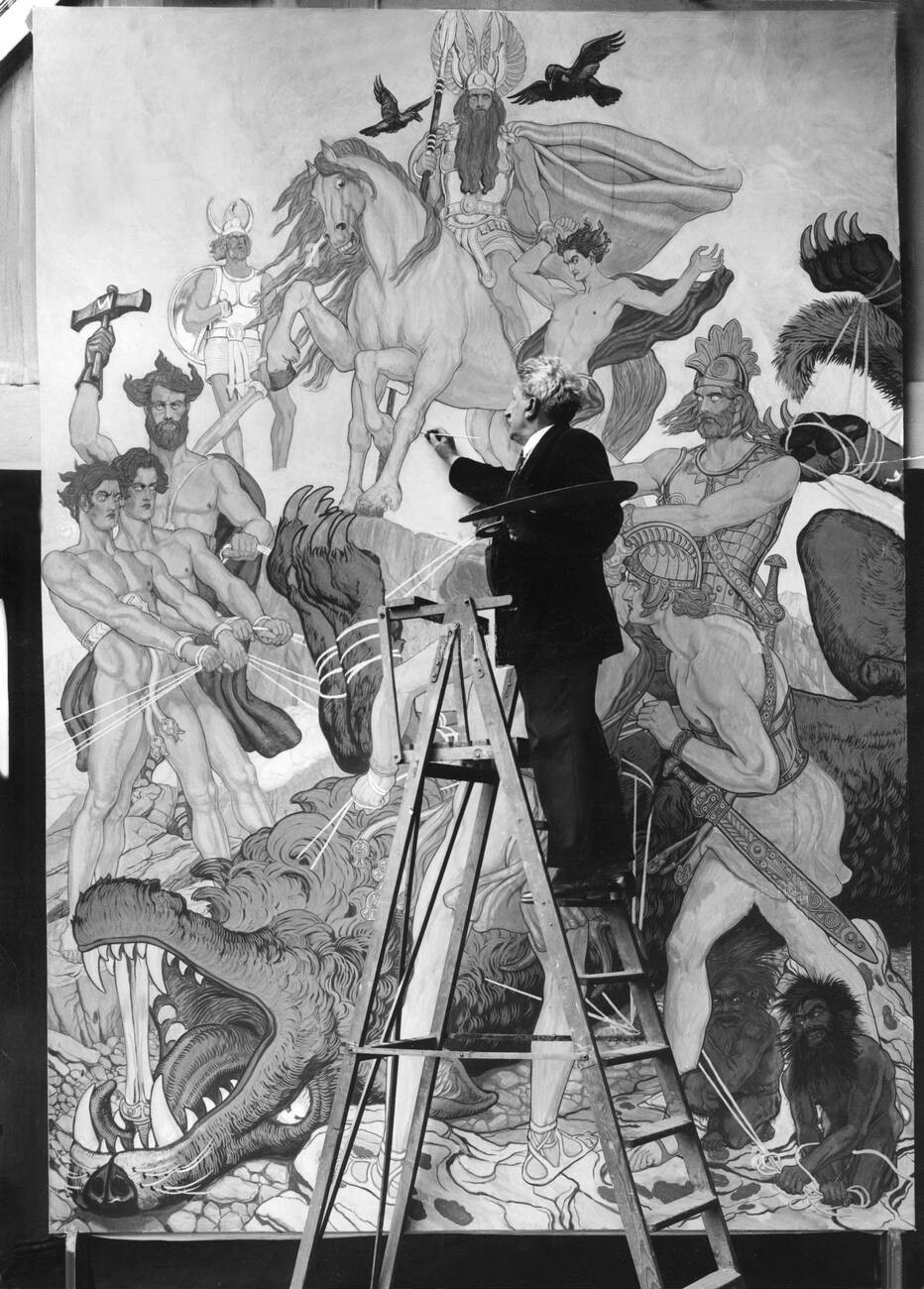
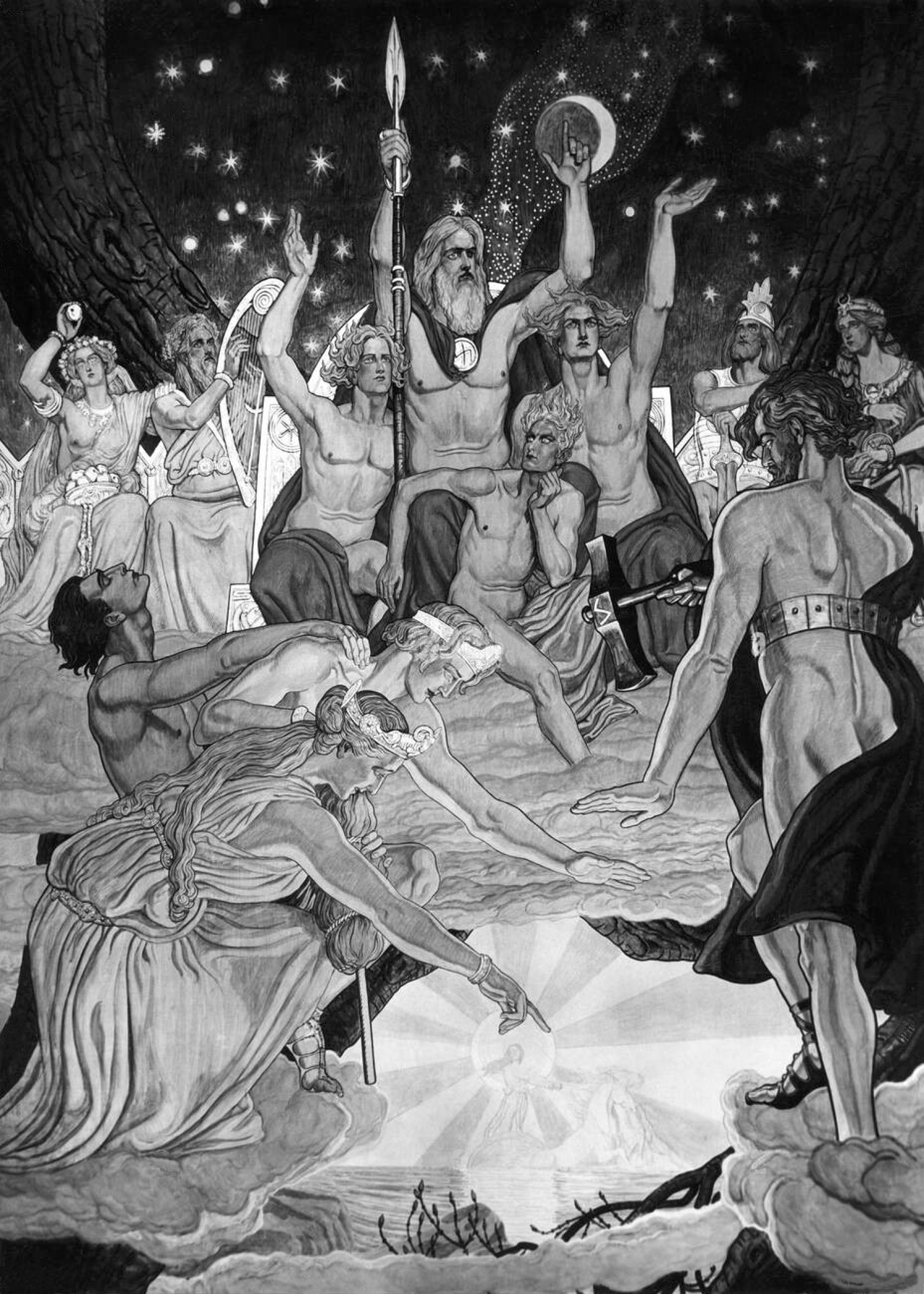
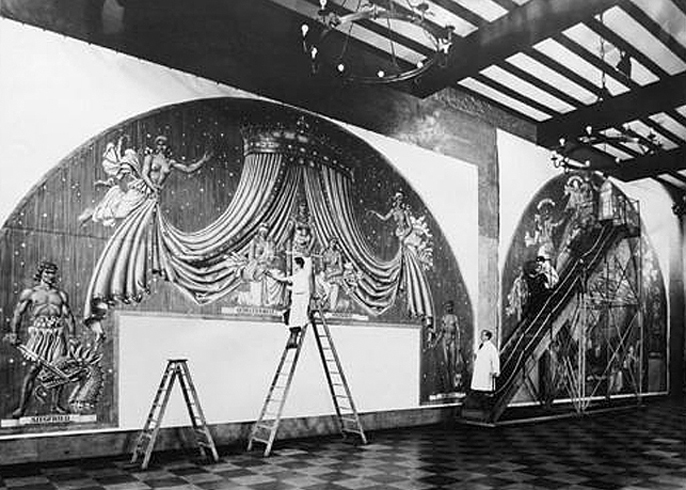
• Franz Stassen (February 12, 1869 – April 18, 1949) was a German painter and illustrator famous for his Der Ring des Nibelungen works. Stassen became a member of the NSDAP in 1930. In 1939 Adolf Hitler awarded him the title of professor and in 1944, Joseph Goebbels placed him on the Gottbegnadeten list (a list of artists considered crucial to National Socialist culture).
[Below: Franz Stassen painting his masterpiece (one of four paintings inspired by the Edda), The Binding of Fenrir, a gigantic tapestry for the Assembly Hall in the Reich Chancellery, 1936.]
[Below: Franz Stassen's 'The Gods When Ordering the World', for the Assembly Hall in the Reich Chancellery, 1935.]
• Click here to see other works by Franz Stassen
• Wilhelm Petersen (1900–1987) was a German painter and official propaganda artist during the Third Reich. He was a member of the SS and was appointed an official war artist of the SS. His work was acquired by both Adolf Hitler and Hermann Göring.
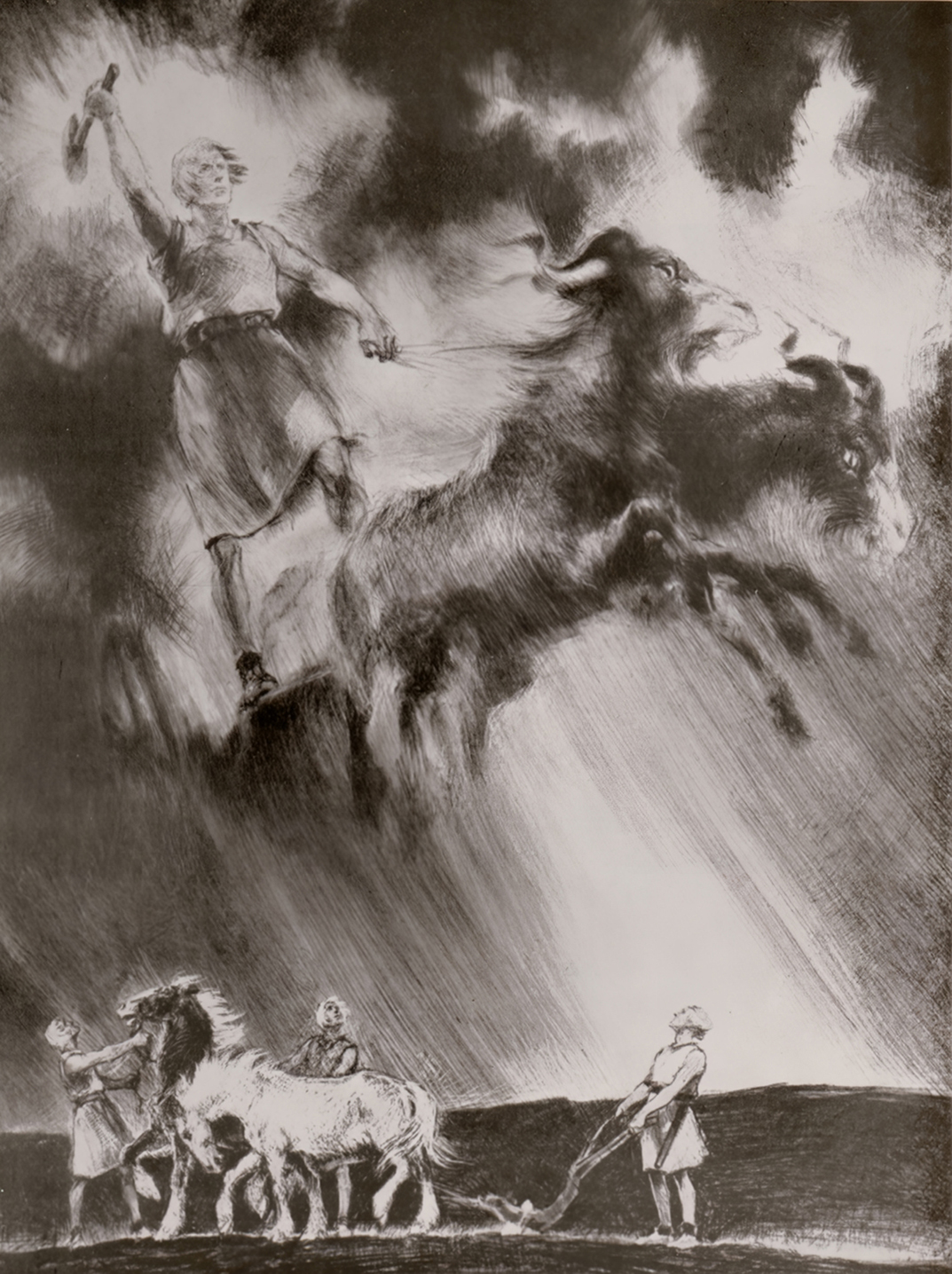
[Below: Wilhelm Petersen's Thor Drives Over Midgard.]
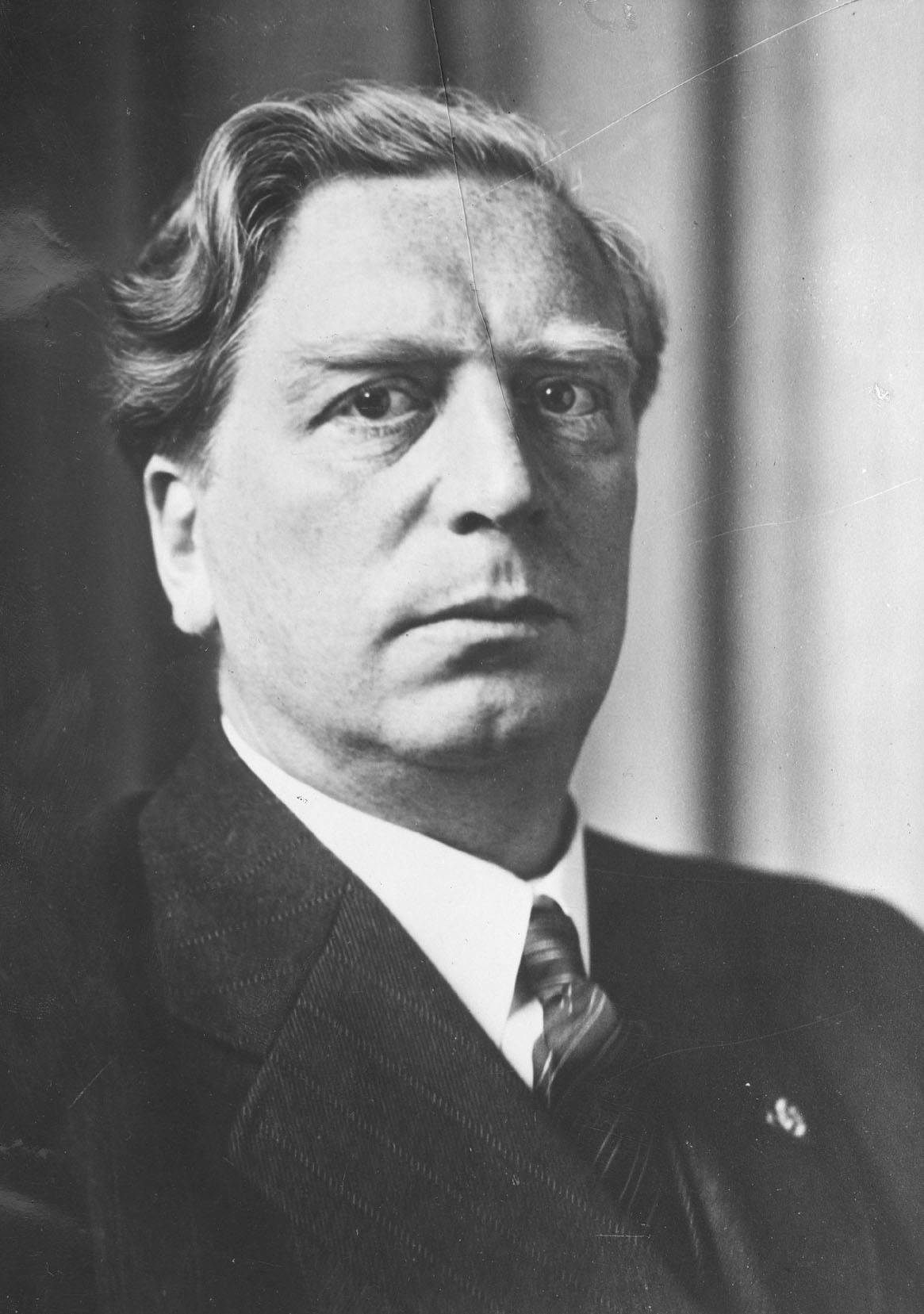
[Below: Wilhelm Petersen.]
• Click here to see other works by Wilhelm Petersen
• Hugo Johann Höppener (October 8, 1868 – February 23, 1948), better known as 'Fidus', was an extremely prolific German illustrator, painter and publisher. Fidus was an enthusiastic supporter and member of the National Socialist Party, which he joined in 1932. His works were even bought by Adolf Hitler and Martin Bormann.
[Below: Fidus' Irminsul.]
[Below: Fidus did a multitude of different art styles.]
[Below: Werner Peiner.]
• Werner Peiner (July 20, 1897 - August 19, 1984) was a German painter who was one of the official painters of the Third Reich. It is said that his painting 'Deutsche Erde' (German Land) was given to Adolf Hitler and hung in his personal residence. With Göring's support he founded his own art academy on January 24, 1936. Peiner joined the NSDAP on July 13, 1937. Adolf Hitler included him in the special list of the God-gifted artists exempt from conscription, marking him as one of the twelve most important visual artists.
[Below: Werner Peiner working on a magnificant tapestry commissioned by Hermann Göring for his home, Karin Hall. The tapestry was never finished.]
[Below: In color.]
• Click here to see other works by Werner Peiner
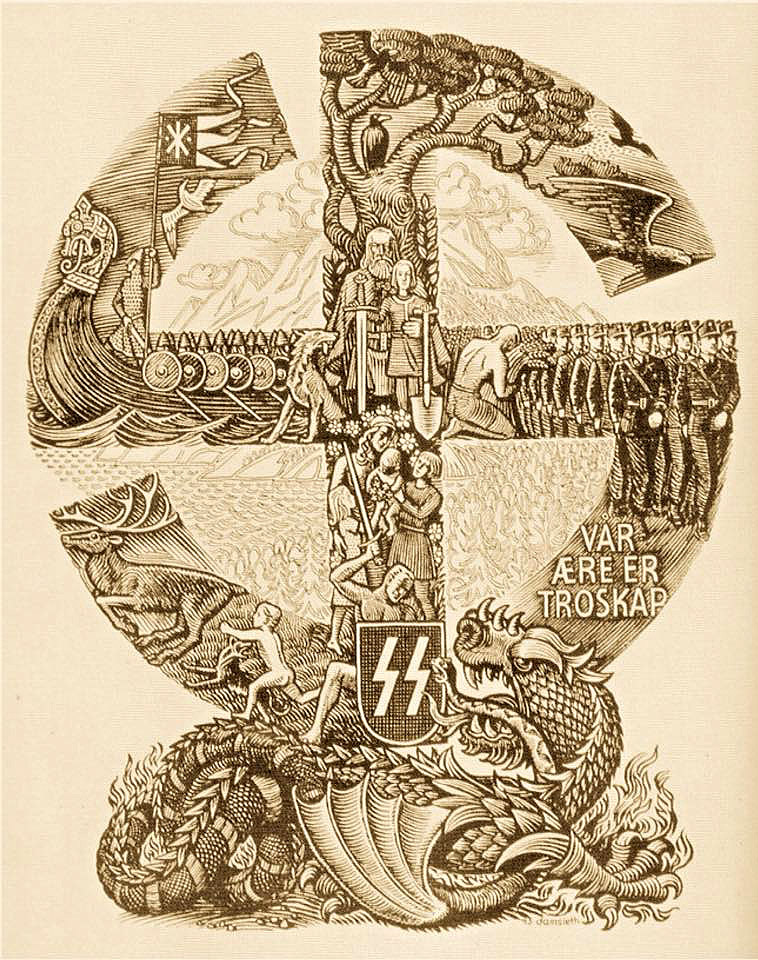
[Above: Norwegian Waffen-SS Recruitment Poster from 1944 by cartoonist and illustrator Harald Damsleth. It has the SS motto 'Vår ære er troskap' (My Honor is Loyalty). Damsleth was a member of Norway's Nasjonal Samling party and was probably their most famous artist.]
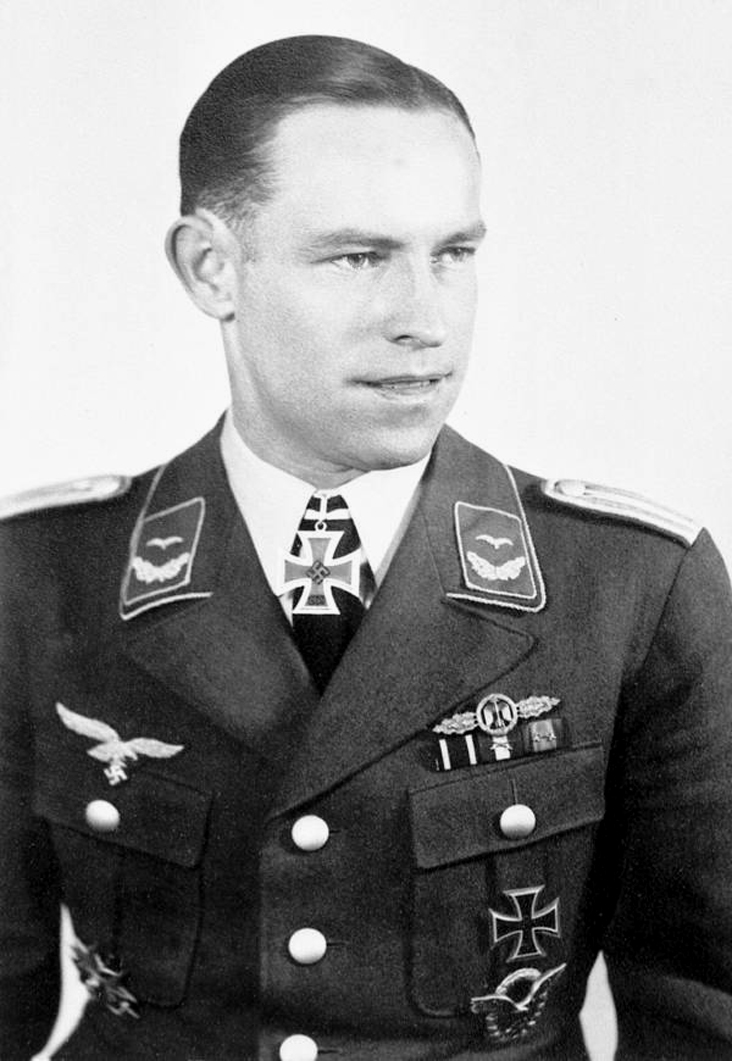
[Above: This is what a hero looks like. This is Heinrich Ehrler, photographed here in September 1942.]
• On April 6, 1945, when all seemed lost, when others put down their weapons and surrendered to the World Enemy, others stood and faced the terrible monster which had ripped the world to ruin. One of those many men and women was Heinrich Ehrler, a German Luftwaffe ace credited with 208 enemy aircraft shot down in over 400 combat missions, included eight in the Messerschmitt Me 262 jet fighter!
On the dark day of April 6th, 1945 Ehrler faced over 1,200 enemy planes which were sent to murder his people and destroy their lands. In a deadly maze of hundreds of enemy fighters protecting the bombers, he managed to destroy two B-17s and ram another after running out of ammunition. We would be hard pressed indeed to find a knight of Germany greater than Heinrich Ehrler. I've never forgotten his sacrifice through the years and I don't think you will easily either.
• It's interesting that it was the Japanese during their 'occupation' (liberation) of the Philippines that the Tagalog Filipino language was saved from instinction by making cultural programs and laws designed to save not only their culture, but their language, which had been nearly forgotten due to the previous American occupation. And let's not forget it was a brutal and genocidal American occupation which took the lives of millions of innocent Filipinos. An American murder spree where waterboarding and other now illegal practices were widely used, not to mention painting bullets in pig's blood before being used on the Filipino Muslim population.
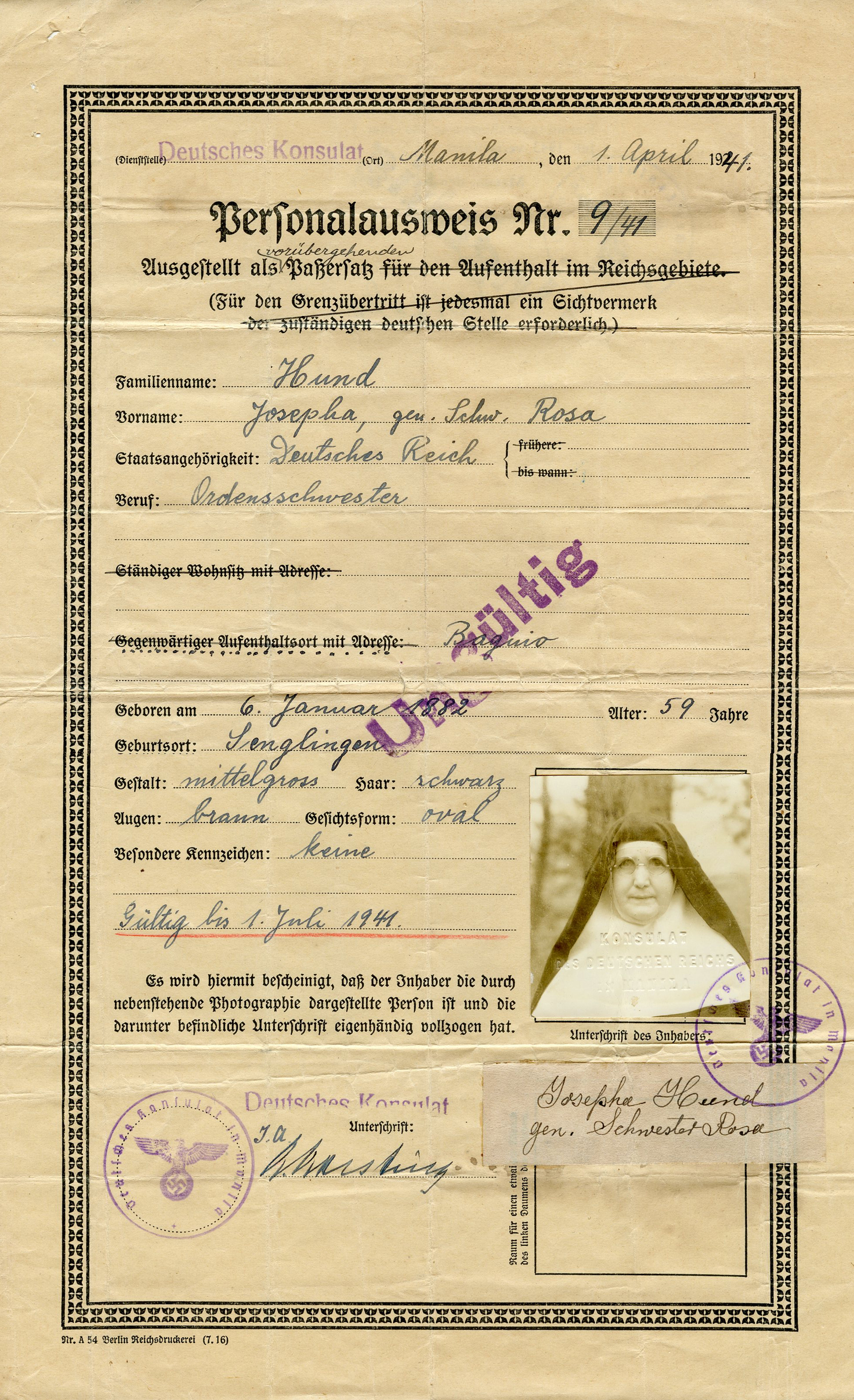
[Above: Here is something very rare and interesting. This is an identification certificate of a German nun in the Philippines! This was issued by the German Consulate in Manila on April 1, 1941. Josepha, or Sister Rosa, as noted here, was born in Senglingen, Baden-Wurttemberg, Germany, on January 6, 1882 (59 years old). She had black hair and brown eyes.]
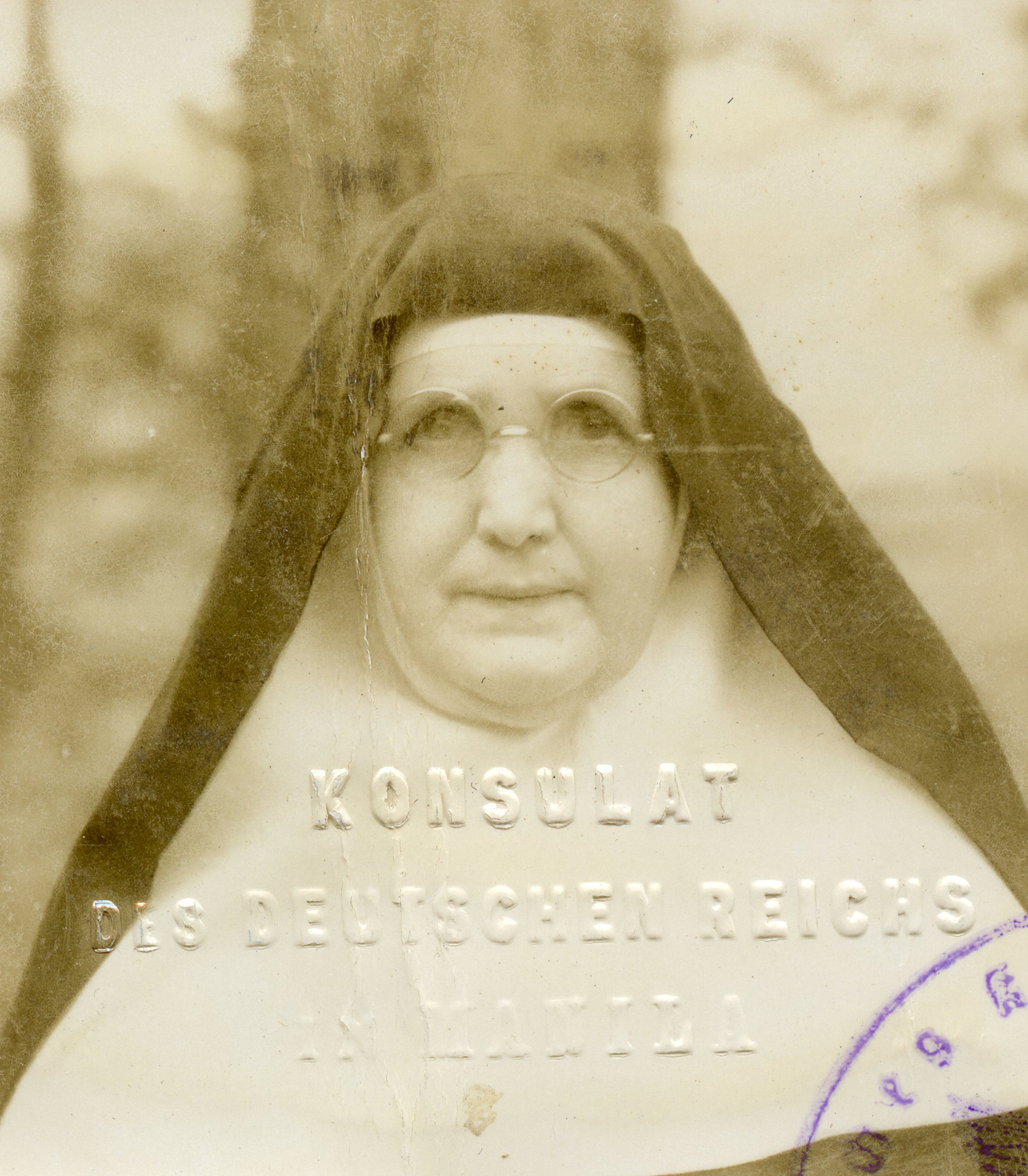
[Above: Close-up.]
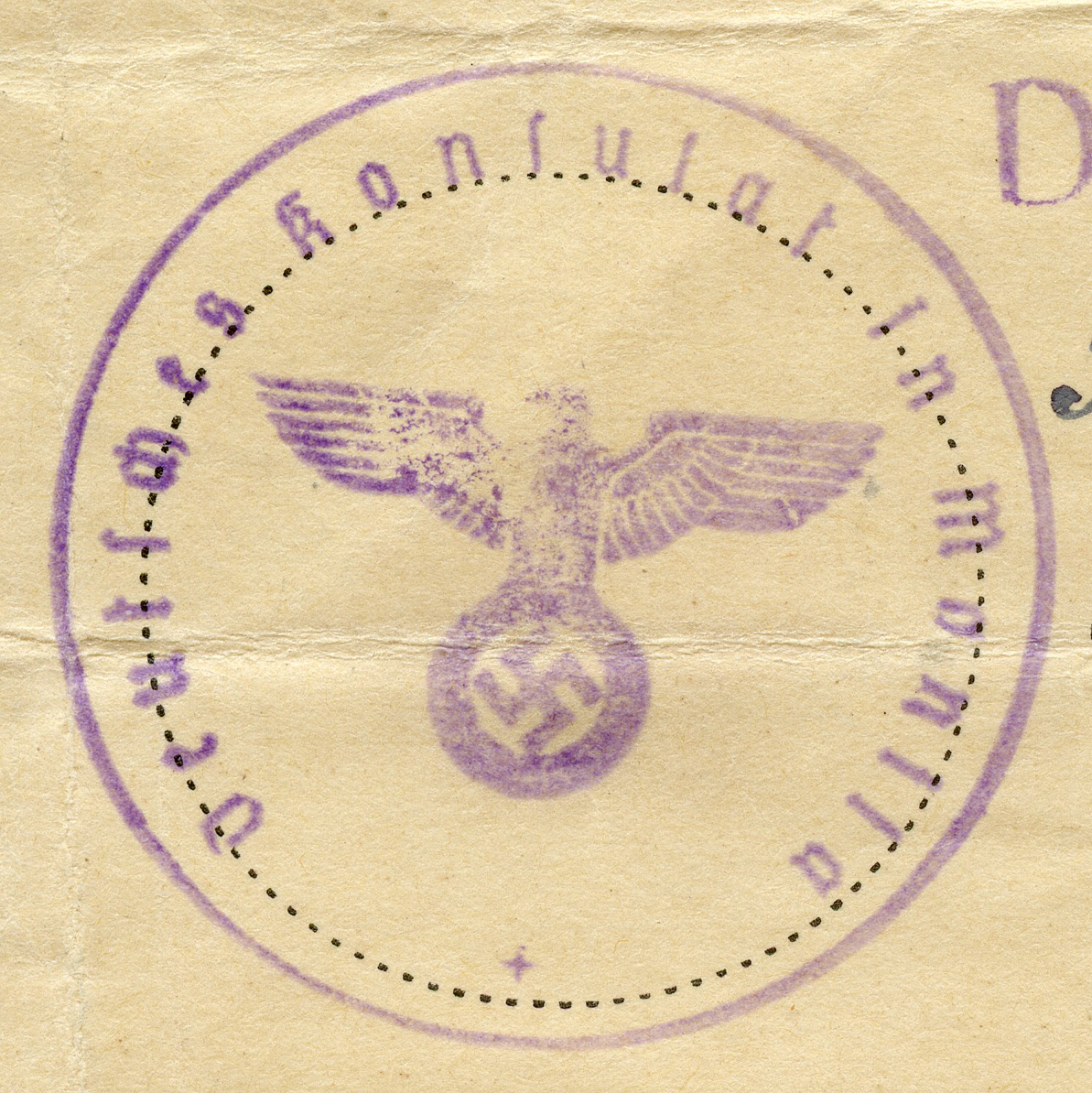
[Above: Close-up of 'German Consulate Manila' ink stamp.]
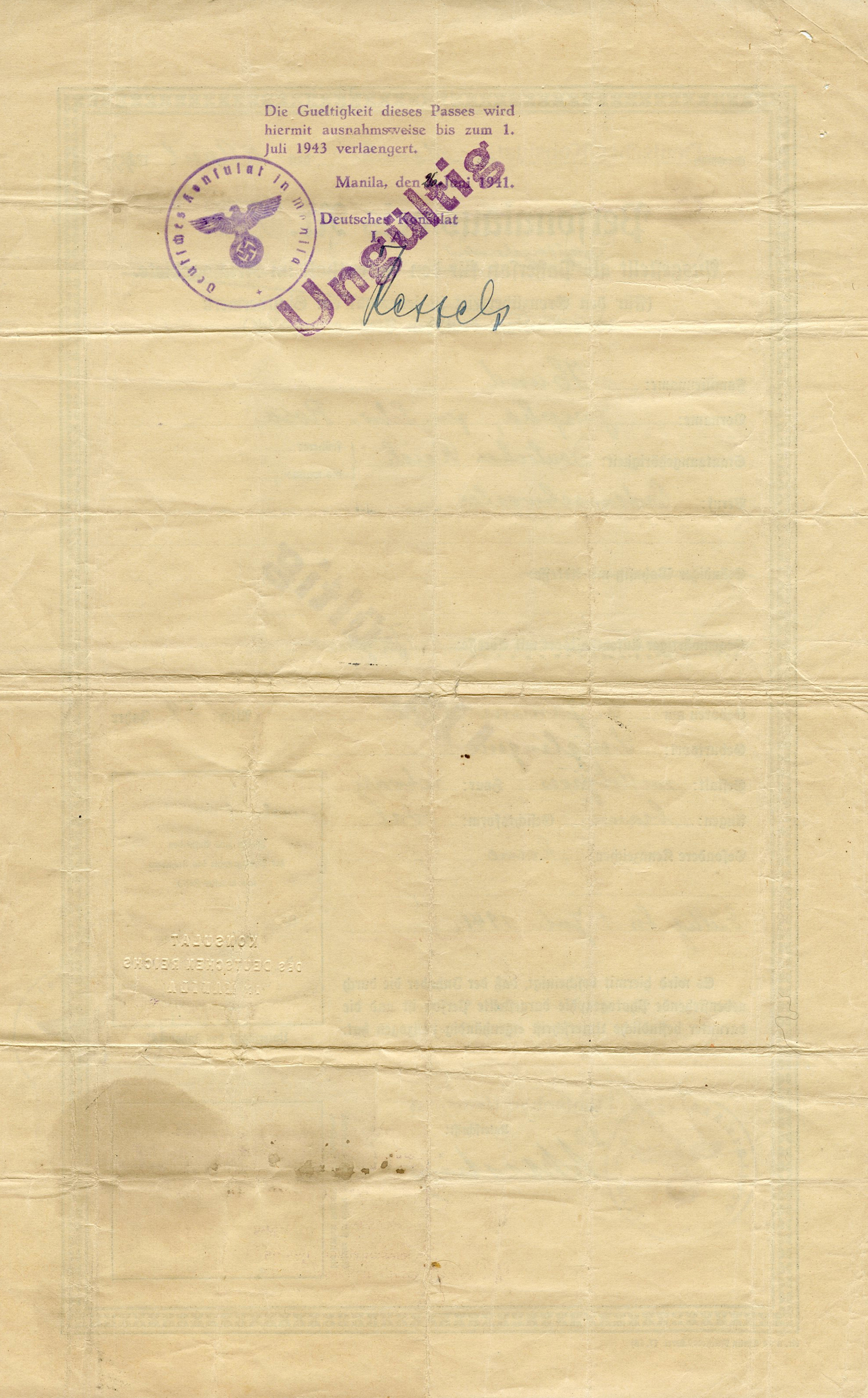
[Above: Document reverse. This stamp extends her stay in Manila until July 1, 1943.]
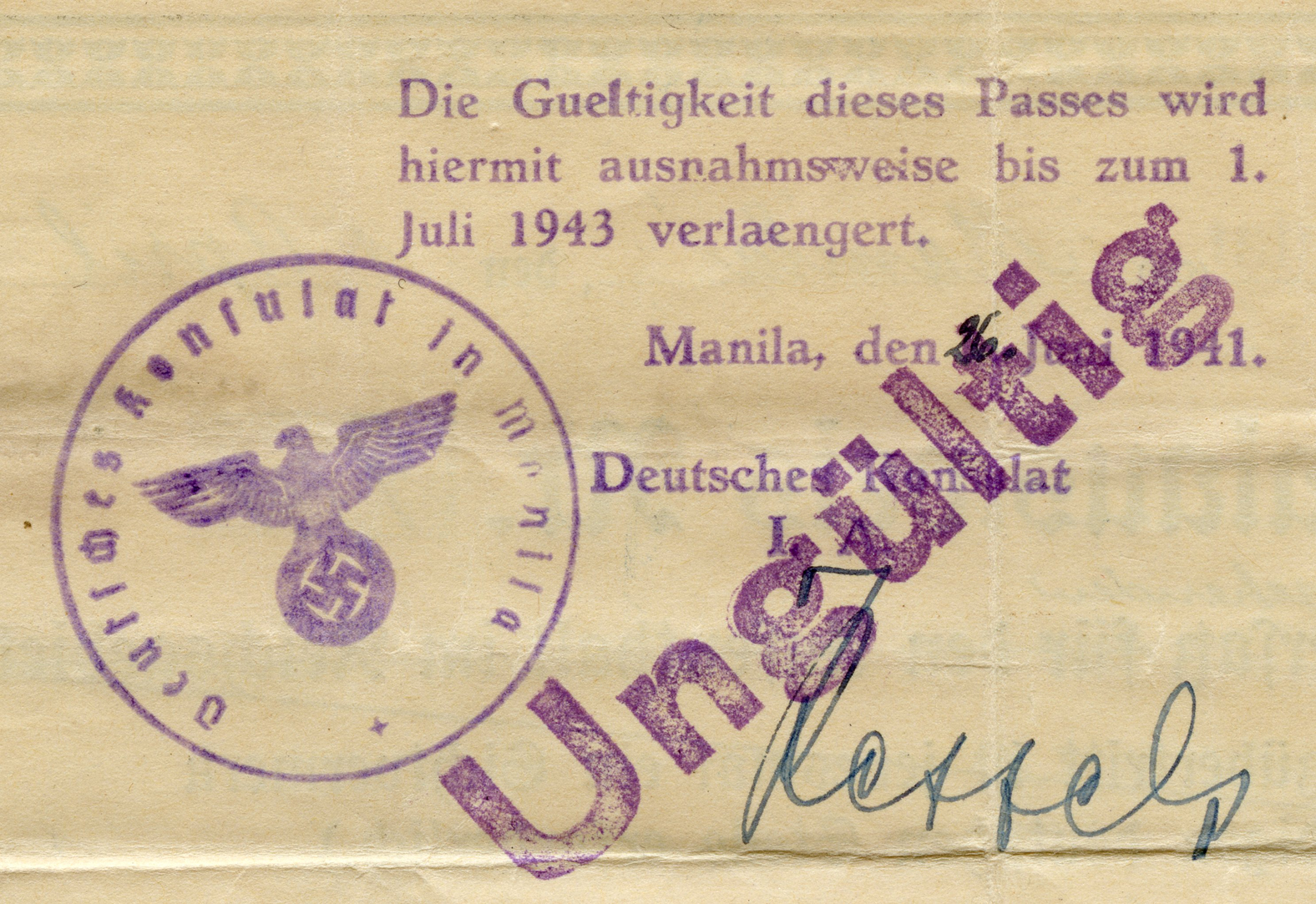
[Above: Close-up. 'Ungültig' means 'Invalid', this was done to invalidate the document.]
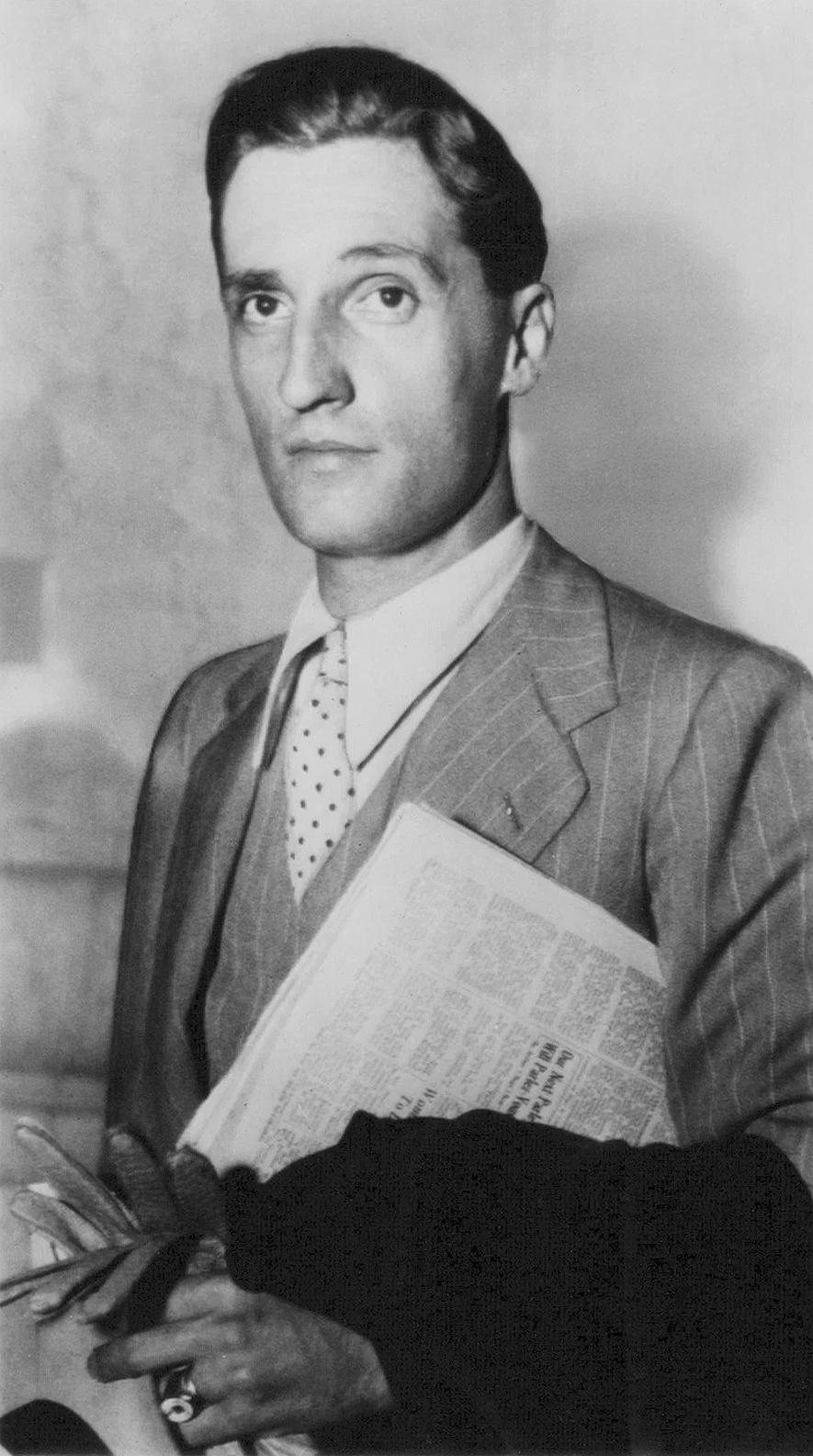
[Above: George Nelson Page.]
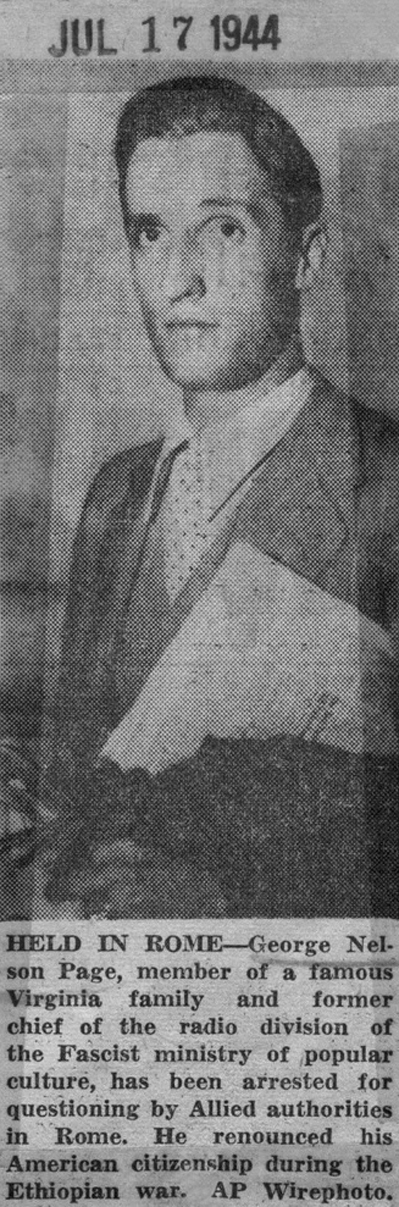
• George Nelson Page is a name you most likely have never heard before. I hadn't, before stumbling across him in an article on American broadcasters working in the Third Reich in a 1943 issue of Harper's Magazine. Unfortunately, there is very little information about him other than he renounced his American citizenship, became a citizen of Fascist Italy, and worked for the radio division of the Italian Ministry of Popular Culture. If he did any radio shows during the war, like Ezra Pound, none of them have surfaced.
Here are the passages that mention Page:
'Two Americans who had thus made a last attempt to adjust themselves at home told me about it when they came back to Europe. They were Charles Flicksteger, who wrote under the name of "Flick," and George Nelson Page, nephew of our former Ambassador in Rome. Neither of them was included in the July indictment, presumably because they had taken out German and Italian citizenship, respectively, as did Lord Haw-Haw, the British radio traitor, who now is technically a Nazi citizen...
George Nelson Page was an introspective American youngster who had spent most of his life with his relatives in Italy. Unfortunately he elected to return home at the height of the depression and after going jobless for a few months and, according to him, being snubbed for his poverty, he returned to Rome, took out his citizenship papers, did his military service, and became an Italian citizen. One night in Rome he poured out to me his bitterness against America for treating him so badly. Through his friendship with Ciano, he got a high post in the Italian Propaganda Ministry (Ministry of Popular Culture, as it was called) but I imagine he has not fared so well since the departure of his friend and his friend's father-in-law...'
They mention his friend Ciano, who was executed on January 11, 1944 for treason on his father-in-law's orders. This obviously had nothing to do with Page, and since he was arrested in Rome after the treacherous secret surrender (Rome was occupied by American forces on June 4, 1944) tells us volumes. Clearly the fascists didn't arrest him, but the American forces did.
[Above: Here is a newspaper article from July 17, 1944 regarding George Nelson Page.]
A September 19, 1933 issue of the New York Times gives us a little more background on Page:
'George Nelson Page, scion of one of America's oldest distinguished families, announced yesterday his intention of renouncing his American citizenship and becoming a citizen of Fascist Italy. Mr. Page, who is in his thirties and whose wife was the former Miss Marjorie Grace Stricker of Niagara Falls, N. Y., and Chicago, made the announcement at the Hotel Vanderbilt here preparatory to going to Richmond, Va., the home of his ancestors, where he will deliver several talks on Fascism and why he prefers it to American "liberalism."
Others Kept Citizenship.
He is the son of George Blunt Page, who was for many years the manager in Rome of the Banca Commerciale Italiana. His grandfather, Thomas Jefferson Page, was an officer in the United States Navy at the outbreak of the Civil War. His wife and two children, then resident in Richmond, moved immediately to Florence, while Captain Page served in the Confederate Navy. At the end of the war he went to England and finally joined his family in Florence. He remained until his death one of the "unreconstructed rebels," but, for all that, a technical citizen of the United States. His son, George Blunt Page, also retained his citizenship, although most of his life was spent in Rome. The present Page, a citizen of this country, will become an Italian citizen on his return to Rome in October. A first cousin once removed of Thomas Nelson Page, historian and United States Ambassador to Italy at one time, George Nelson Page explained his reasons for the step. "I believe," he said, “in Fascism because I believe in discipline of all activity in a nation, commercial, political and cultural. The liberalism that is obtainable in this country, and so highly thought of, does not seem to me to be important."
Free Speech Unimportant.
"I'm talking about the right to say what you think, even about the President, and so forth. I do not think that is very important. This liberalism is the only form of government in which individual capitalistic enterprise is given full freedom, and I think, for that reason, that it becomes absolute capitalistic futilism."
In 1931 Mr. Page came to America and worked for various newspapers and other organizations in the search for the thing that he felt he finally wanted to do. His accumulation of experience from that effort he summed up in his repudiation of liberalism: "Here, a dozen different newspapers, all powerful in their own way, will be seeking a dozen different things at the same time. I think that makes for a minimum of actual accomplishment.'
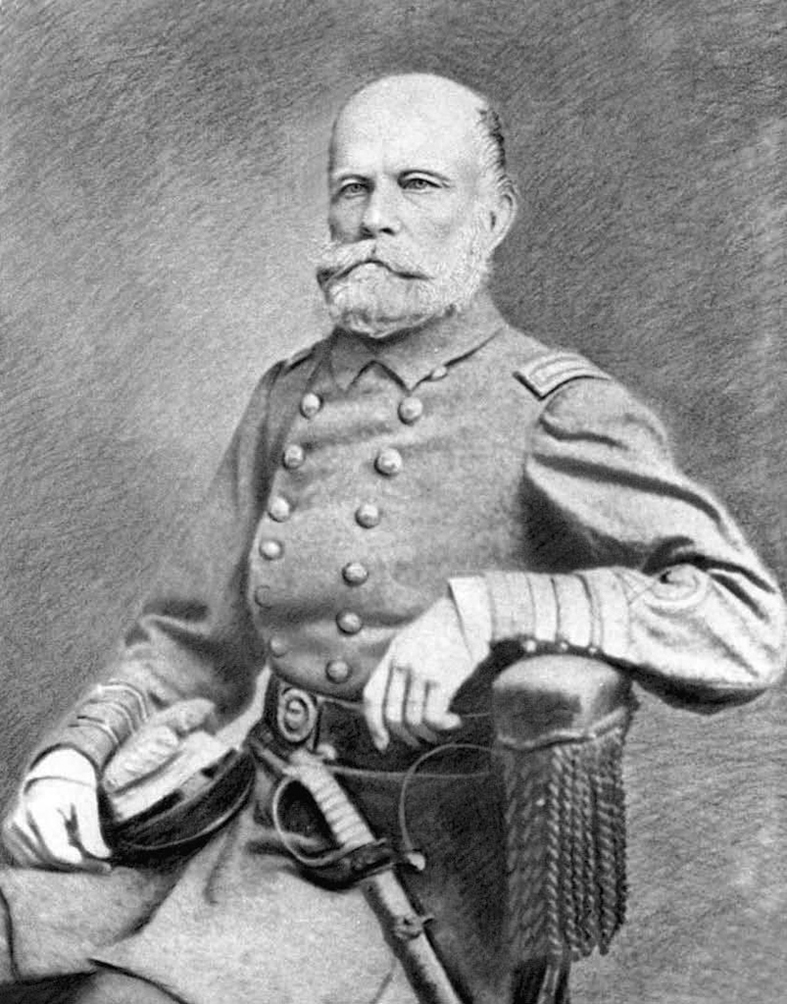
[Above: Page's ancestor Thomas Jefferson Page. It seemed rebellion to tyranny ran in both of their bloods.]
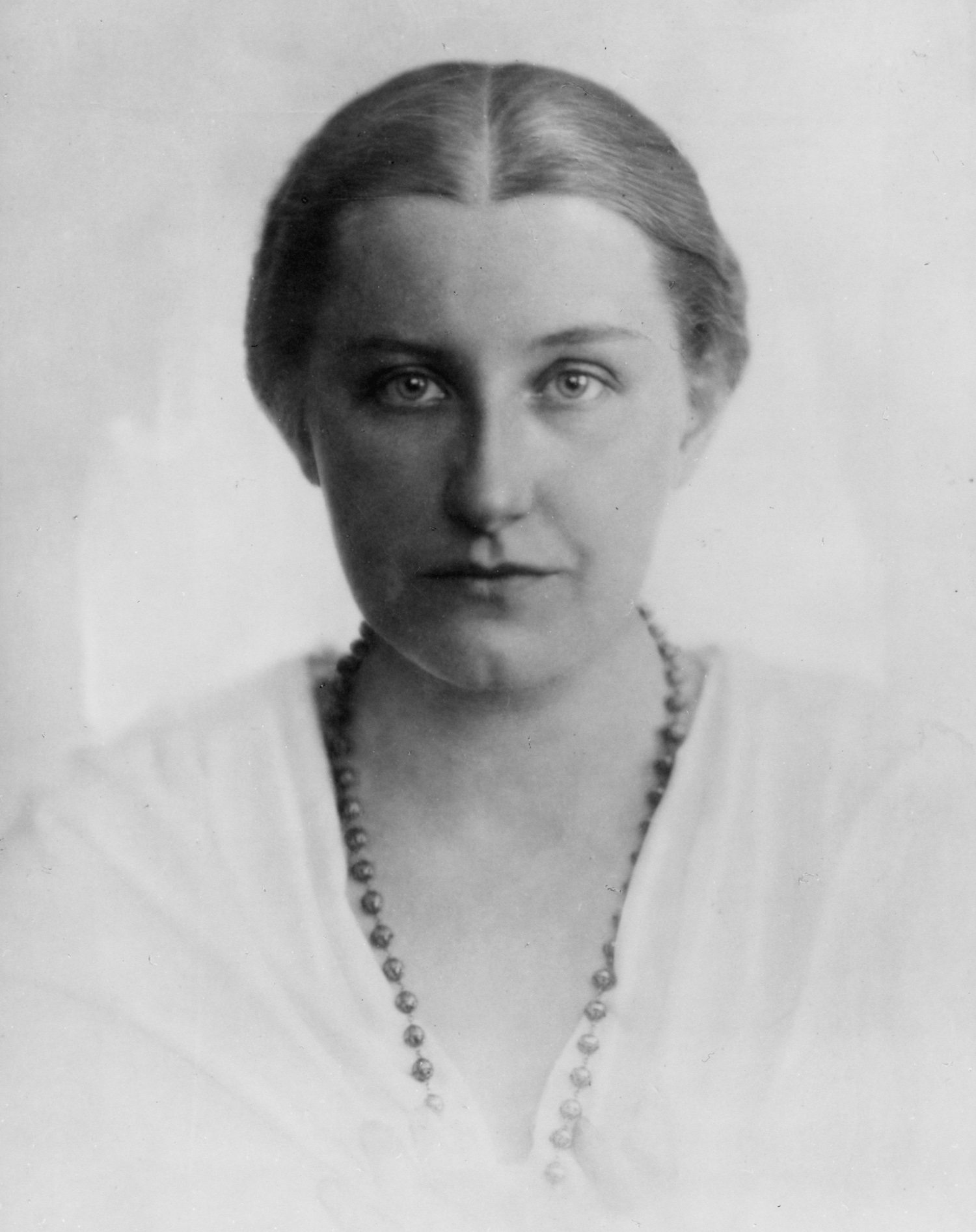
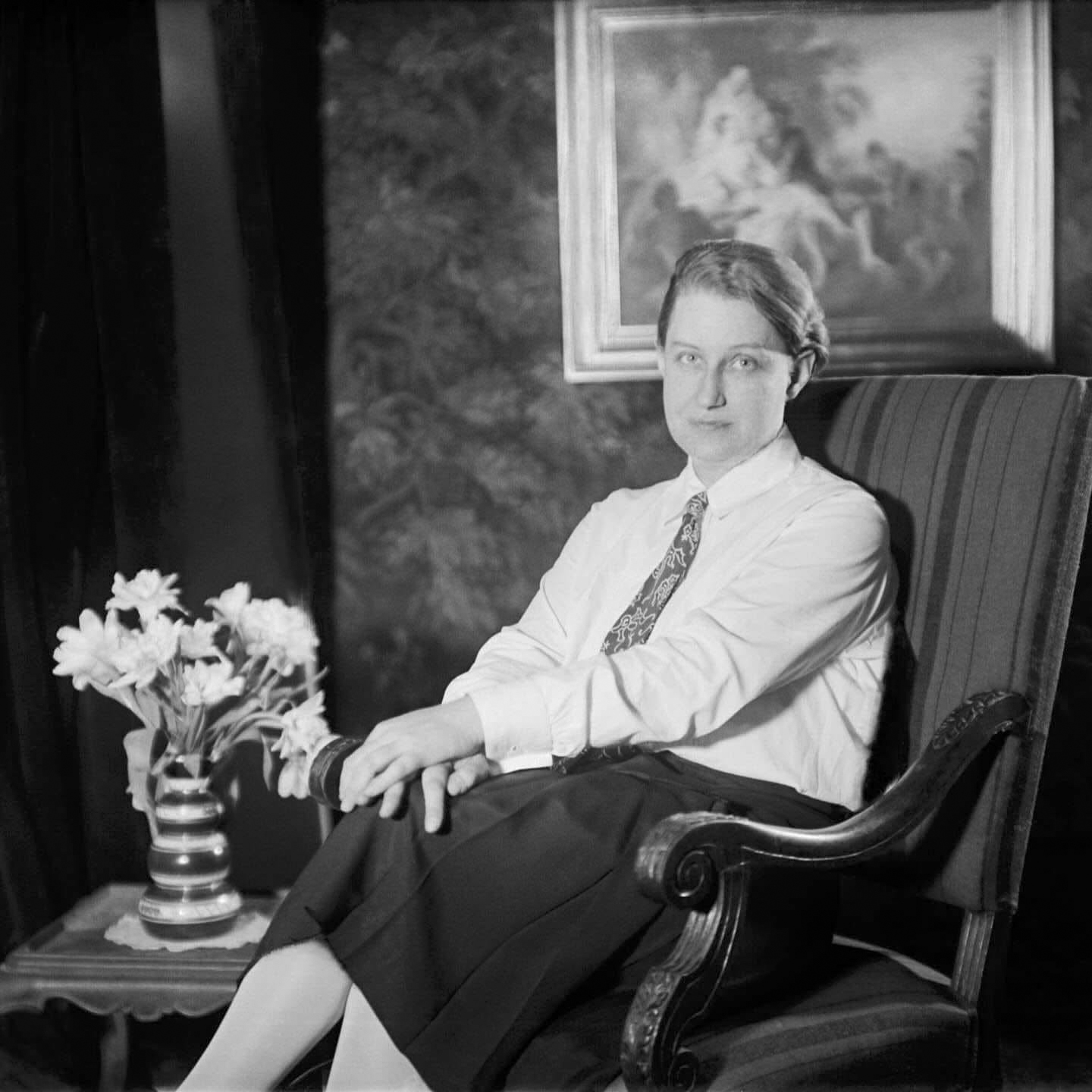
[Above: Thea von Harbou.]
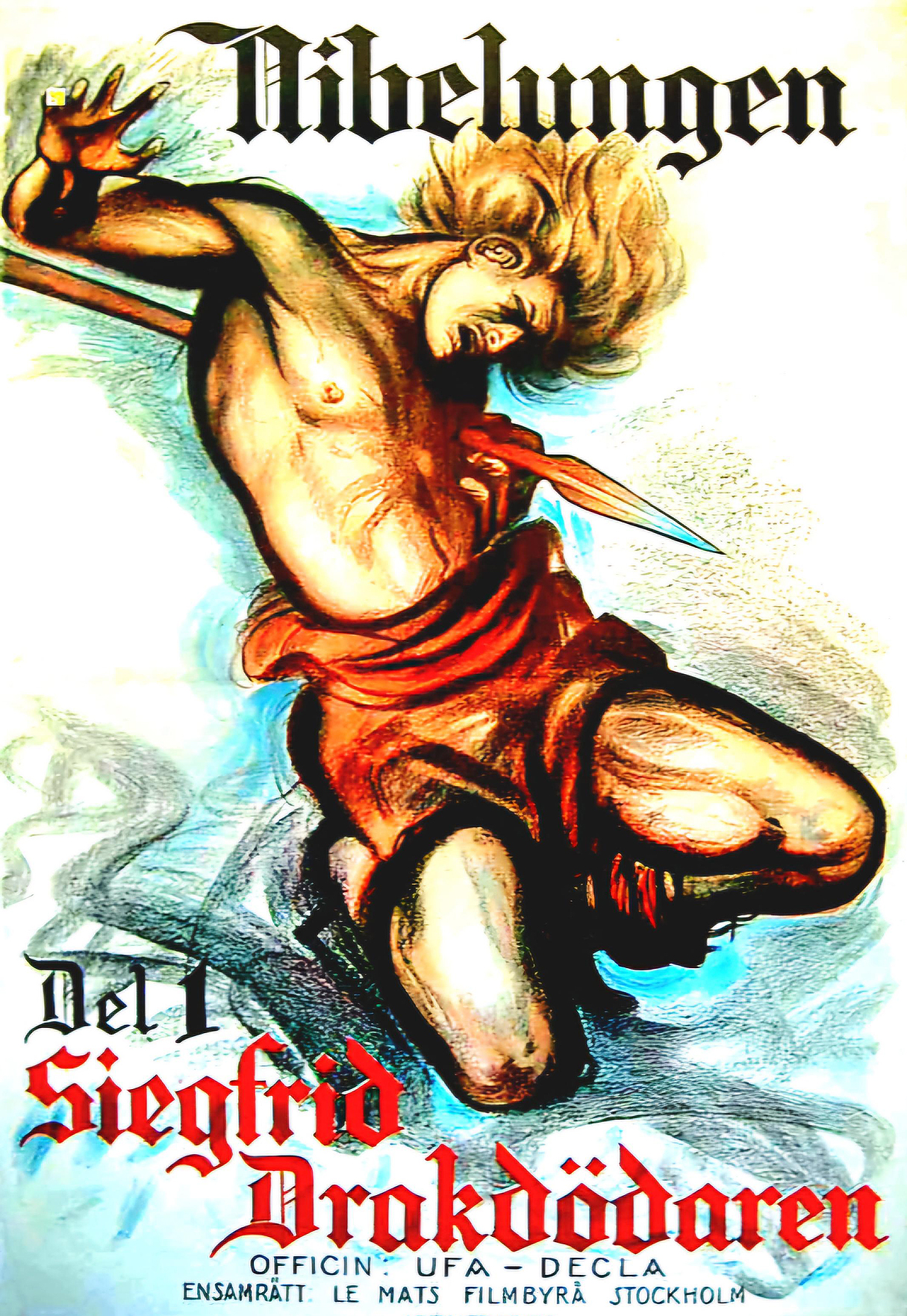
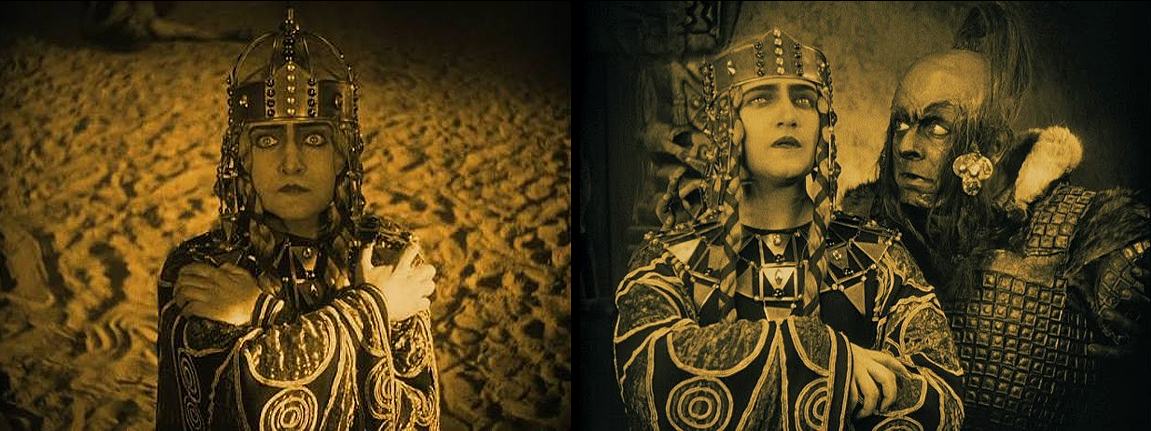
• Now here is an interesting profile that I stumbled on investigated the 1924 film Metropolis, directed by the Jewish director Fritz Lang. If you look even a little bit into this early, pioneering silent film, you will read lies like 'Metropolis was banned in Germany during the Third Reich', for whatever dumb reason they might fantasize. But the reality is that the film was widely loved by the Third Reich. Looking deeper into the film you will find a remarkable and highly artistic woman, who is also the writer of the book and screenplay: Thea von Harbou. Harbou was a pioneering screenwriter, novelist, film director, and actress. She was also the co-author of other early, popular films, like the 1922 film 'Dr. Mabuse der Spieler' (Dr. Mabuse, the Gambler) and the spectacular 1924 film 'Die Nibelungen' (The Nibelungs, referring to the treasure-hoarding dwarfs of Germanic and Norse mythology and famously tied to the 'Nibelungenlied', or Song of the Nibelungs, an epic 13th-century poem).
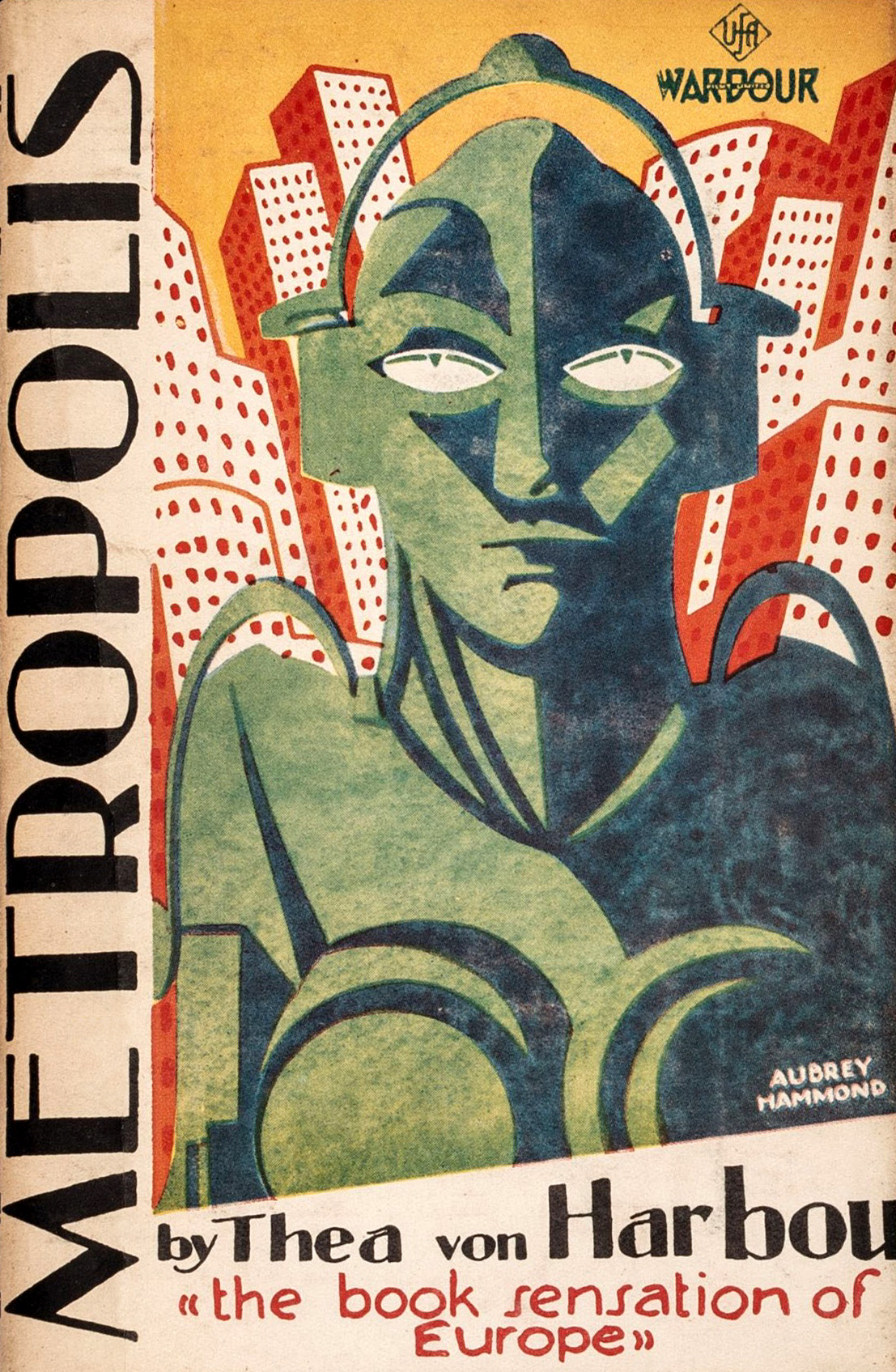
[Above: 1st English edition.]
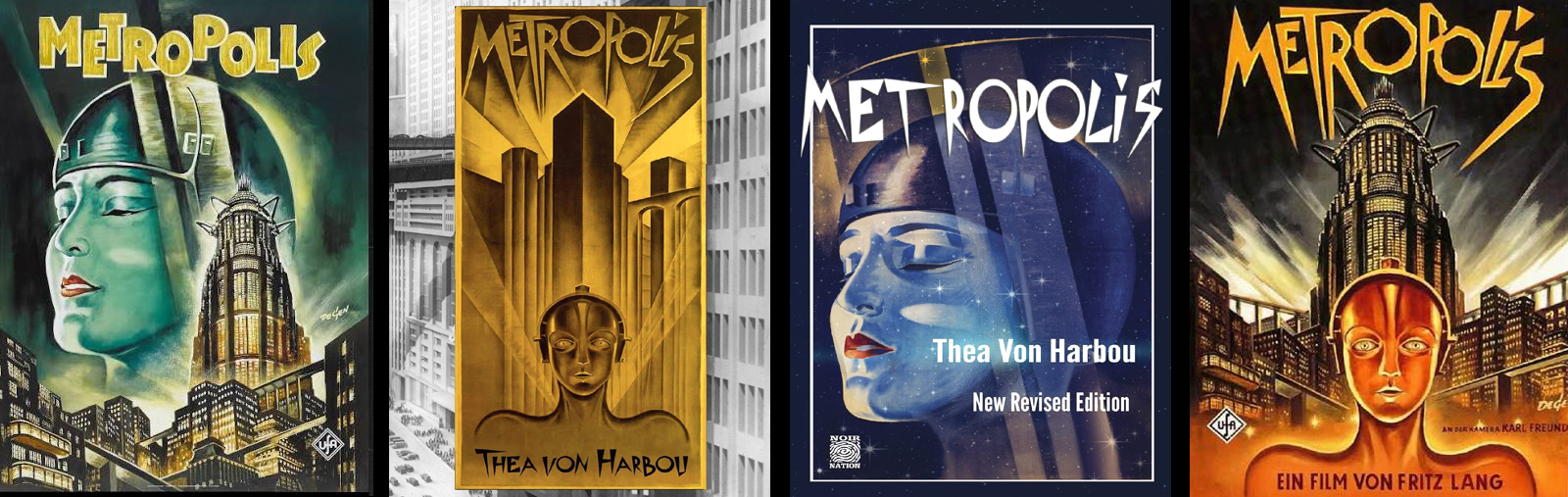
[Above: Modern DVD releases of Metropolis.]
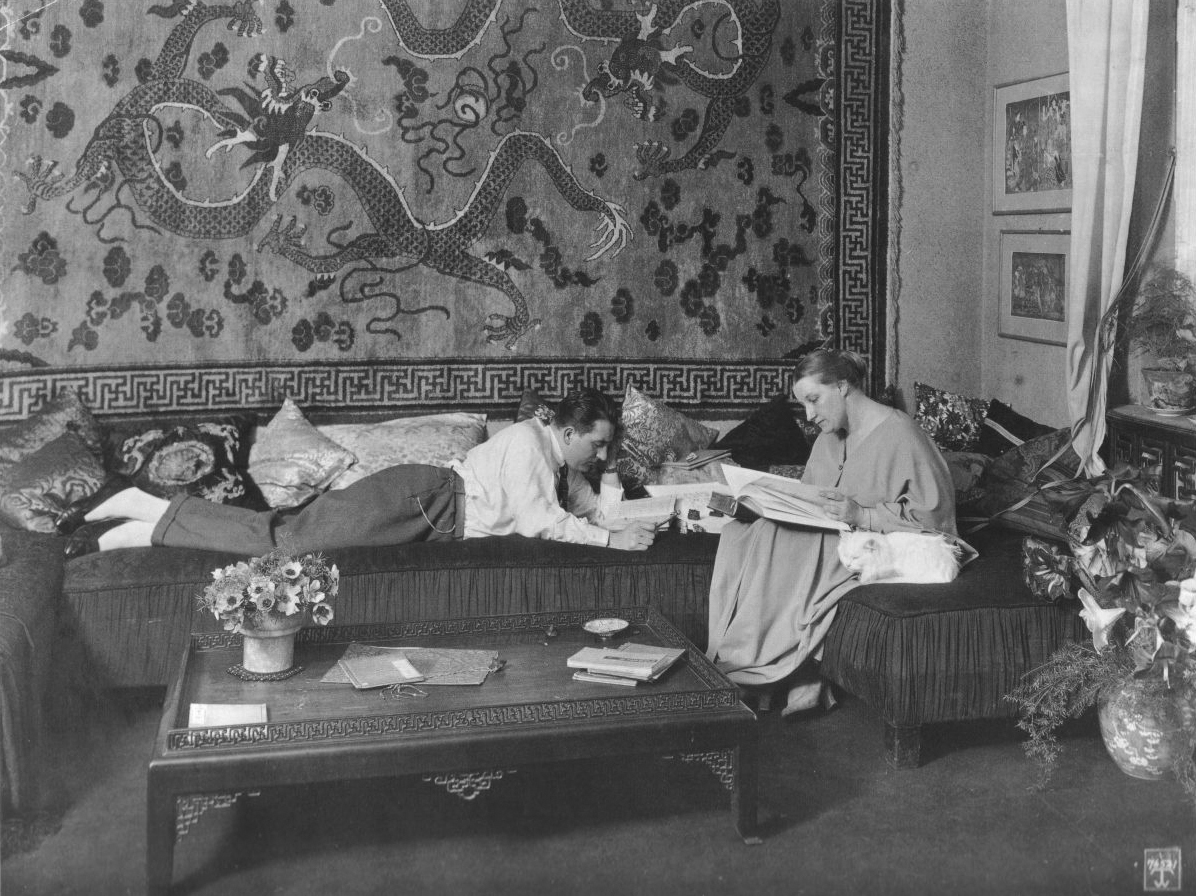
[Above: Fritz Lang and Thea von Harbou in their Berlin house, 1923-1924. Check out the swastika pattern on the tapestry's trim.]
Here is an early description of Metropolis:
'Then came the idea to create something gigantic and over-whelming in its possibilities; some-thing that would give a glimpse of the mysterious future, and which would at the same time appeal to all nations. The outcome of this idea was "METROPOLIS." First the novel, then the scenario, and now the film which will astonish the whole world with its revelations of manifest wonders.
Thea von Harbou is an unbiassed authority in the realm of pictures. Her ideas and words are the most precious foundations of each film, and they take unto themselves visible shapes through the genius of her husband, Fritz Lang, acknowledged by the world to be the master-mind of cinema technique.'
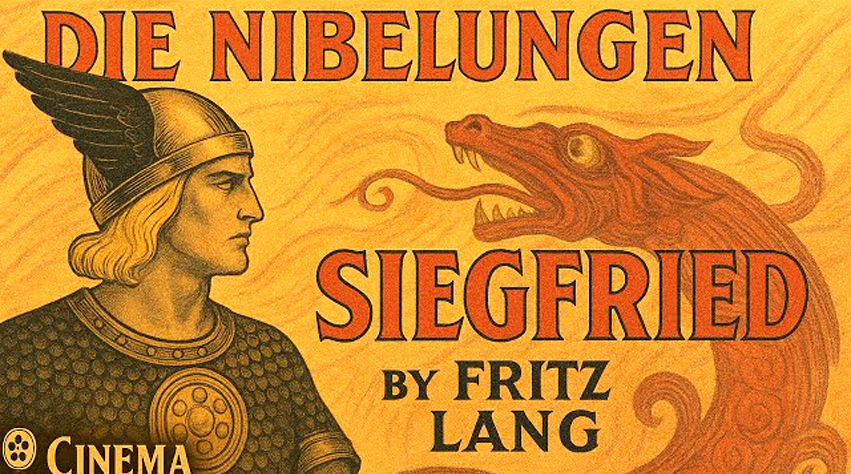
[Above: Die Nibelungen graphic.]
[Above: Die Nibelungen poster.]
[Above: Nibelungen was a two-part series of 'Die Nibelungen - Siegfried' and 'Die Nibelungen - Kriemhild's Revenge'.]
Regarding the film Metropolis: If you would like to watch a music video put together by a fan, using music from the great song by 'Zager & Evans - In the Year 2525', which fits the film perfectly, check it out:
HERE
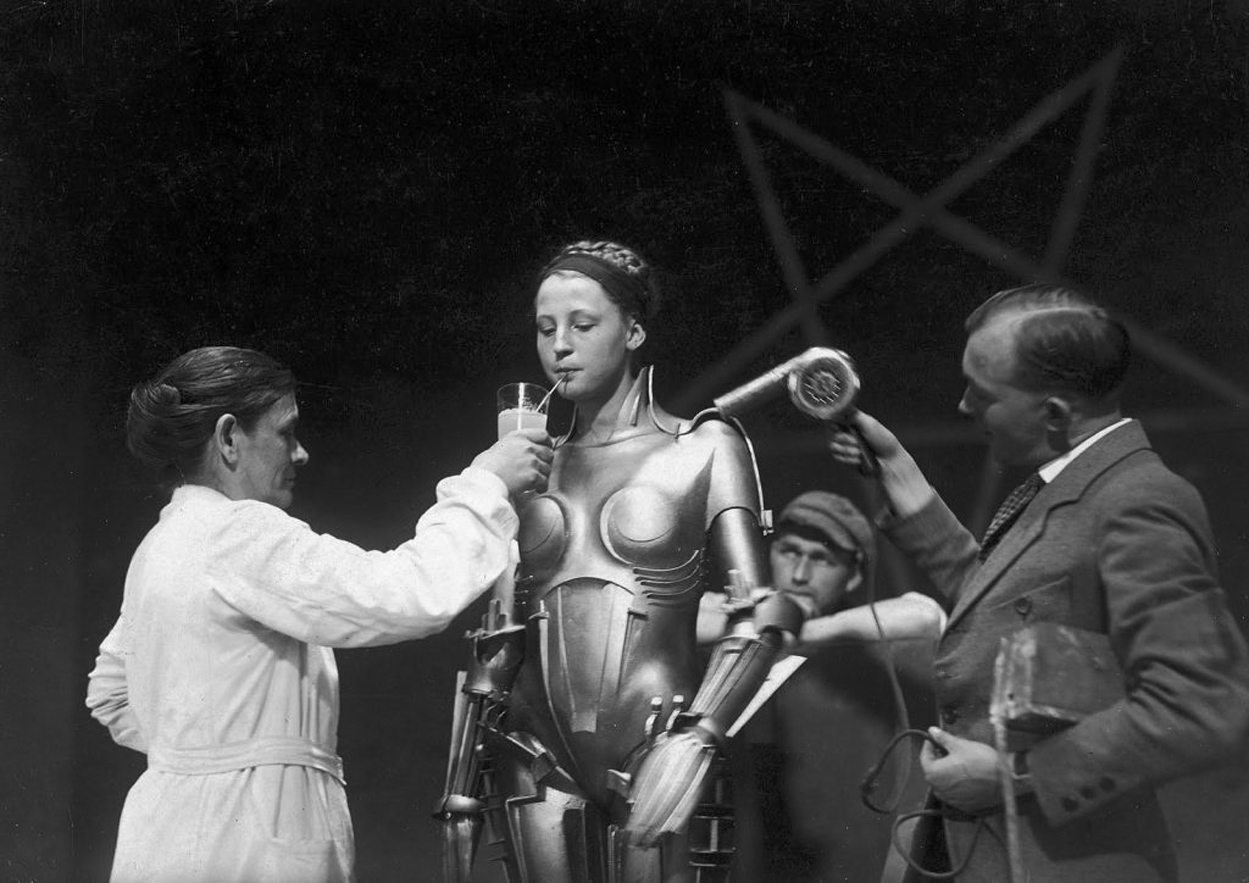
[Above: A behind the scenes look at Metropolis.]
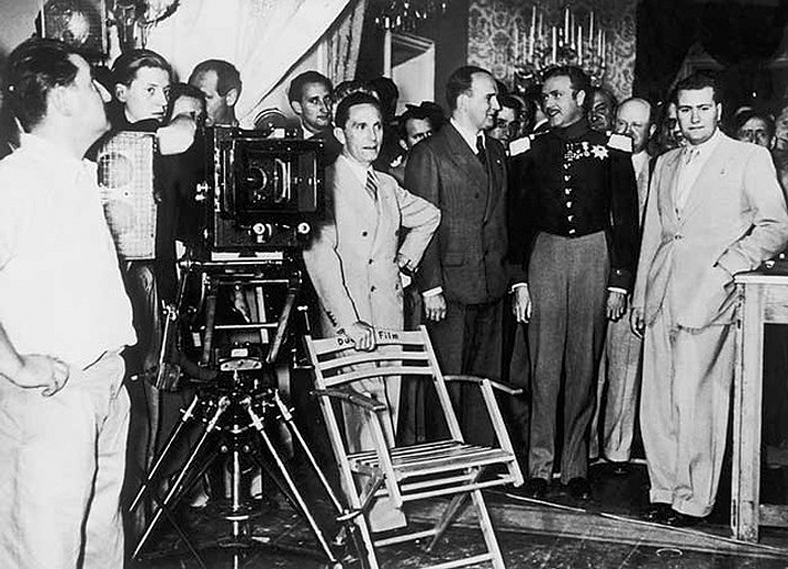
[Above: Joseph Goebbels and Vittorio Mussolini (a film critic, producer and writer) visit the set of 'A Prussian Love Story', produced in 1938.]
During the Third Reich 'companies went on to produce co-productions with companies of other countries: eight co-productions with the Kingdom of Italy, six co-productions with the French Third Republic, five co-productions with the Kingdom of Hungary, 5 co-productions with Czechoslovakia, 3 co-productions with Switzerland, two co-productions with the Second Polish Republic and the Empire of Japan (e.g., The Daughter of the Samurai), and one each with Francoist Spain, the United States, the Kingdom of Yugoslavia, and Sweden.'
A whopping 1,097 feature films were produced between 1933 and 1945. 500 of those films were exported to the United States between 1933 and until the USA and German went to war in 1942.
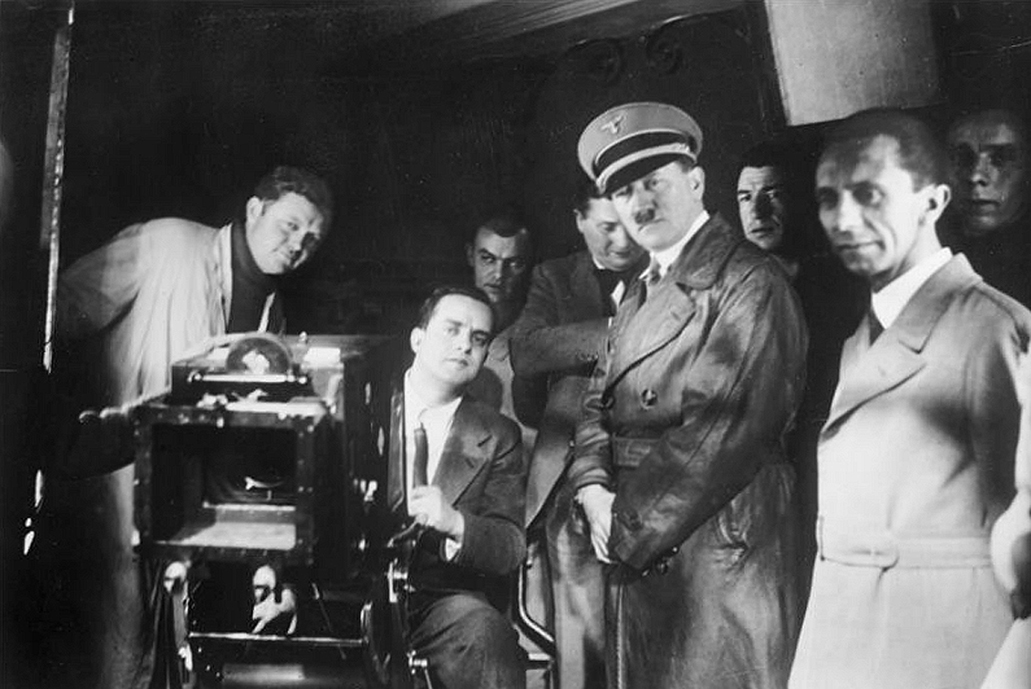
[Above: Adolf Hitler, Joseph Goebbels, and others watch filming at Ufa (Universal Film Association), 1935.]
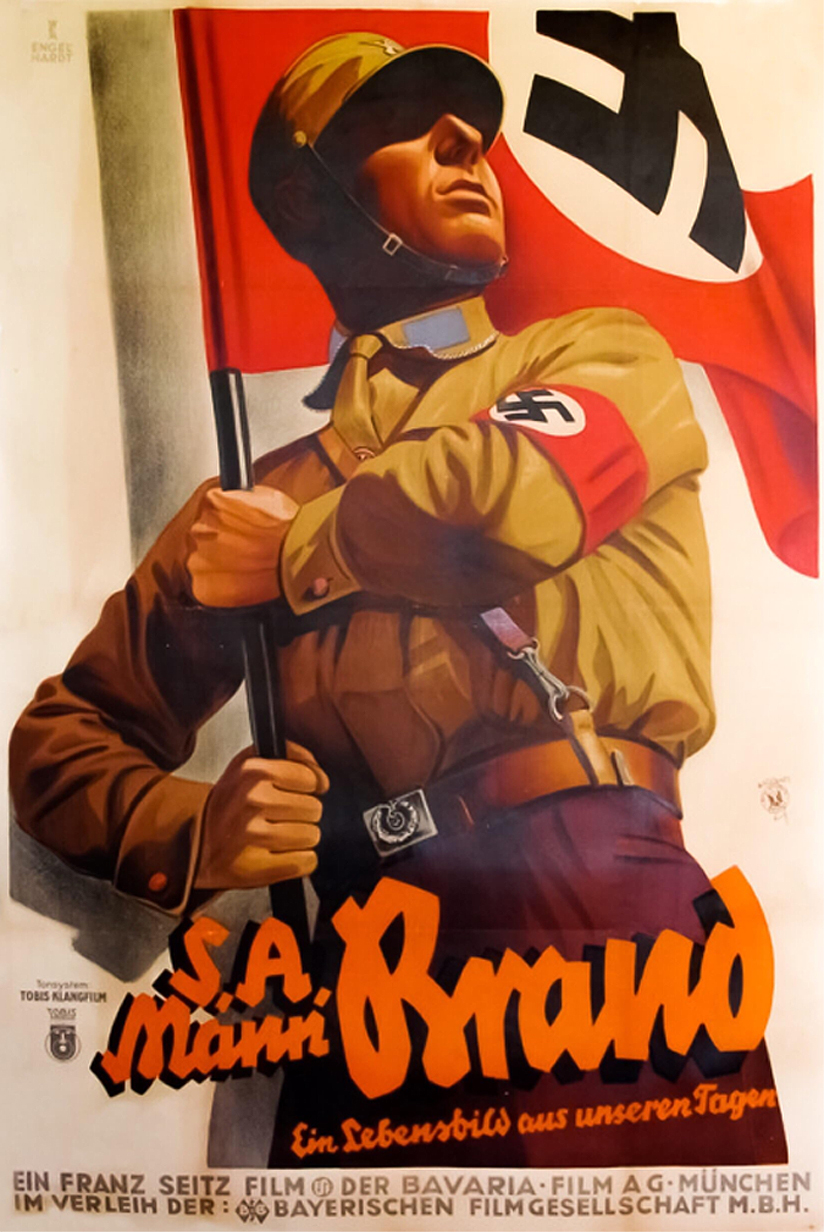
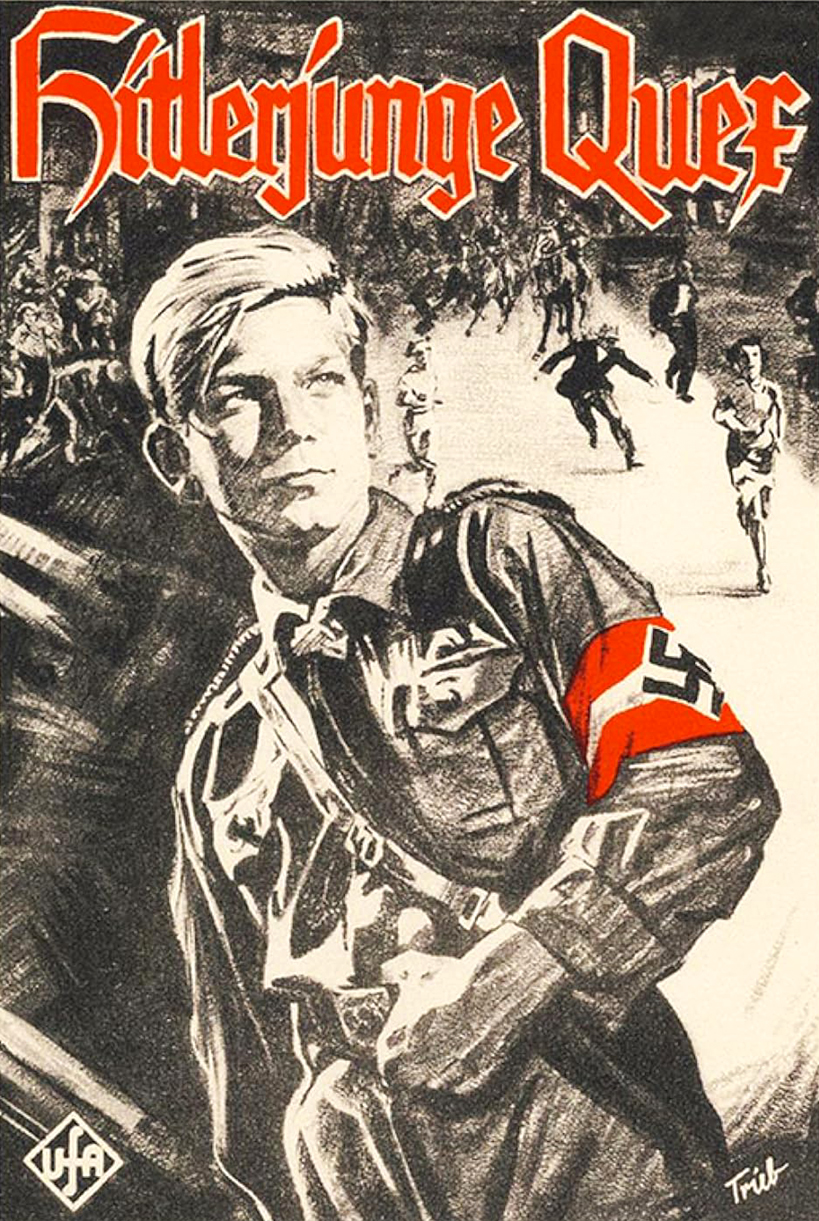
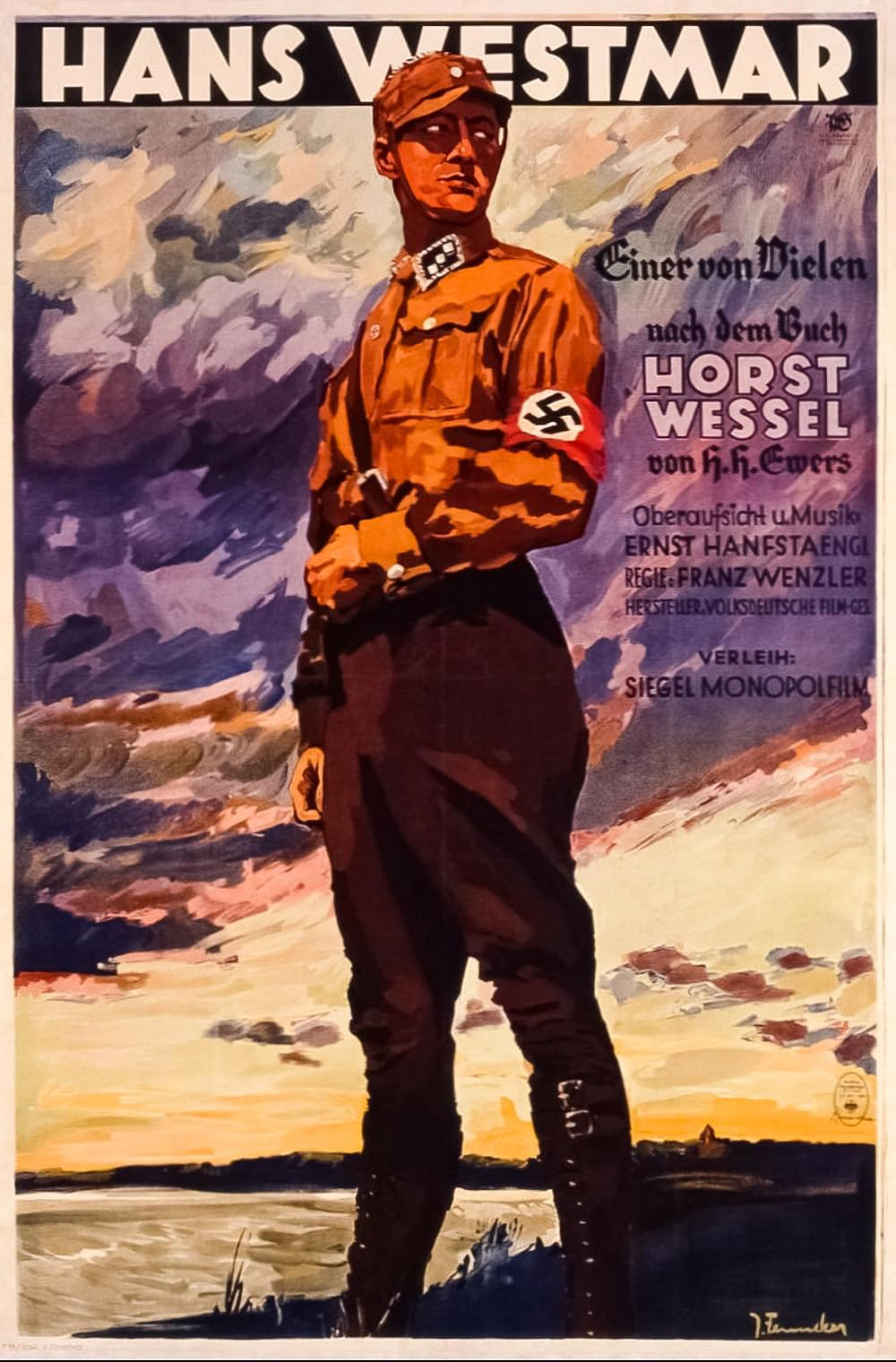
The National Socialists produced three feature-length films about the party's meteoric rise to power in 1933. These films being 'S.A.-Mann Brand', 'Hitlerjunge Quex', and 'Hans Westmar' (based on Horst Wessel).
[Above: S.A.-Mann Brand, Hitlerjunge Quex, Hans Westmar were all produced in 1933.]
Lang and Harbou were divorced in the spring of 1933, later that year Adolf Hitler was appointed Chancellor of Germany, Lang went into self-imposed exile, continuing his career in Hollywood (ironically fleeing to THE Metropolis!), while Harbou found immense success working as a successful director, film advisor and screenwriter during the Third Reich.
In 1933, she was appointed as a chairwoman of the official Association of German Talking-Picture Authors. Joseph Goebbels
himself was very fond of Harbou's undeniable talents, and put her skills to work for the National Socialist awakening of Germany. She worked extensively reviewing and rewriting screenplays to fit the National Socialist world view.
While directing wasn't necessarily her forte, in 1934 she directed two films: Elisabeth und der Narr (Elisabeth and the Fool) and Hanneles Himmelfahrt (Hannele's Assumption to Heaven). Harbou wrote screenplays for prominent like Veit Harlan (director of the world famous film Jud Süß), Josef von Báky, Hans Steinhoff, and Erich Engel.
[Above: Thea von Harbou.]
During this time she also helped Indian nationalists who fled to the Third Reich to fight the occupation of India by Britain. Her help to these freedom fighters involved giving them a place to stay and even finacially supporting them. One of these political activists, a Brahmin (considered Aryan by anthropoligists) and doctoral student and journalist by the name of Ayi Tendulkar, she is said to have had a relationship with.
Following the end of WWII, Harbou arrested for being a NSDAP member and her 'cultural status' and was put in the British concentration camp 'Staumühle'. Like millions of other Europeans, she was blacklisted by the Allied Occupation Government in Germany and the world at large. She was forced to do manual labor clearing the mountains of rubble left from the Allied terror war on civilians.
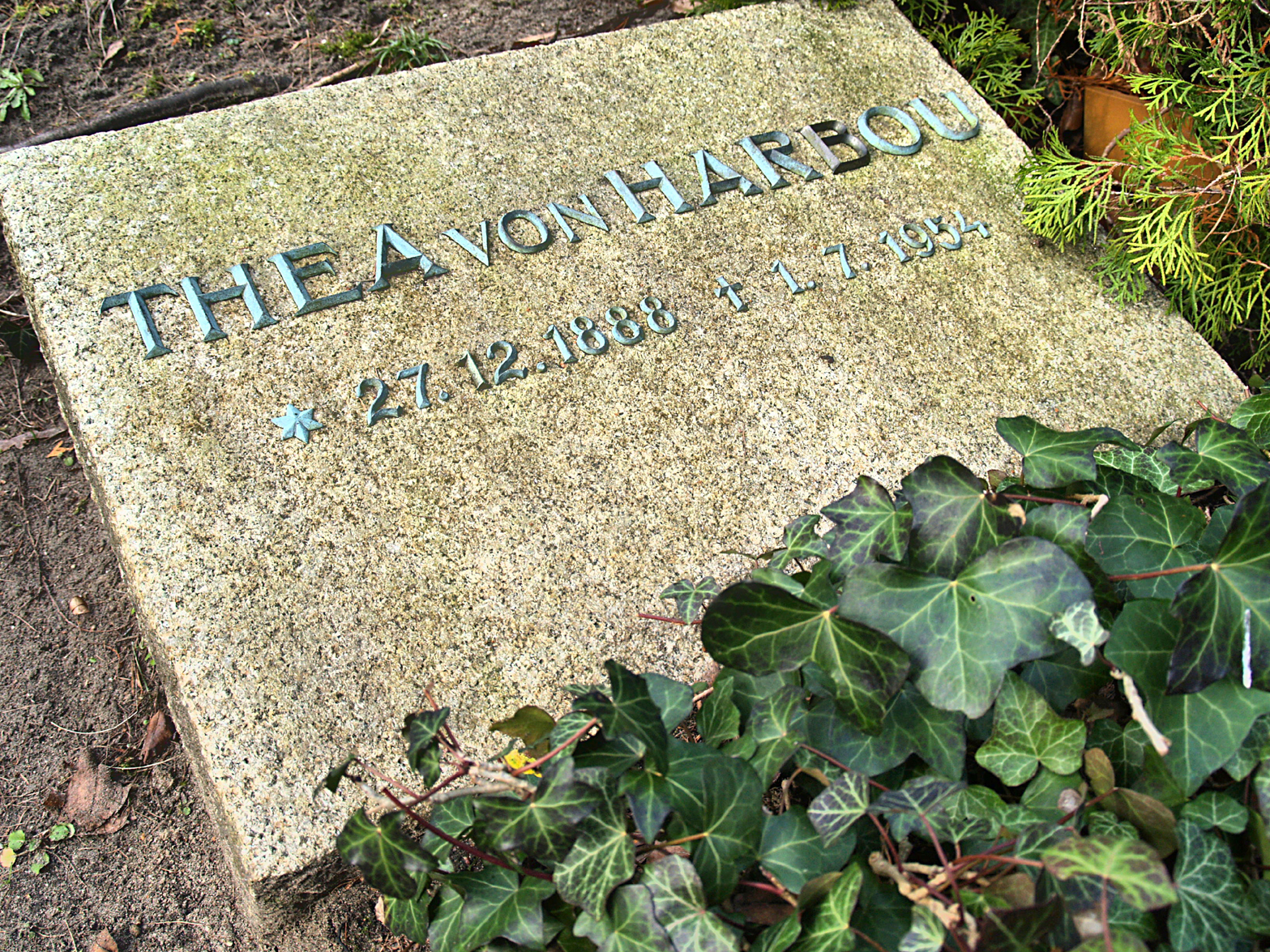
[Above: The sunny grave of Thea von Harbou. Thea fought with her gift for cinema for the Third Reich until the last days.]
• Click here to see other photos of Thea von Harbou
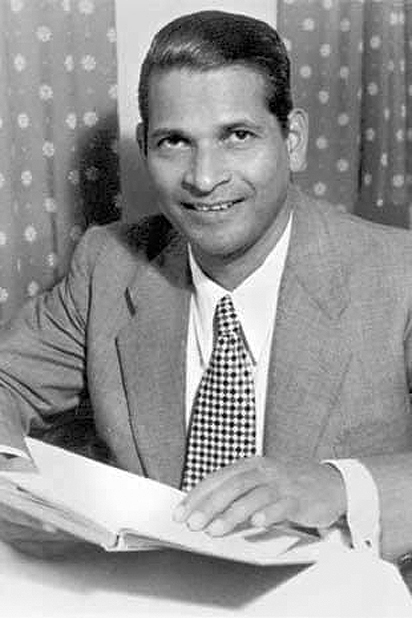
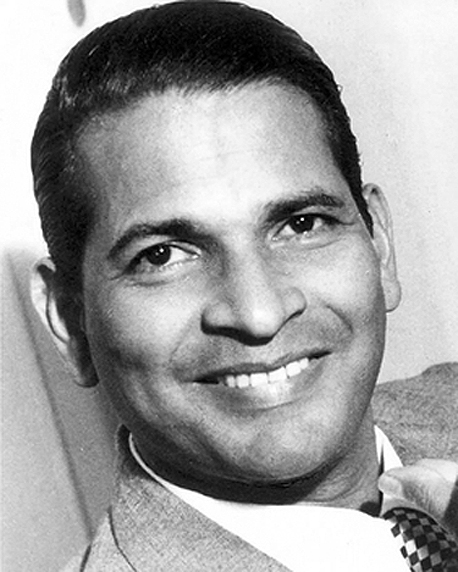
Ayi Ganpat Tendulkar is a lesser-known Indian independence activist, probably only known at all because of his relationship with Thea von Harbou. It is claimed that they were 'married' in an agreement by mouth,a sort of pact between the two apparently.
Before meeting Harbou Tendulkar had built a reputation as a 'radical' intellectual, journalist, community organizer and most importantly, an anti-British broadcaster for the Berlin radio. His work in Berlin is said to have 'helped bridge the gap between European intellectual circles and the Indian freedom struggle.'
He was born in n Maharashtra, and began his political life in India as the personal secretary to another Indian freedom fighter named Vallabhbhai Patel at Mahatma Gandhi's operational headquarters for the India's independence movement.
Early in his life he was sponsored to study abroad, first in Paris and later to Germany, going to school at the Berlin University as a Humboldt scholar to pursue a doctorate in mechanical engineering.
After his broadcasting work in the Third Reich he moved back to India and again became involved in the Indian Independence Movement. He later settled down, getting married and having a daughter.
He passed away on January 1, 1975, at the age of 71.
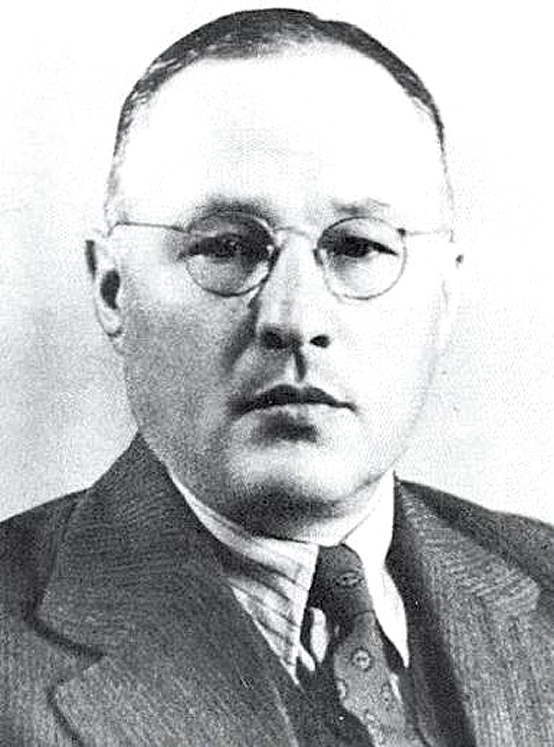
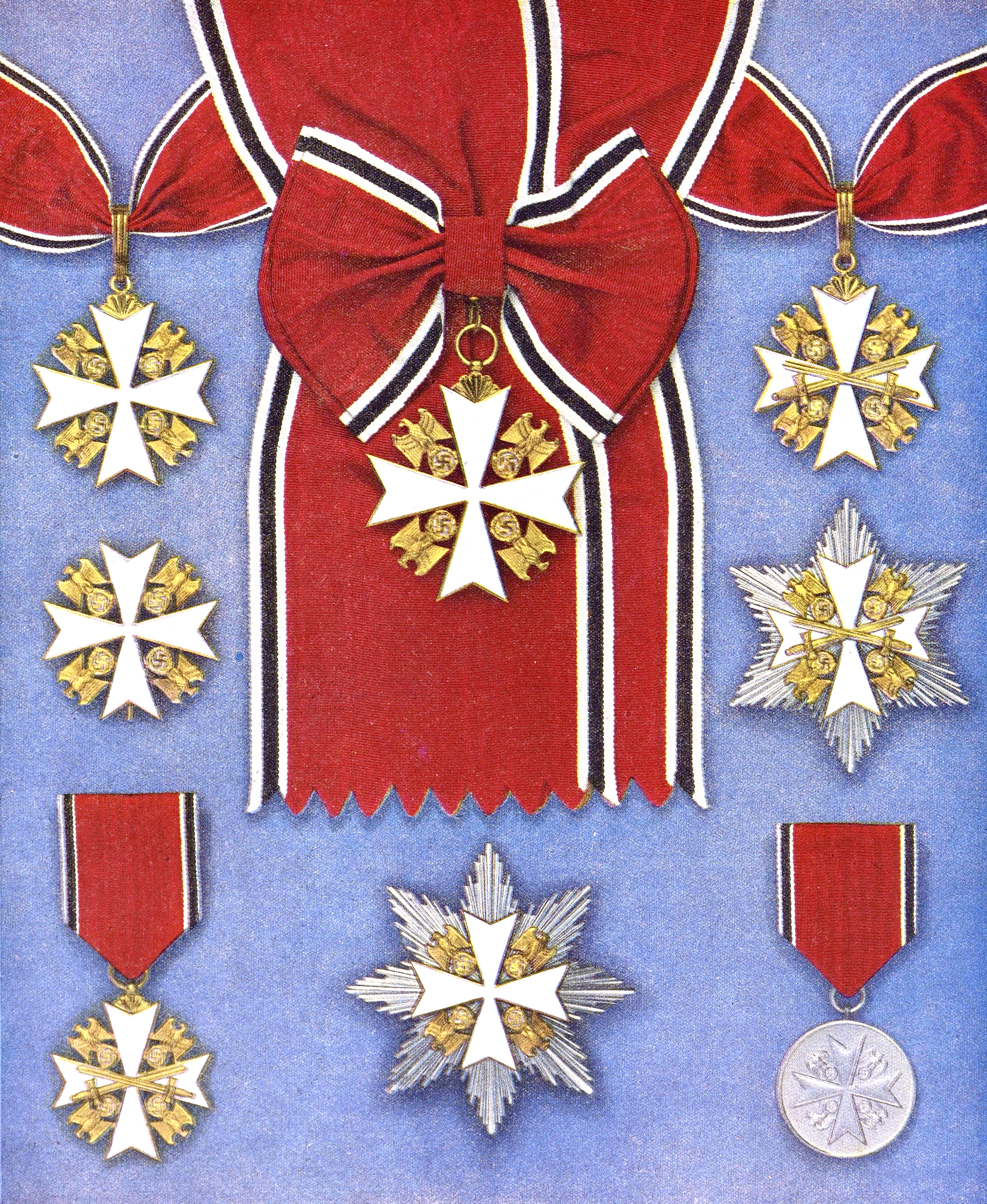
[Above: Ecuadorian Foreign Minister Julio Tobar Donoso, 1940. Donoso was awarded by Germany The Order of Merit of the German Eagle, instituted on May 1, 1937 by Adolf Hitler.]
[Above: Different grades of The Order of Merit of the German Eagle, Signal Magazine, 1942.]
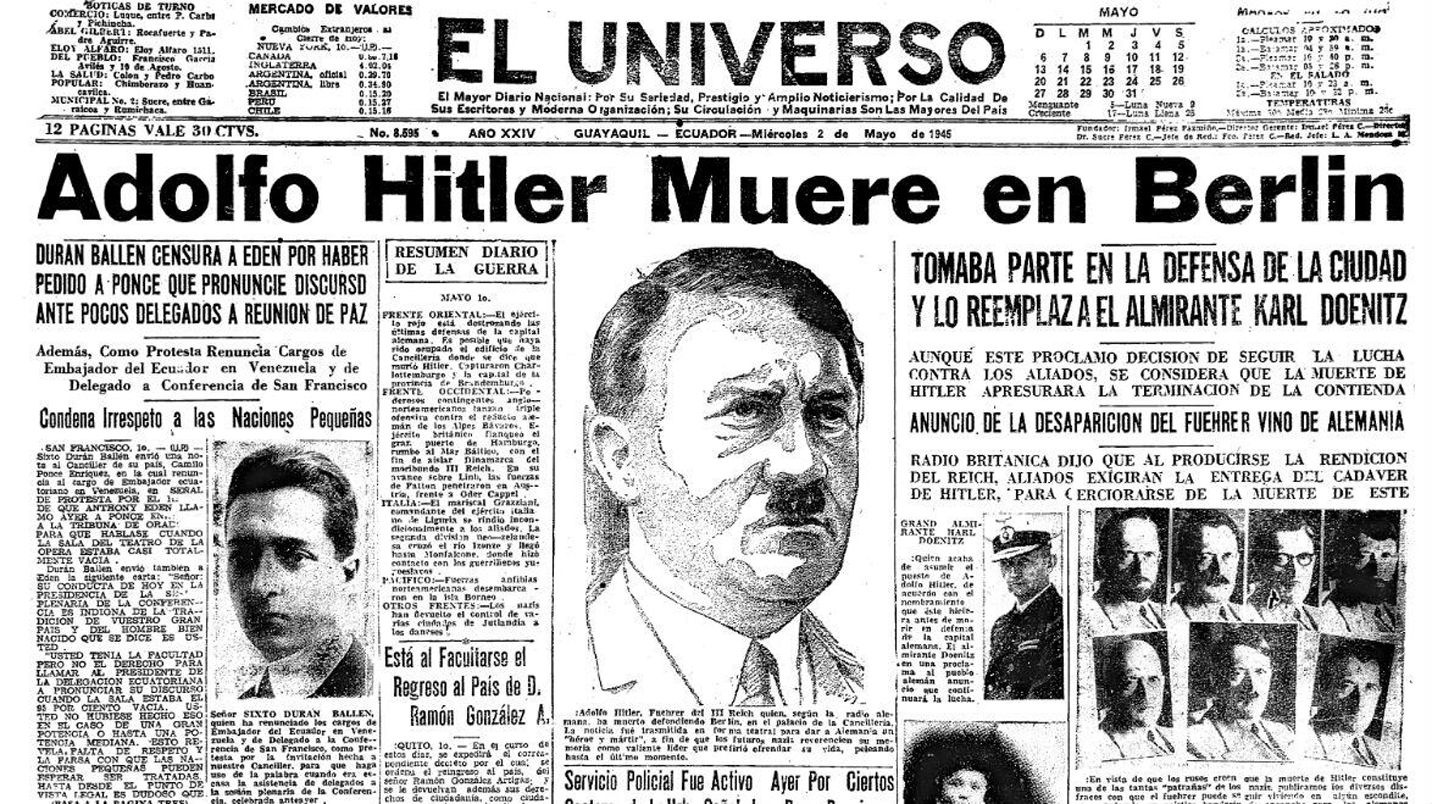
[Above: El Universo, May 2, 1945, announces:
'Adolf Hitler Dies in Berlin
Adolf Hitler, Führer of the Third Reich, who, according to German radio, was broadcast theatrically to give Germany a "hero and martyr," so that future Nazis would revere him as a brave leader who preferred to sacrifice his life, fighting bravely.
He was taking part in the defense of the city and is replaced by Admiral Karl Dönitz.
Although this proclaimed the decision to continue the fight against the Allies, Hitler's death is considered to have hastened the end of the war.
Announcement of the Führer's death came from Germany
BRITISH RADIO SAID THAT UPON THE SURRENDER OF THE REICH, THE ALLIES WILL DEMAND THE HANDOVER OF HITLER'S BODY, TO (VERIFY HIS DEATH)
In view of the fact that the Russians believe that Hitler's death constitutes one of the many "hoaxes" of the Nazis, we publish the various disguises with which the Führer can appear...']
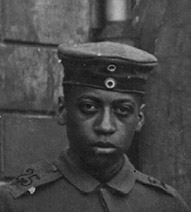
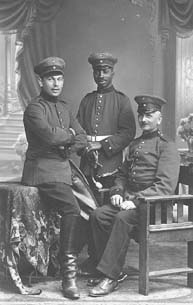
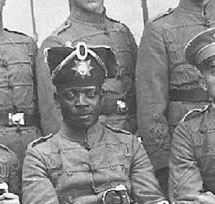
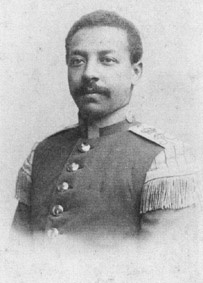
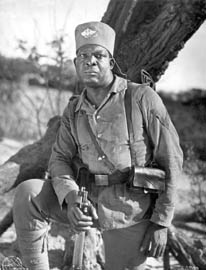
[Above: Here is a black man serving in the Imperial German army. He was a member of Landwehr-Infanterie-Regiment Nr. 25.]
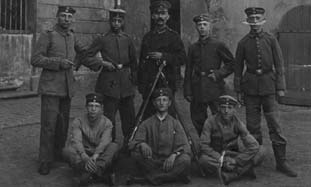
[Above: Here is the full portrait with the above man with WWI era German comrades.]
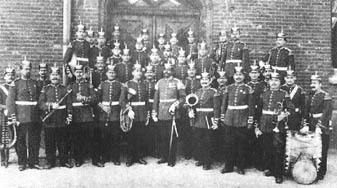
[Above: Studio portrait of black officer and comrades.]
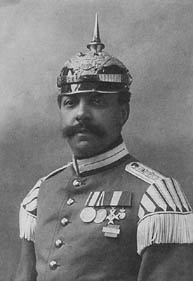
[Above: Black officer in parade regalia.]
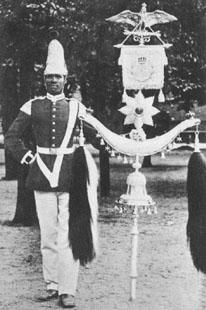
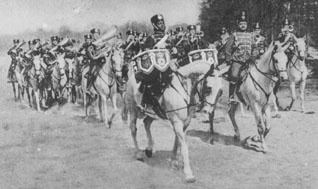
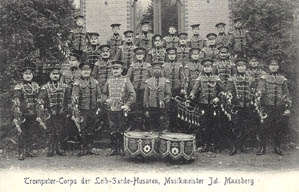
[Above & below: Elo Sambo, kettle drummer of the German Leib Garde Hussars. Elo was originally from the German colony of Kamerun (Cameroon).]
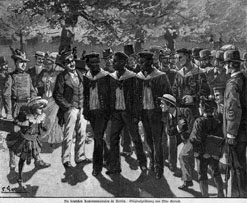
[Above: German newspaper illustration showing Cameroon Africans serving the German military in Europe. Circa 1886.]
[Above: Gustav Sabac el Cher (March 10, 1868 - October 4, 1934) was a Prussian military musician from the 'Musikkorps des 1. (Ostpreußischen) Grenadier-Regiments Nr. 1 'Kronprinz''.]
[Above: Gustav Sabac el Cher (center, front).]
[Above: Gustav Sabac el Cher as a student at the Königlichen Hochschule für Musik, Berlin, 1894.]
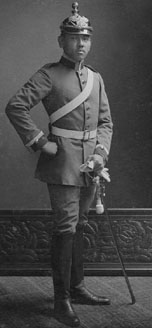
[Above: Africans weren't the only race to serve with the German military. This is a picture of Lt. Tep from Siam (Thailand).]
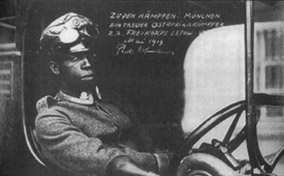
[Above: This photo was taken by Heinrich Hoffmann (whom would later become Hitler's official photographer) in May 1919. It is of 'Mohamed Husen' in Munich. Husen was a highly decorated officer who served in East Africa with the Germans and later with a Freikorps unit. The inscription on the photo reads in part 'To the battles: Munich. A loyal East African fighter.' Mohamed Husen is shown here while working with the 'Lettow-Vorbeck Freikorps' acting as a chauffeur. He is what is called an 'askari' (An askari was a local soldier from Africa serving in the armies of the European colonial powers, particularly in East Africa, Northeast Africa, and Central Africa. The word was not only used by the Germans, but also the French, English, Italian, Urdu and Portuguese).]
Mohamed Husen (birth name Majub) was born in Tanzania (German East Africa) in 1905. At the age of nine Husen volunteered to fight with Germany against his country's invaders in WWI. After the war he was given combat pay by Germany for his deceased father who was killed in action during the war.
Sometime later he found a job as a steward in a German ship. This job enabled him to travel to Germany, first to Hamburg and later to Berlin.
During this tumultuous time he joined the revolutionary 'Lettow-Vorbeck Freikorps' acting as a chauffeur. Sometime during this time he earned German citizenship and later got a job in a circus as an entertainer. In his spare time he also taught Swahili to German government civil servants and diplomats, who would later use these language skills in Africa.
[Above: Mohamed Husen]
After Adolf Hitler came to power Husen began appearing in German films and proved to be a popular actor. He appeared in eleven films from 1934 to 1941.
A London Guardian news article reported about him:
'...by the mid-1930s, he was dressing up in military gear and appearing at rallies in front of National Socialist banners.'
Not much is known further about Husen. It is reported that he had a wife while in Germany and later children. Reports say that at least one of his children died in Allied Terror Bombings and possible his wife as well.
One thing is clear: Husen's story is another piece of proof that the National Socialists were not the racists their enemies teach that they were.
[Above: Paul Emil von Lettow-Vorbeck (March 20, 1870 – March 9, 1964). Circa 1913. Courtesy of the Bundesarchiv.]
• In WWI the askari were led by their most beloved German leader Paul Emil von Lettow-Vorbeck. Lettow-Vorbeck was a general in the Imperial German Army and the commander of its forces in German East Africa. For four long years, with a force that never exceeded 14,000 (3,000 Germans and 11,000 Africans), he held in check a much larger force of 300,000 British, Belgian, and Portuguese troops. His loyal troops and he endured hunger, malaria and the elements in what has been described by Edwin Palmer Hoyt as 'the greatest single guerrilla operation in history, and the most successful.'
Lettow-Vorbeck's force was undefeated in the field. His fluency in the Swahili language earned the respect and admiration of his African soldiers. He appointed black officers, proclaiming to his men what he believed in his heart:
[Above: Poster bearing the image of General Paul Emil von Lettow-Vorbeck on horseback leading African soldiers. Text at top reads 'Colonial War Funds Donation'.]
• The historian Charles Miller stated 'It is probable that no white commander of the era had so keen an appreciation of the African's worth not only as a fighting man but as a man.'
After the armistice of WWI Lettow-Vorbeck's army surrendered to the British. The British repatriated the white German soldiers but confined the askaris in filthy concentration camps. General von Lettow-Vorbeck refused to leave until he had won promises of decent treatment and early release for his black troops.
General von Lettow-Vorbeck brought back some of his askari soldiers to Germany where they served in his brand of Freikorps.
[Above: Postcard with the picture of General Paul Emil von Lettow-Vorbeck and Governor Dr. Heinrich Schnee.]
•
'In 1953 in Dar Es Salam (Tanzania-ed.) I wanted to greet my old Askari. At mid-day I arrived at the local market
place and I was surrounded by over 400 Askari, they had tears in their eyes and covered my hands
in kisses. Around open campfires the Askari talked all through the night and they said that I had
shaken the hand of every one of them, they said it is something that the English never did'.
• Click here to see more pictures of the Freikorps
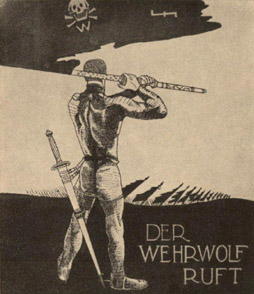
[Above: Post WWI Freikorps era postcard with skull and crossbones and 'Wehrwolf' theme. This is based on a 1910 novel that took place during the 30 Years War which used themes of heroic resistance.
[Above: Postcard from 1924 showing a memorial in Webicht of National Socialist martyr and hero Albert Leo Schlageter, who was executed May 26, 1923. Schlageter was an underground freedom fighter during the French occupation and one of the Third Reich's first martyrs. This postcard was released by the Weimar Wehrwolf resistance organization.]
[Above: Graphic on the back of the above postcard.]
[Above: Wehrwolf postcard 'The Wehrwolf Calls'. Circa 1930.]
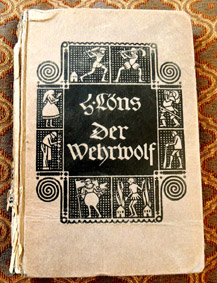
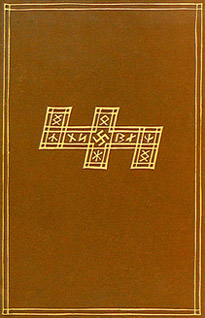
[Above: Book cover of Der Wehrwolf by Hermann Löns, (c)1920.]
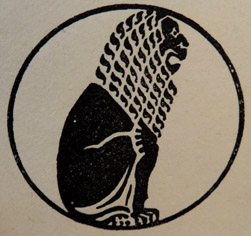
[Above: Inside graphic of Der Wehrwolf by journalist Hermann Löns, (c)1920 (first published in 1910). Click to see more pictures!]
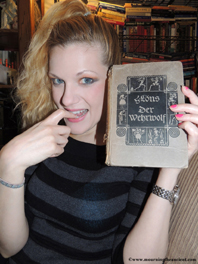
[Above: Showing off a beloved, ragged copy of Der Wehrwolf]
• Special thanks to mein Wehrwolf Marco R.!
'The Wehrwolf movement represents a minority. Only the best of our people belong to it.
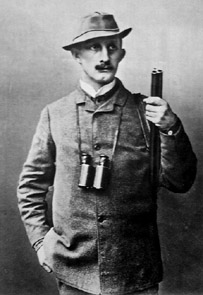
Hermann Löns was a life long nature and animal lover who found immortality through his beloved Der Wehrwolf novel. Although he wrote a handful of other books, none are so well known and loved as Der Wehrwolf. To this day over seven million books by Löns have been printed. He was also a beloved poet, in 1911 he released a collection of poems. One of these poems, the 'Matrosenlied' (Sailors' Song) has the chorus 'Denn wir fahren gegen Engelland' (For we are sailing against England), was put to music by Herms Niel and was one of the most-sung German military songs of World War II!
But Hermann Löns would never see the fame and wealth that largely escaped him during his tumultuous life. At the age of 48, after first being rejected for ill health, he managed to join the German Army and fight in WWI. On the dark day of September 26, 1914 the great patriot and naturalist fell. Löns died just three weeks after enlisting on September 3. Of the 120 brave men in his unit only about two dozen survived an assault on a French position at Loivre near Reims in France.
[Above: Hermann Löns (August 29, 1866 – September 26, 1914)]
[Above: Third Reich era copy of Der Wehrwolf. By 1945 the Wehrmacht alone sold more than 865,000 copies of the book! This made him one of the most successful authors in Germany at the time. Click on the image to learn more and see inside this edition of Der Wehrwolf.]
• Löns was a poet whose poems often dealt with the natural world. He was a pioneer of nature conservationism. In fact, he was co-initiator of the Heideschutzpark at Wilseder Berg which later grew into the famous Naturpark Lüneburger Heide (Lüneburg Heath Nature Park), which was the first nature reserve in Germany.
[Above: This copy of Der Wehrwolf was printed with proceeds going to help needy soldiers in the Wehrmacht (left). On the right is one of the many editions for soldiers to read at the front.]
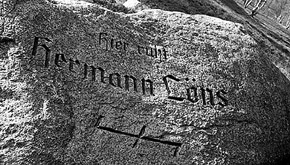
• Löns was buried on the battlefield where he fell. In 1934 his remains were located and reburied in Germany. Today there are some 113 memorials to Löns in Germany, plus another eight in Austria and 19 in other countries. There are also 247 streets and roads in Germany which have been named after him. Twelve schools also bear his name and even a stadium.
[Above: 'Here rests Hermann Löns'. The grave marker near Walsrode where the body of Hermann Löns was reburied in 1935. Click to see more!]
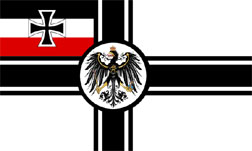
[Above: Pin from The Reichskolonialbund (Reich Colonial League).]
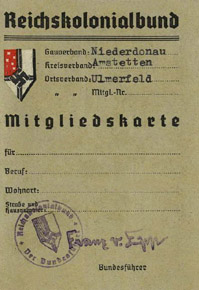
• The Reichskolonialbund was a collective body that absorbed all German colonial organizations during the time of the Third Reich. It was led by Franz Ritter von Epp.]
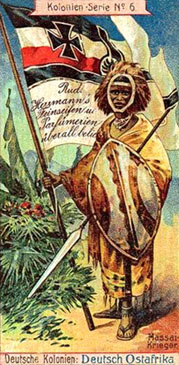
[Above: Card from German East Africa showing a traditional African warrior carrying the German Imperial flag.]
[Above: Franz Xaver Ritter von Epp (October 16, 1868 – December 31, 1946) was an army officer in the Imperial German Army in the early 20th century. He eventually rose to the office of Reichsstatthalter of Bavaria. After the war he was arrested and sent to an Allied death camp in Munich where he was murdered in detention on December 31, 1946.]
[Above: Membership book from The Reichskolonialbund (Reich Colonial League). Circa 1939.]
[Above: German colonial exhibition.]
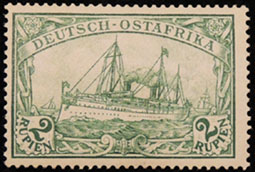
[Above: Here is a postage stamp from colonial German East Africa. Circa 1901. This shows an illustration of the Kaiser's yacht.]
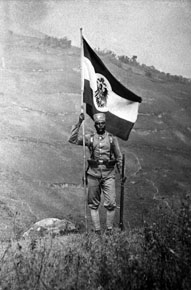
[Above: Here is a picture of a black East African German colonial soldier, or askari. Unlike other European nation's colonies around the world, Germany didn't take any of her colonies by force.]
[Above: Askari soldier of German General Paul Emil von Lettow-Vorbeckin posing for history.]
[Above: German East African gold coin from 1916.]
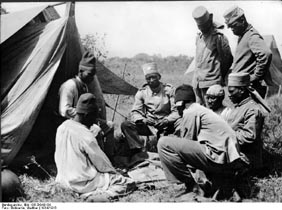
[Above: Askari men of German General Paul Emil von Lettow-Vorbeckin relax in camp. Courtesy of the Bundesarchiv.]
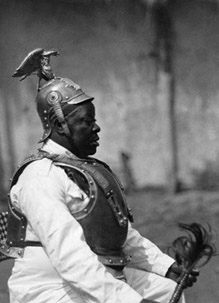
[Above: This strange and spectacular photo is of a tribal chief from Cameroon wearing a German helmet, armor, and uniform during a funeral.]
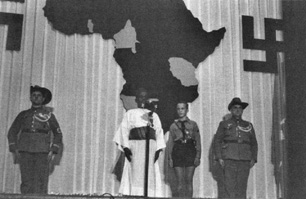
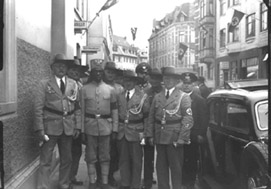
[Above: Men from Germany's lost colonies, which were blatantly stolen from her after WWI by the Versailles treaty. Note what is obviously a swastika armband on the black African.]
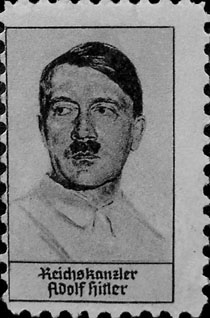
[Above: This is a donation stamp to the Reichskolonialbund (RKB). Click on the image to see more stamps from the set.]
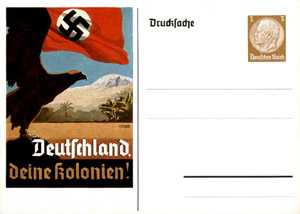
[Above: Postcard that says: 'Germany your colonies!'.]
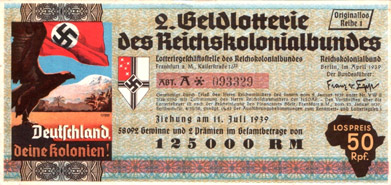
[Above: A beautiful Reichskolonialbund lottery ticket from 1939 for 125,000 Reichsmarks.]
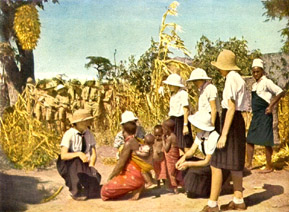
[Above: German BDM girls on a trip to East Africa in the 1930s.]
[Above: German BDM girls celebrating May Day in Africa.]
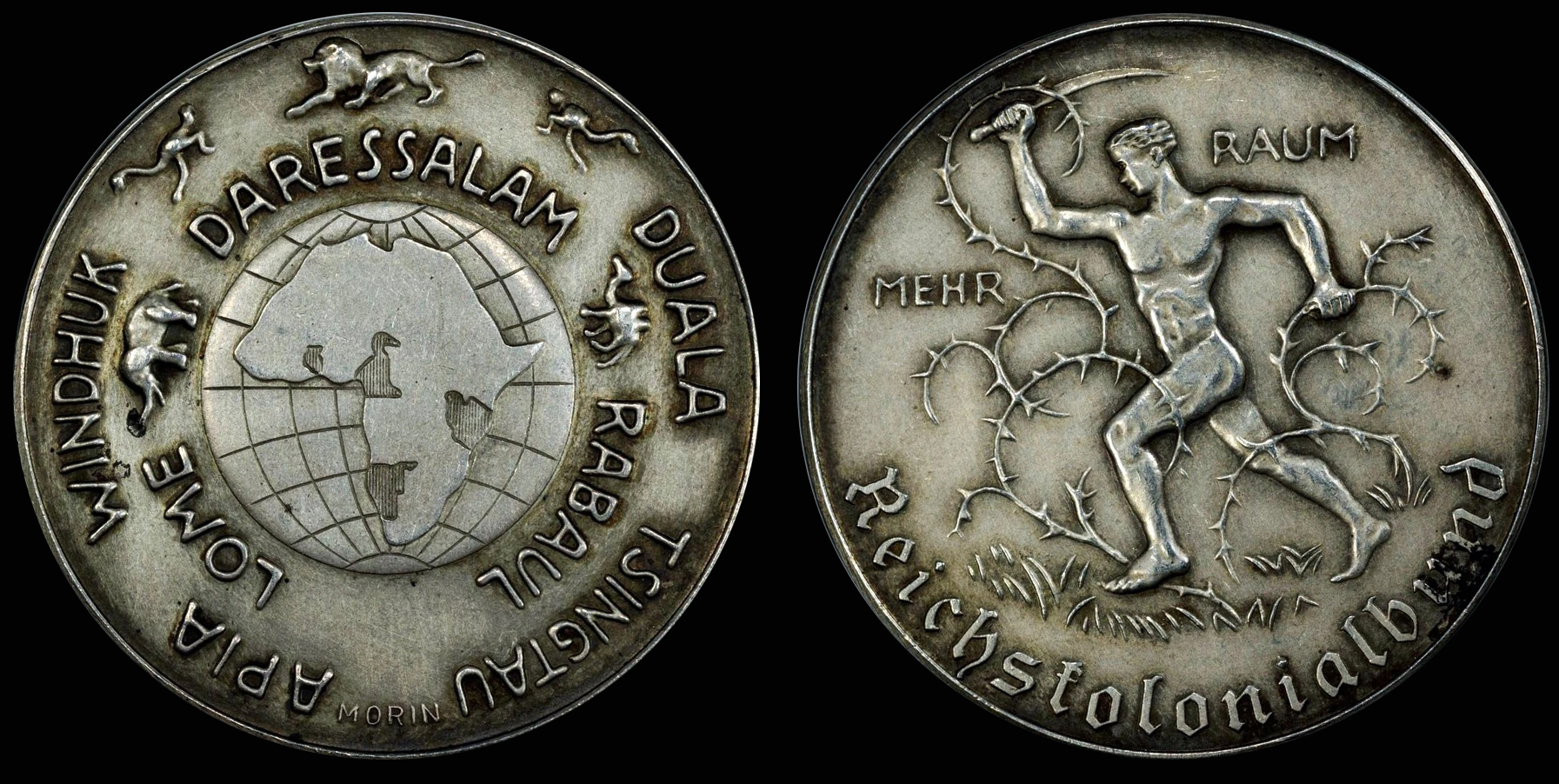
[Above: This is a 1933 colonial medal from the German colonial organization, this shows a man tangled in barbed wire, trying to cut his way free, with the words 'more room' (living space). Germany was very overcrowded and still is, I suppose, just not with Germans now.]
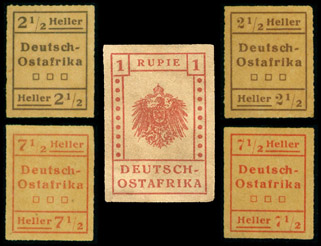
[Above: March 1916 provisional stamps. These relatively rare postage stamps were never issued. The condition of the majority of these stamps is poor due to the fact that they were buried in wet soil and later dug up (in August 1921)! Only a small part of the issues were salvageable, and after being returned to Germany from East Africa, they were put up for auction in May 1922. How odd is that?]
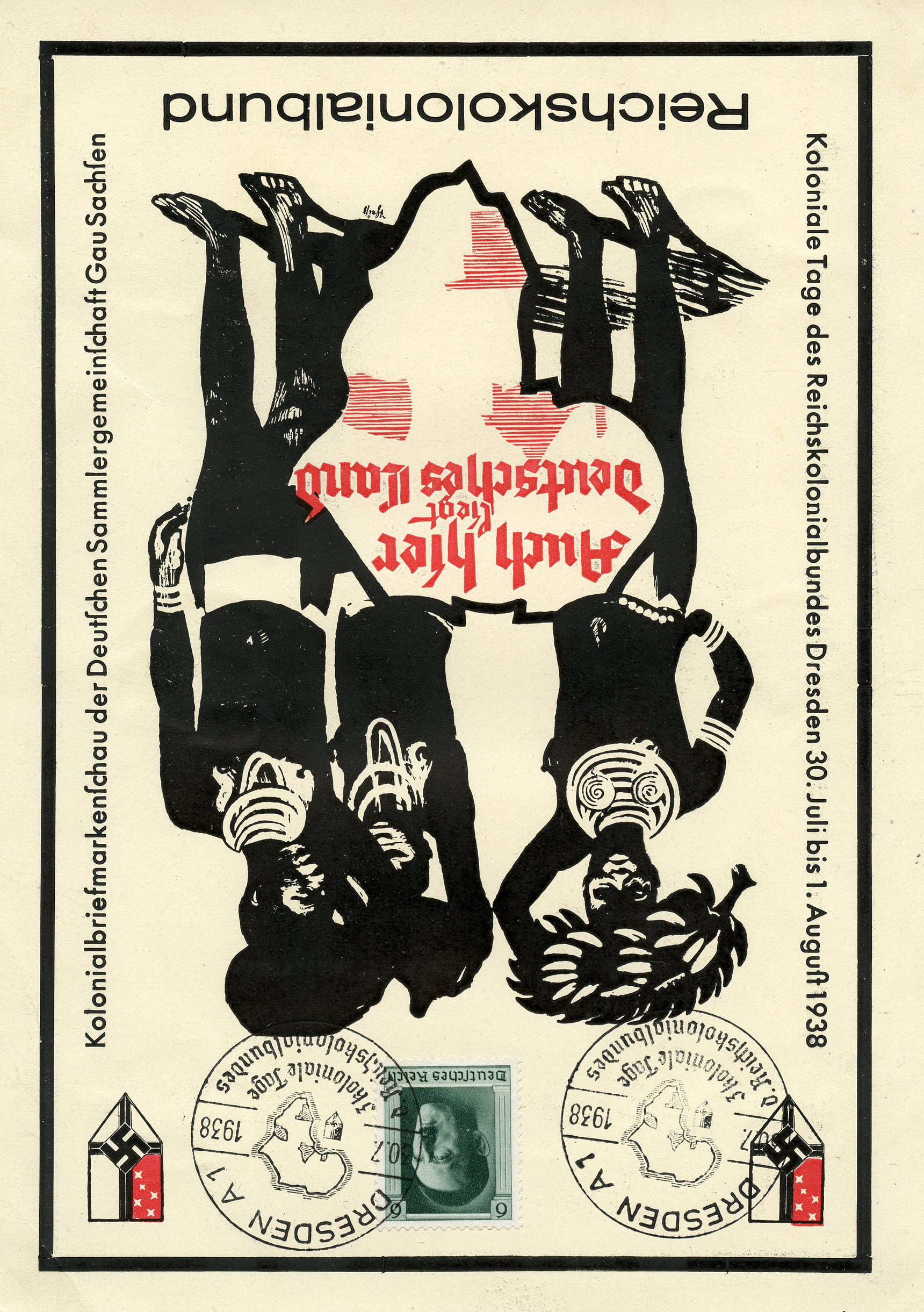
[Above: Rare August 1938 Colonial Day from Dresden. This card is large and on heavy stock.]
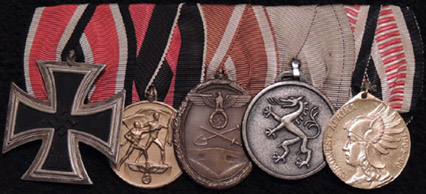
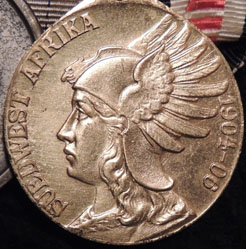
[Above: This is a medal bar containing German medals from WW2 and a German-African medal on the far right.]
[Above: Here is a close-up.]
• Click here to see other pictures of German-Askari soldiers
• Click here to see pictures of art and postal related items
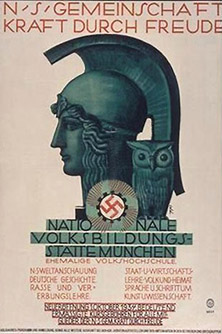
• Athena is the goddess of wisdom, courage, inspiration, civilization, law and justice, strategic warfare, mathematics, strength, strategy, the arts, crafts, and skill.
Here is a quote from the 1930s book 'Die Kunst im Dritten Reich':
'Athena is the goddess of war and art. She personifies the strong, fresh spiritual strength of the human being. She stands freely, upright. She recognizes, measures, and uses the strength of all things in the victorious battle with the enemy and in the conquest of nature for the creation of art. The picture of the goddess is the fitting expression of the heroic character of the Führer and the National Socialist movement and, in the deepest sense, of the art the Führer wants. An art form for which the artist has to fight in a serious and concentrated working procedure so that he may receive a blessing from it.'
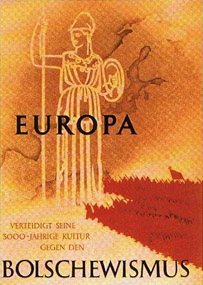
[Above: The mighty and wise Athena meets the Bolshevik armies head on! This says 'Europe - Defending its 3000 year old culture against Bolshevism']
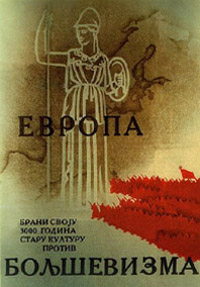
[Above: An Eastern European version of the Athena poster above.]
[Above: This poster, showing Athena and a communist, is from a Greek newspaper from March 15, 1943. It says: '3000 years of culture are in danger!']
[Above: The above poster shown in the 'Illustrierte Zeitung' (number 31, August 5, 1943).
'3000 Jahre Kultur sind in Gefahr!
(3000 years of culture are in danger!
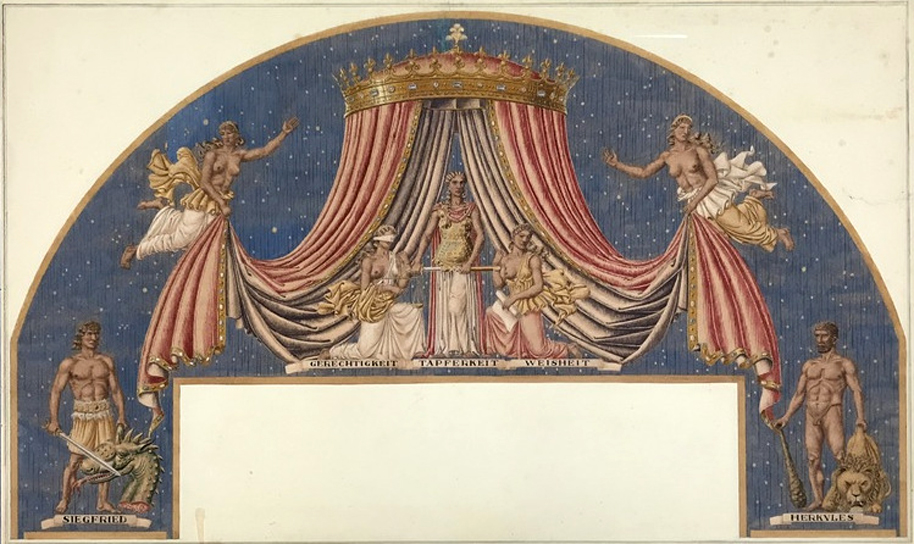
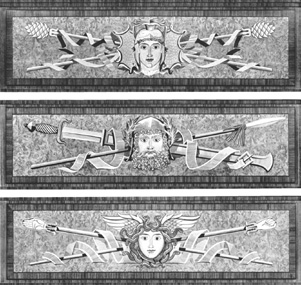
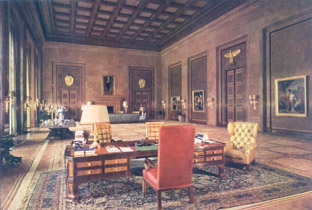
[Above: Adolf Hitler's spectacular desk in The New Reich Chancellery (Die Neue Reichskanzlei). Of special note are the three panels on the desk (from left to right):
[Above: Close-up of the desk panels.]
[Above: Here is a view of the desk from the other side.]
[Above: This postcard is from 1934 and done by Richard Klein.]
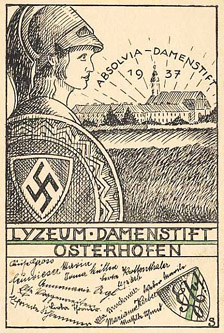
[Above: 'Absolvia - Damenstift 1937'. This is a school student organization graduation postcard.]
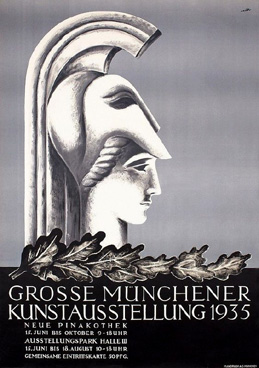
[Above: This is a 1935 catalogue of artists works celebrated on the 'Day of German Art'.]
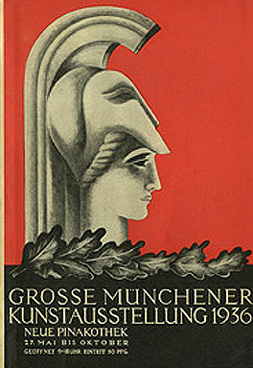
[Above: This is a 1936 catalogue of artists works celebrated on the 'Day of German Art'.]
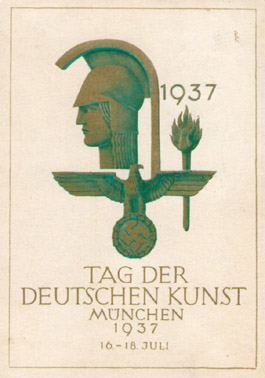
[Above: This postcard is from 1937 celebrating the 'Day of German Art'. Click on the image to see the stamp and cancel commemorating the event.]
[Above: This postcard is from 1938 celebrating the 'Day of German Art'.]
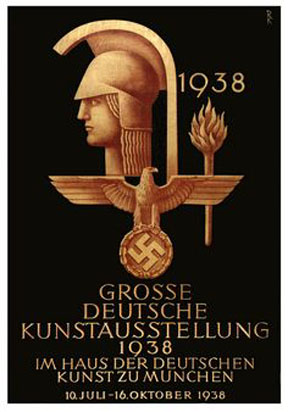
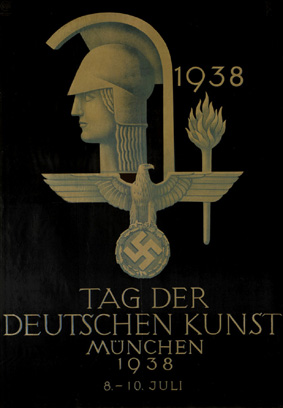
[Above: This is the poster version from 1938 celebrating the 'Day of German Art'.]
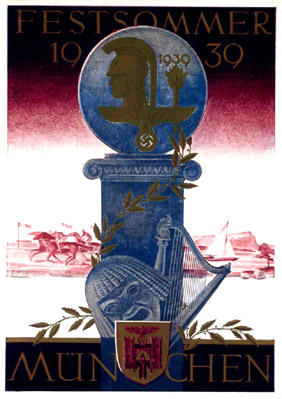
[Above: This postcard commemorates a 1939 summer rally in Munich. The artist is Gottfried Klein.]
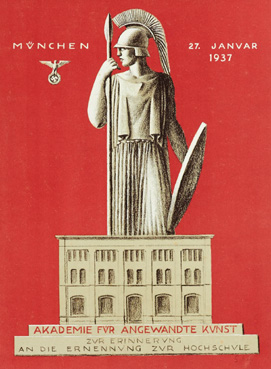
[Above: 1937 poster celebrating the opening of the 'Akademie für Angewandte Kunst' (Academy of Applied Arts).]
[Above: Day of German Culture machine cancel on envelope from July 1937.]
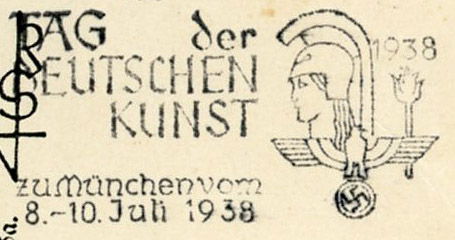
[Above: Day of German Culture cancel on envelope from July 8-10, 1938.]
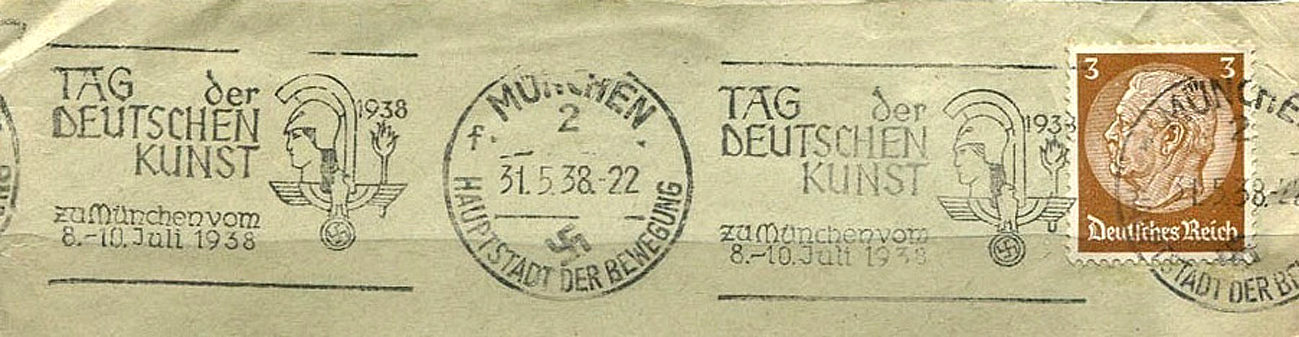
[Above: Day of German Culture machine cancel on envelope from July 8-10, 1938.]
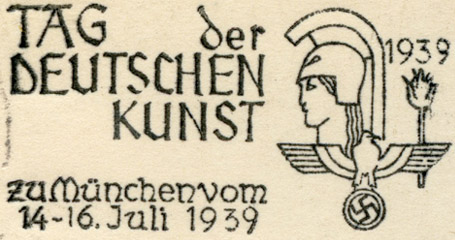
[Above: Day of German Culture cancel on envelope from July 14-16, 1939.]
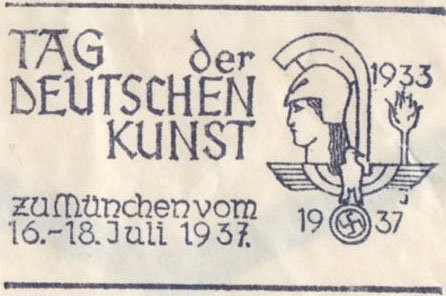
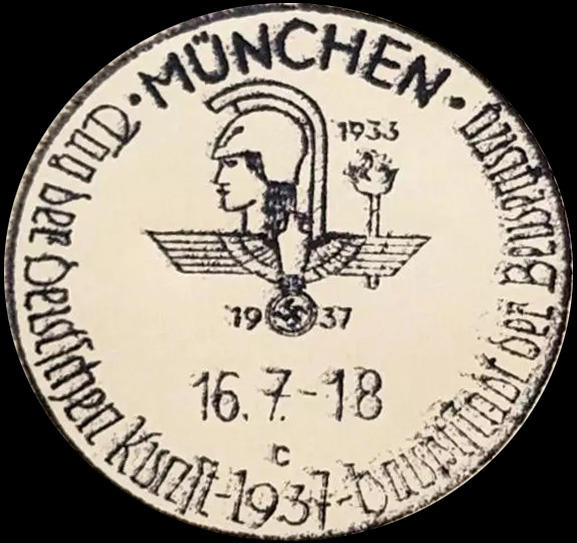
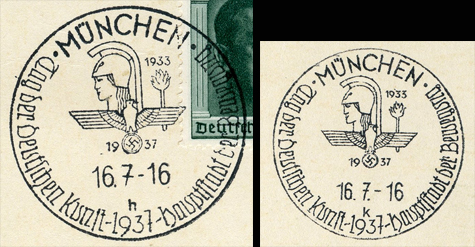
[Above: An uncommon round cancel variation for the Day of German Culture from July 16-18, 1937.]
[Above: This cancel came in two different sizes. Click here to see the postcard and cancels.]
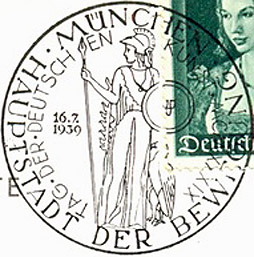
[Above: Postal cancel honoring the Day of German Art showing Athena from July 16, 1939.]
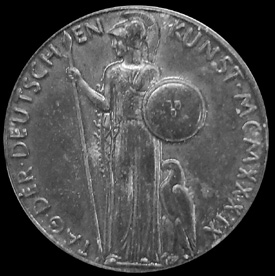
[Above: Zinc tinnie from 1939 using the same design as the cancel above.]
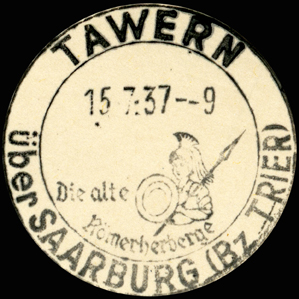
[Above: This 1937 Athena cancel is from Tawern (a municipality in the Trier-Saarburg district, in Rhineland-Palatinate, Germany.) It says 'Die alte Römerherberge' (The old Roman hostel).]
[Above: This is a 1939 House of German Art folio containing a variety of beautiful German art. Paintings, sculptures and drawings, all very high quality and ready to frame.]
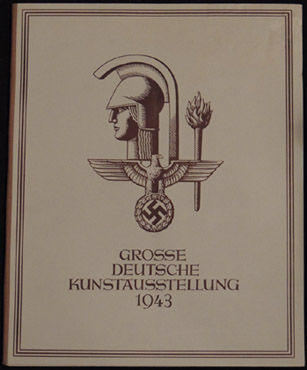
[Above: This is a 1943 House of German Art folio containing a variety of beautiful German art. Paintings, sculptures and drawings, all very high quality and ready to frame.]
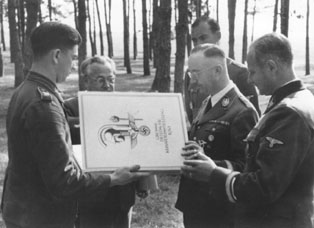
[Above: The 1941 edition of the book being presented to Heinrich Himmler.]
• Click here to see other issues and a few examples of the featured art
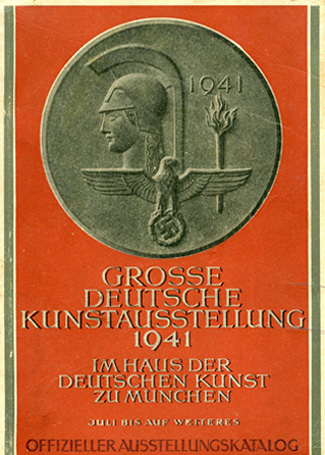
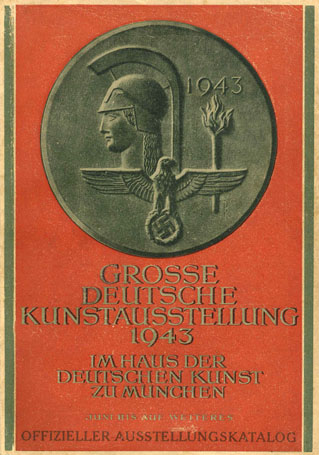
[Above: House of German Art exhibition catalogs from 1941 and 1943.]
[Above: Advertisement found in the back of the 1941 catalog above. It says:
(The Art of the German Reich
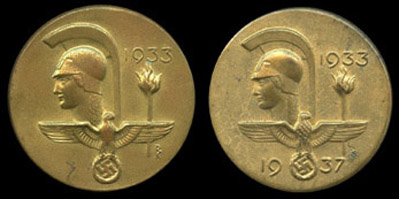
[Above: Two tinnies from 1933 & 1937.]
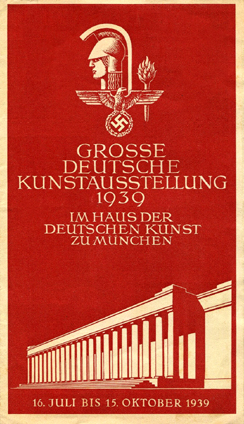
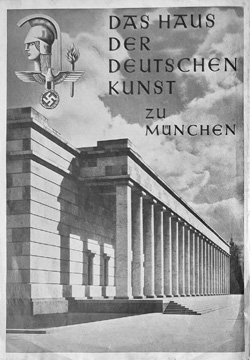
[Above: 1939 House of German Art advertising brochure. Click to see more.]
[Above: House of German Art book.]
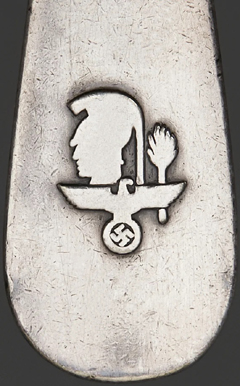
[Above: House of German Art silverware. From the top we see a dinner fork, an ice cream spoon and a dessert fork. These were used in the two restaurants within the House of German Art. Click to see more.]
[Above: House of German Art silverware. Close-up.]
[Above: House of German Art restaurant. It says:
[Above: Retouched photo postcard of the House of German Art restaurant. Click to enlarge and see reverse.]
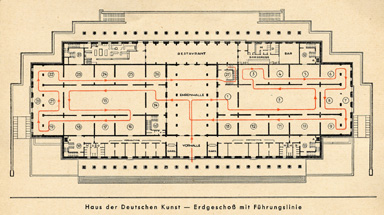
[Above: Here is a map of the House of German Art from the House of German Art exhibition catalog from 1941. This is the first floor (it shows the guide line and exhibit numbers. These numbers were written above the doorways of the rooms - see example below).]
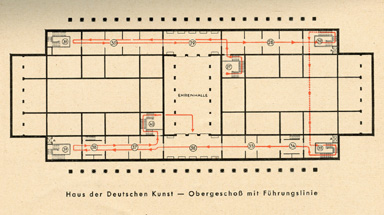
[Above: Second floor.]
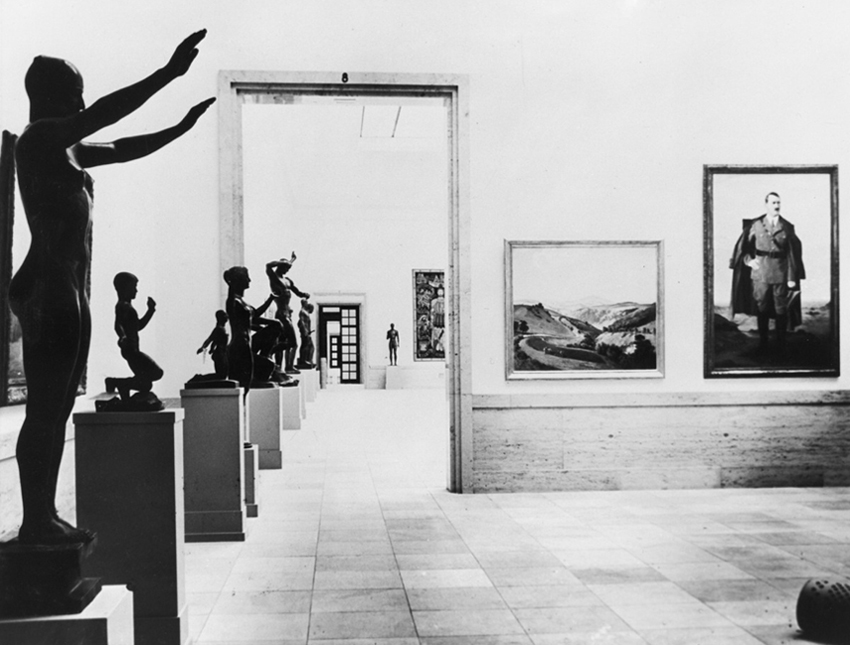
[Above: Note the number '8' above the door.]
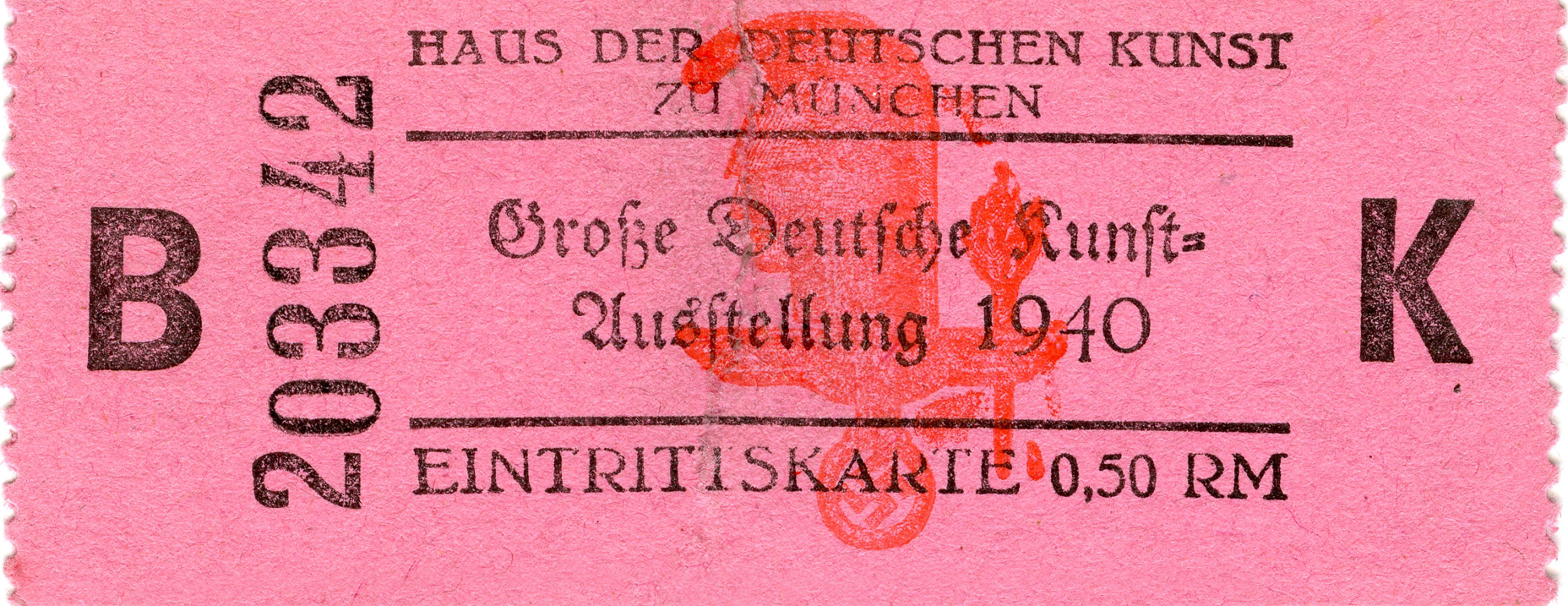
[Above: Wow, now this is rare! It's a 1940 ticket to the House of German Art. As you can see, someone used this ticket (like most tickets, it was ripped in half upon use) and carefully glued it back together. This ticket is number 203,342 and only cost .50 Reichsmarks (equivalent to 50 cents). Adolf Hitler wanted to bring culture and art to Germans, whether they lived in Munich, where the House of German Art was located, or even in remote locations. They actually had traveling groups of artists and musicians who would travel to small towns. Many of these people had never experienced concerts and other cultural events. Front/reverse.]
[Above: Athena close-up.]
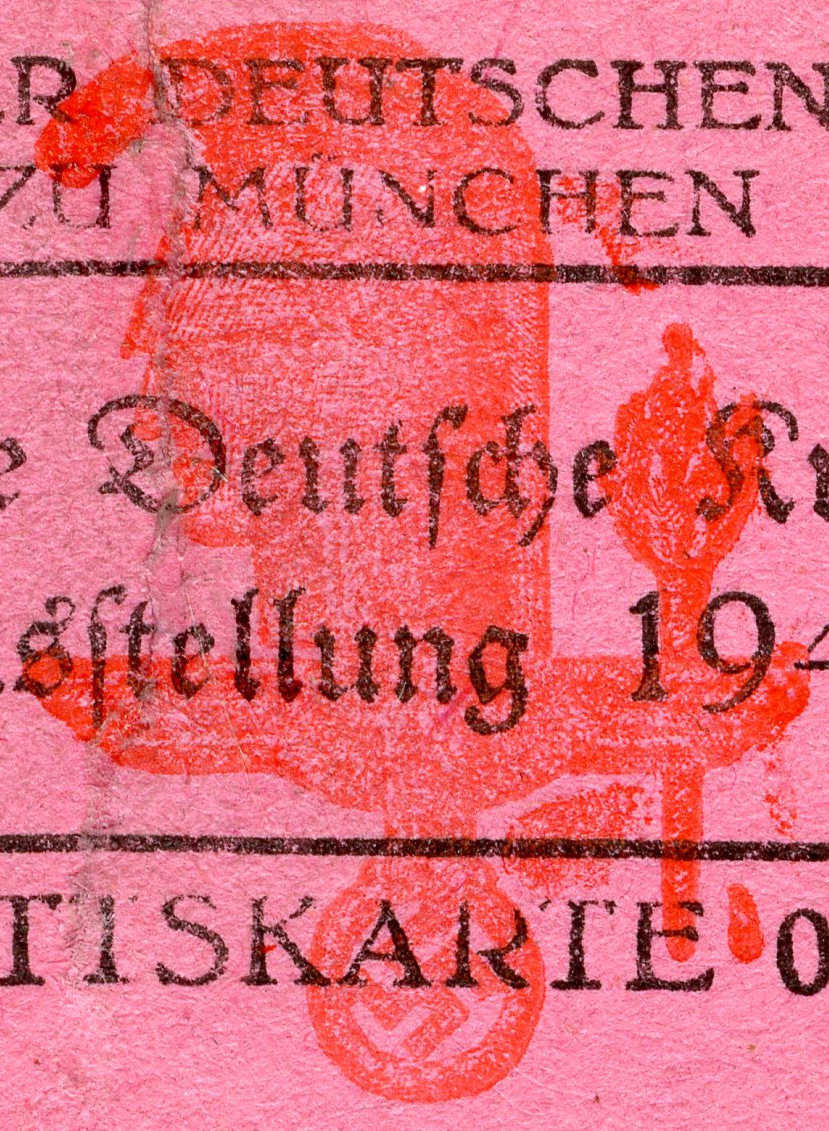
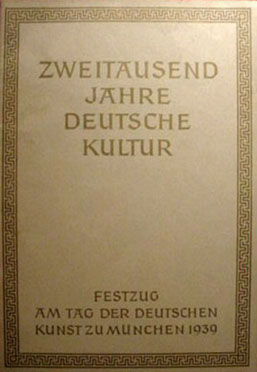
[Above: This book celebrates 2000 years of German culture. It basically says: 'Pageant on the Day of German Culture in Munich 1939']
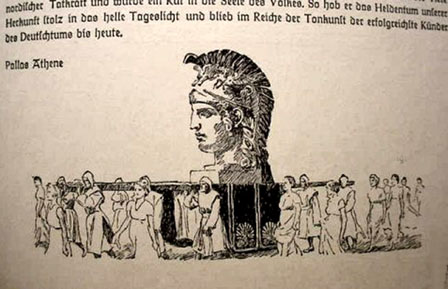
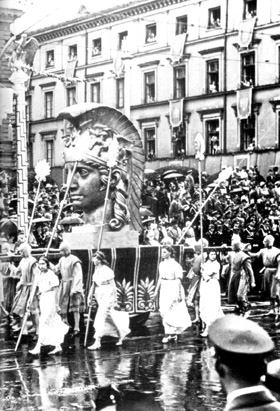
[Above: This picture, from the book above, shows Athena's head, carried in a parade procession on the Day of German Art in Munich.]
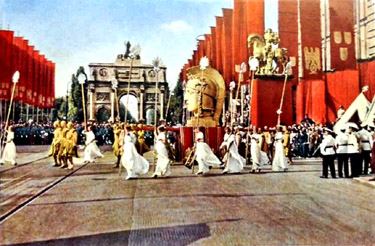
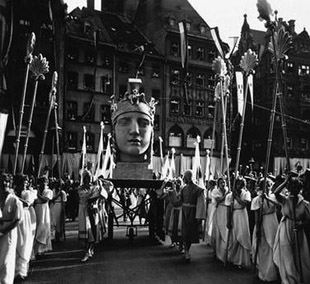
[Above: Photograph showing Athena's head, very similar to the illustration above, carried in a parade procession on the Day of German Art in Munich, 1939.]
[Above: Parade for the Day of German Art, Munich, 1939.]
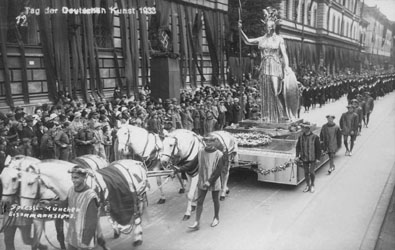
[Above: Day of German Culture parade, circa 1933.]
[Above: Kraft durch Freude (Strength through Joy) festival. Another Athena head.]
[Above: Kraft durch Freude (Strength through Joy) festival. Another Athena head.]
[Above: Kraft durch Freude (Strength through Joy) festival. Yet another Athena head.]
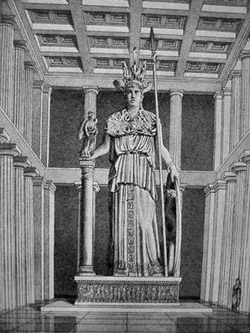
[Above: Illustration of Athena from a period German book.]
• Click here to see more images of National Socialist festivals
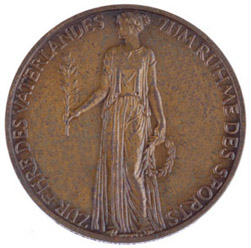
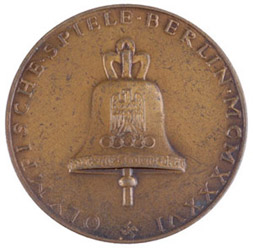
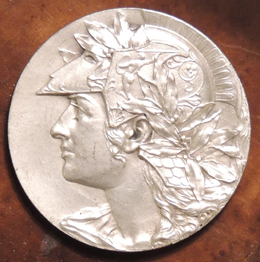
[Above: 1936 Olympic Games Commemorative Medal featuring the image of Athena. The front of the medal is the image of Athena.]
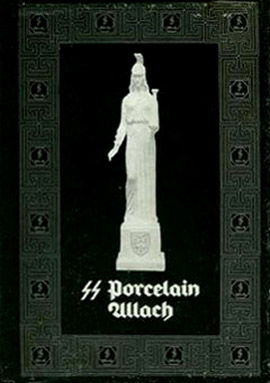
[Above: SS Allach porcelain book showing Athena figure.]
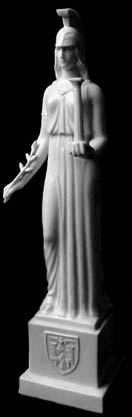
[Above: SS Allach porcelain Athena figure.]
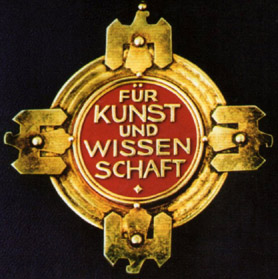
[Above: German National Prize for Arts and Sciences, President's Neck Badge. A beautiful piece bearing the image of Athena. This is the front of the badge.]
[Above: This is the reverse of the badge. It says: 'Für Kunst und Wissenschaft' (For Art and Science)]
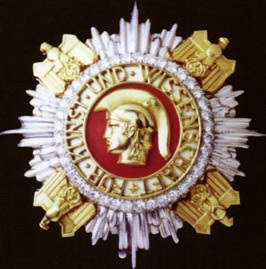
[Above: German National Prize for Arts and Sciences in gold and platinum and set with diamonds (dress copy). Another beautiful piece bearing the image of Athena.]
Many other medals and the like were inscribed with the holy image of Athena. Here's a description of one from the Academy of Art of Munich:
'The Academy of Art of Munich gave Hitler a golden medal. On the front was the head of Pallas Athena. The back featured Pegasus. The medal carried the following inscription: 'To the leader of the German people, Adolf Hitler, who has put national thought in the center of our spiritual life and who has rendered back to art it's old rights. His prophetic plans have given art its own task, to be the language of the people.'
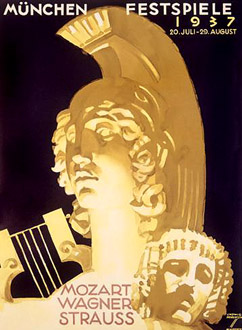
[Above: Music Festival, Munich 1937.]
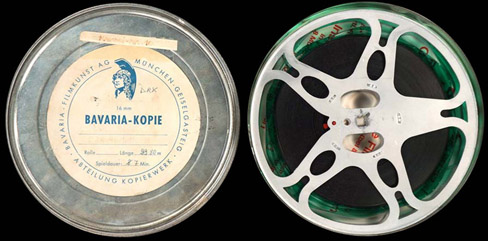
[Above: A late-war 16mm German Red Cross film with the image of Athena.]
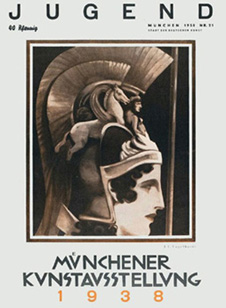
[Above: 1938 Munich magazine 'Jugend' (Youth).]
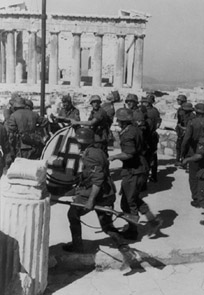
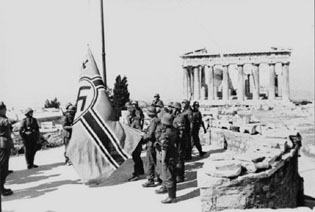
[Above: Preparing to raise the flag under the shadow of the Acropolis. Circa 1941.]
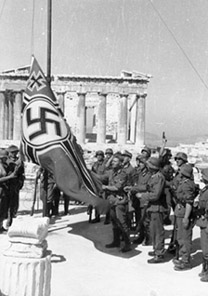
[Above: The flag of freedom raised under the shadow of the Acropolis in Greece, circa 1941.]
[Above: The flag of freedom raised under the shadow of the Acropolis in Greece, circa 1941.]
[Above: The flag of freedom raised under the shadow of the Acropolis in Greece, circa 1941.]
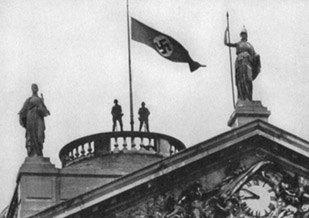
[Above: Athena statue seen over Brussel's city hall.]
• Click here to see more pictures of Germans in Greece
[Below: Although the next postcards are not from the Third Reich era, we thought we'd include them anyway because they bear Athena's image.]
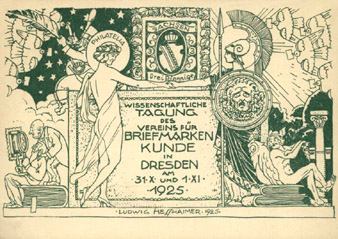
[Above: Athena on a postage stamp for an event in Dresden, circa 1925.]
[Above: Athena is seen on this post card from Munich, circa 1901.]
[Above: Athena is shown here on a war exhibition postcard from Hamburg, WWI era.]
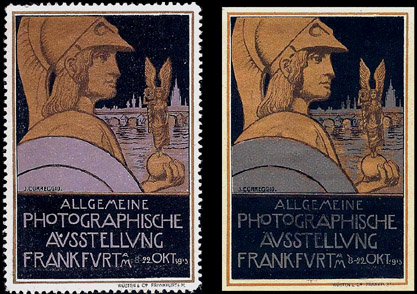
[Above: These are postal vignettes bearing Athena's image from a 1913 photography exhibition held in Frankfurt, Germany.]
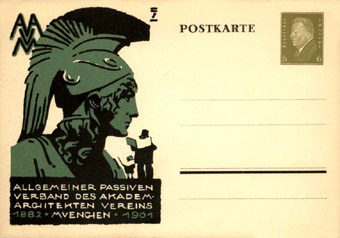
[Above: This is a WWI era German postcard.]
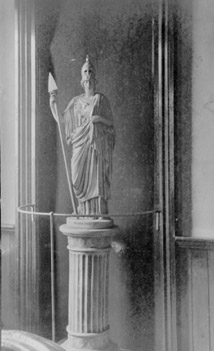
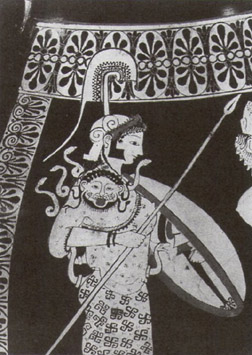
[Above: An ancient image of Athena with her dress covered in swastikas.]
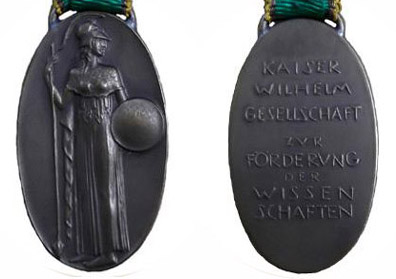
[Above: Merit badge of the Kaiser Wilhelm Society for the Advancement of Science. This class is bronze, there is also gold.]
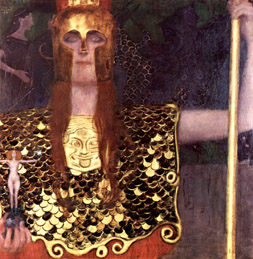
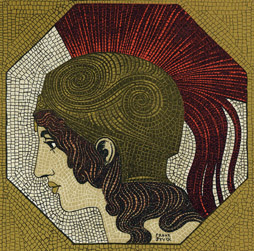
[Above: 'Pallas Athena' on canvas, done in 1898 by Austrian/German artist Gustav Klimt (July 14, 1862 – February 6, 1918).]
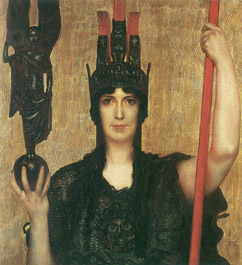
[Above: 'Pallas Athena' on panel, also done in 1898, by German artist Franz von Stuck (February 23, 1863 – August 30, 1928).]
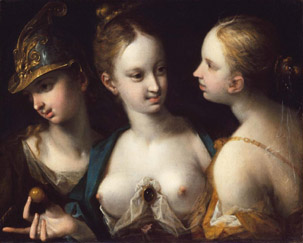
[Above: 'Pallas Athena, Venus and Juno' painted in 1593 by German artist Hans von Aachen (1552 – March 4, 1615).]
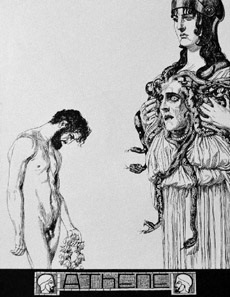
[Above: 'Götter' painted in 1901 by Franz Stassen.]
[Above: Beautiful original 1897 Athena lithograph 'Kunst-Ausstellung' by Franz Stuck. Click to see full image.]
[Above: I think this is some sort of table medal, or award. It has a gorgeous rendition of Athena. This was purchased from Italy, but who knows its origin? It must be pretty old, this new world could never produce something so beautiful.]
Page One
-|-
Page Two
-|-
Page Three
-|-
Page Four
-|-
Page Five
Page Six
-|- Page Seven
-|- Page Eight-|-
Page Nine
-|- Page Ten
Page Eleven
-|-
Page Twelve
-|- Page Thirteen
-|- Page Fourteen
Page Fifteen
-|- Page Sixteen
-|- Page Seventeen
-|- Page Eighteen
Page Nineteen
-|- Page Twenty
-|- Page Twenty-one
-|-
Third Reich Photographs
-|-




Then it is Christianity which allows them to shape the worldview of the "Goyim" in such a way that they come to accept them as "the chosen people" by their own God Jehovah.
[...]
The Germans must come to the realization that Christianity as a world religion was devised by Jews in order to achieve the objectives of their ancestral religion.'
--General Erich Ludendorff, German Defense: Antisemitism against Antigojism
[Antigojismus
(or anti-goyism) refers to prejudice, hostility, or discrimination directed against non-Jews (goyim) by Jews.]
Ludendorff Publishing House 1934, pgs. 3 & 5.


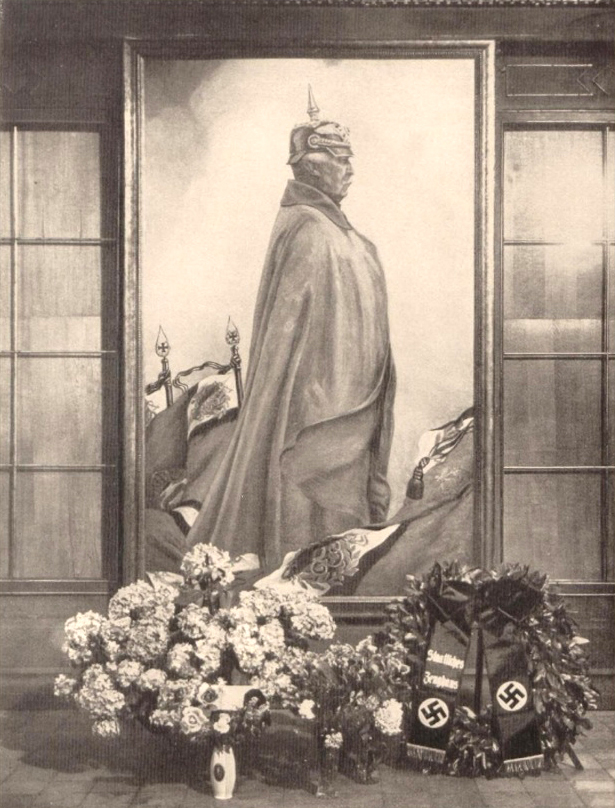
'General Ludendorff
after the colossal painting by L. Richter, provided to the Berlin Armory for
exhibition by Dr. M. Ludendorff
The photograph of the general [...] shows the essential difference between a photograph and a painting. While a photograph only captures a moment,
in a living work of art the creative artist, beyond the external form, shapes over time the inner essense of the person, which can never be reproduced by a camera, as it radiates outwards.
Therefore, this monumental painting of the general exerts such a profound and compelling effect on every viewer, an effect that the much smaller and monochrome image cannot even begin to convey.'
-Ludendorff - Der Feldherr der Deutschen im Weltkriege, 1935.]
They are the enemies of the Nordic race because they produced Christianity, which has been the poison that has destroyed the vitality of the Aryan people.'
--General Erich Ludendorff
--General Erich Ludendorff
Note the pentagram, maligned and misused by New Age garbage, heavy metal and rebellious teenagers, in truth it is an ancient symbol of truth, sometimes equated with the Aryan race.]
-Kurt Eggers, writer, poet, songwriter, Untersturmführer in SS Division Wiking, and martyr who gave his life defending light against darkness in WWII.












[Harper's Magazine, pg 401, October 1943]





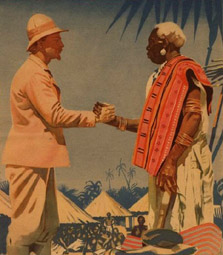




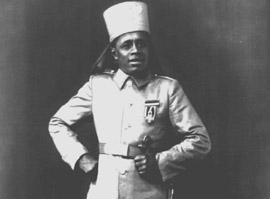

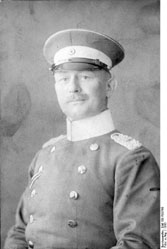
'we are all Africans here'.
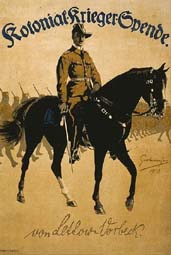
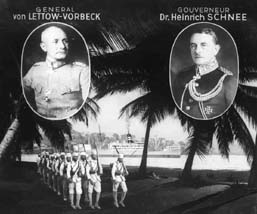
-Paul von Lettow-Vorbeck, from his 1957 book Mein Leben (My Life)

-Radio Wehrwolf, 1945.
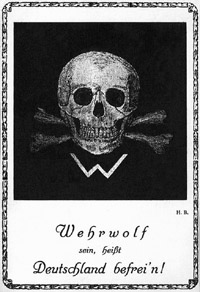
'Wehrwolf sein, heißt Deutschland befrei'n!' = 'To be a werewolf is to free Germany! Later, in the final days of WWII, the Wehrwolf movement of resistance fighters was formed, with the intention of fighting the Allied occupiers after the war.]
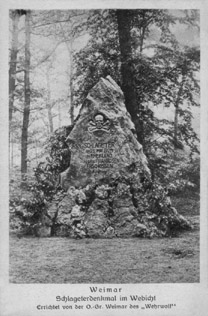
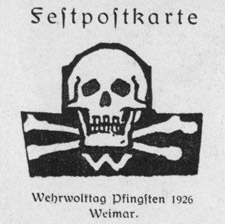
It is more worthwhile and more promising of success to fight with a hundred determined men and women than to have a thousand [nominal] members.'
-Radio Wehrwolf, April 7, 1945.








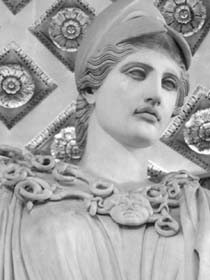
Most interesting in this context, Athena is a devoted companion of heroes and is the patron goddess of heroic endeavor. She was called 'Minerva' by the Romans and Athena by the Greeks.

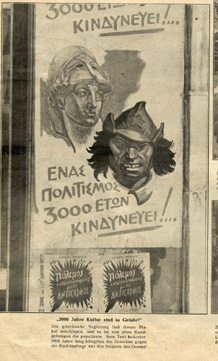
The bottom says:
Die griechische Regierung ließ dieses Plakat
anschlagen und es ist von allen Kundgebungen
die populärste. Sein Text bedeuet:
3000 Jahre lang kämpften die Griechen gegen
die Eindringlinge aus den Steppen des Ostens!'
The Greek government had this poster
and it is the most popular in all the rallies.
Its text means:
For 3000 years the Greeks fought against
the invaders from the steppes of the East!)]
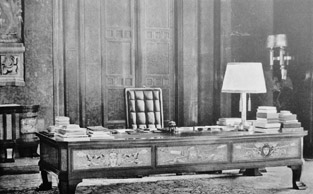
Athena/Minerva, Ares/Mars (Athena's brother) and Medusa (whose head was given to Athena by the hero Perseus and was then added to the magnificent Aegis armor. This beautiful work was done by Hermann Kaspar (April 19, 1904 - August 2, 1986). Kaspar was a respected German designer, painter, university professor and also a close friend of Albert Speer. He also designed the mosaics, frescoes, floors, friezes and wood inlays for the New Reich Chancellery. In 1969 Speer wrote in his 'Memoirs' that Adolf Hitler was very pleased with the desk inlay...]
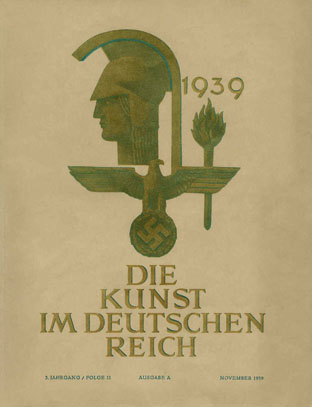
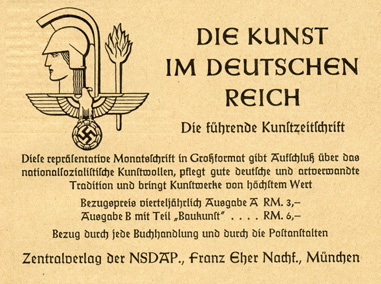
'Die Kunst im Deutschen Reich
Die führende Kunstzeitschrift
Diese repräsentative Monatsschrift in Großformat gibt Aufschluß über das nationalsozialistische Kunstwollen,
pflegt gute deutsche und artverwandte
Tradition und bringt Kunstwerke von höchstem Wert'
The leading art magazine
This representative monthly magazine in large format provides information on the National Socialist art movement,
cultivates good German and related tradition, and presents works of art of the highest value).]

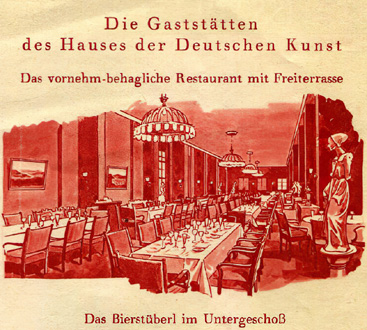
'Die Gaststätten des Hauses der Deutschen Kunst - Das vornehm-behagliche Restaurant mit Freiterrasse - Das Bierstüberl im Untergeschoß'
(The restaurants of the House of German Art - The cozy restaurant with outdoor terrace - Bierstüberl {like a beer garden or bar} in the basement).]
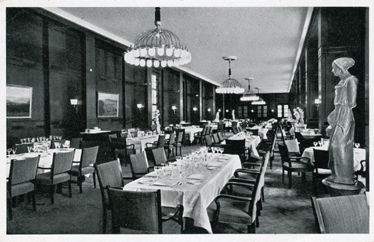




-Art of the Third Reich, by Peter Adam, pg. 115, (c)1992



-|-
The Graves of Martyrs
-|-
-|-
Third Reich Philatelia
-|-
-|-
Third Reich Ephemera
-|-
-|-
Third Reich Awards
-|-
-|-
Third Reich Miscellanea
-|-
-|-
Third Reich Identification Books
-|-
-|-
Third Reich Currency
-|-
-|-
The Great War
-|-
-|-
Hand of Pandora
-|-
-|-
Waffen-SS Technical Information -|-
-|-
The European Volunteer Movement in WWII -|-
-|-
Copyright -|-