-Chandra Bose
______________________________________

[Above: Chandra Bose as a student in England preparing for his Indian Civil Service entrance examination, 1920.]
______________________________________

[Above: Chandra Bose.]
______________________________________

[Above: Chandra Bose.]
______________________________________

[Above: Chandra Bose.]
______________________________________

[Above: Chandra Bose. Circa 1936.]
______________________________________

[Above: Chandra Bose.]
______________________________________

[Above: Chandra Bose.]
______________________________________

[Above: Chandra Bose.]
______________________________________

[Above: Chandra Bose.]
______________________________________

[Above: Chandra Bose.]
______________________________________

[Above: Chandra Bose.]
______________________________________

[Above: Chandra Bose with his Generals.]
______________________________________

[Above: Chandra Bose.]
______________________________________

[Above: Chandra Bose.]
______________________________________

[Above: Chandra Bose.]
______________________________________

[Above: Chandra Bose in garlands.]
______________________________________

[Above: Chandra Bose.]
______________________________________

[Above: Chandra Bose.]
______________________________________

[Above: Chandra Bose and unknown others.]
______________________________________

[Above: Chandra Bose.]
______________________________________

[Above: Chandra Bose.]
______________________________________

[Above: Chandra Bose.]
______________________________________

[Above: Chandra Bose, the determined voice of a free India.]
______________________________________

[Above: Bose took the oath of allegiance to the Provisional Government of India on October 23, 1943, proclaiming: 'I, Subhas Chandra Bose, will continue this sacred war of freedom till the last breath of my life...']
______________________________________

[Above: Bose making a radio broadcast on July 6, 1944.]
______________________________________

[Above: Bose, far left.]
______________________________________

[Above: Chandra Bose.]
______________________________________

[Above: Chandra Bose.]
______________________________________

[Above: Chandra Bose and the future leader of India, Nehru.]
______________________________________

[Above: Chandra Bose and George Lansbury (October 25, 1932 – October 8, 1935). Landsbury was a lifelong pacifist and Leader of the Labour Party of Britain. He also supported Indian and Irish independence.]
______________________________________

[Above: Chandra Bose with Legion commander Major Krappe (right)]
______________________________________

[Above: Chandra Bose(far right) beside Legion commander Major Krappe]
______________________________________

[Above: Chandra Bose and Legion commander Major Krappe]
______________________________________

[Above: Chandra Bose and Legion commander Major Krappe]
______________________________________

[Above: Chandra Bose meeting Heinrich Himmler. Circa 1943.]
______________________________________

[Above: Chandra Bose meeting Heinrich Himmler. Circa 1943.]
______________________________________

[Above: Chandra Bose meeting with Heinrich Himmler. Circa 1943.]
______________________________________

[Above: Chandra Bose meeting with Heinrich Himmler. Circa 1943.]
______________________________________

[Above: Chandra Bose meeting with Heinrich Himmler. Circa 1943.]
______________________________________

[Above: Chandra Bose meeting with The Grand Mufti of Jerusalem Mohammad Amin al-Husayni in Berlin, Germany. Circa 1943.]
______________________________________

[Above: Chandra Bose reviewing his Azad Hind volunteers.]
______________________________________

[Above: Chandra Bose reviewing his Azad Hind volunteers.]
______________________________________

[Above: Chandra Bose reviewing his Azad Hind volunteers.]
______________________________________

[Above: Chandra Bose reviewing his Azad Hind volunteers. Circa 1942. Courtesy of the Bundesarchiv.]
______________________________________

[Above: Chandra Bose and Legion commander Major Krappe reviewing Azad Hind volunteers.]

[Above: Chandra Bose is in the foreground]
______________________________________

[Above: Chandra Bose eating with his men.]
______________________________________

[Above: Chandra Bose with the Azad Hind.]
______________________________________

[Above: Chandra Bose with the Azad Hind.]
______________________________________

[Above: Chandra Bose speaking at the inauguration of the Indo-German Friendship Society in Hambburg, 1942.]
______________________________________

[Above: Chandra Bose and Captain Werner Musenberg on the deck of submarine U-180 en route to Japan.]
______________________________________

[Above: Chandra Bose on the deck of submarine U-180 en route to Japan.]
______________________________________

[Above: Chandra Bose and Captain Werner Musenberg.]
______________________________________

[Above: The crew of the Japanese submarine I-29 after a rendezvous with the German submarine U-180 300 sm southeast of Madagascar; Bose is sitting in the front row, second from left. April 28, 1943.]
______________________________________

[Above: Chandra Bose, front and center, with members of the 'Azad Hind Fauj', or the Indian National Army (INA). Singapore, October 21, 1943.]
______________________________________

[Above: Chandra Bose and Lakshmi Sahgal, the Minister of Women's Affairs in the Azad Hind government, at the camp in Bras Basah Road. Bose is seen here reviewing an Indian National Army female combat regiment -- one of world's first. In the background one can see the former apothecary building and the arched verandahs of what later would be the Soon Chong Leong building at the corner of Bras Basah Road and Bencoolen Street.]
______________________________________

[Above: Young women recruits. The women's regiment attracted numerous recruits from the working class in Singapore and Malaya. Bose deeply believed that if he had one thousand recruits as courageous as Lakshmi Sahgal he could drive the British out of India.]
______________________________________

[Above: Bose spoke to his women volunteers in Rangoon, saying in part: 'Sisters, there is no sphere of our activity in which our women have not gladly and bravely shared the burden of work...']
______________________________________

[Above: Female volunteers in the Indian National Army]
______________________________________

[Above: Female platoon in the Indian National Army]
______________________________________

[Above: Female volunteers of the Indian National Army during rifle training]
______________________________________

[Above: Chandra Bose reviewing INA volunteers.]
______________________________________

[Above: Chandra Bose reviewing INA volunteers of the Gandhi Brigade of Azad Hind Fauj. The INA regiments were named 'Gandhi Brigade', 'Azad Brigade', 'Nehru Brigade' and 'Subhas Brigade'.]
______________________________________

[Above: Chandra Bose reviewing INA volunteers.]
______________________________________

[Above: INA soldiers on the march in the rocky area of Assam. Note the placard one of the them is holding in the background, which is most likely the image of Bose.]
______________________________________

[Above: On October 25, 1943 Bose addressed his new army of liberation: 'Comrades! The Azad Hind Fauj has only one single aim: the liberation of Mother India; the Fauj has only one destination: the ancient Red Delhi Fort!.... The Provisional Government and its Army are the servants of the Indian Nation.]
______________________________________

[Above: Chandra Bose giving a speech.]
______________________________________

[Above: Chandra Bose speaking with Japanese comrades.]
______________________________________

[Above: Bose (left) and his staff officers examine campaign details.]
______________________________________

[Above: Participants of the Greater East Asia Conference Held in Tokyo, Japan, Nov 5-6, 1943.
Left to right Ba Maw (Burma), Zhang Jinghui (Manchukuo), Wang Jingwei (China), Hideki Tojo (Japan), Wan Waithayakon (Thailand), José P. Laurel (Philippines), Subhas Chandra Bose (India).]
______________________________________

[Above: Participants of the Greater East Asia Conference joined by others.]
______________________________________

[Above: Subhash Chandra Bose speaking at the Greater East Asia Conference.]
______________________________________

[Above: Wang Jingwei looking on while Hideki Tojo and Subhas Chandra Bose shake hands.]
______________________________________

[Above: Chandra Bose (second from right) toasting with Japanese leaders.]
______________________________________

[Above: Chandra Bose (third from right) toasting with Japanese leaders.]
______________________________________

[Above: Chandra Bose visiting with Japanese and Chinese officials in Lin Baisheng and Chu Minyi in Nanjing, November 1943.]
______________________________________

[Above: Chandra Bose lighting a cigarette.]
______________________________________

[Above: Bose photograph inscribed while in Japan in 1943.]
______________________________________

[Above: Bose having a smoke in Tokyo, November 1943.]
______________________________________

[Above: Bose with unknown others.]
______________________________________

[Above: Subhas Chandra Bose with his brother Sudhir Chandra Bose and his Brother's wife. Circa 1939.]
______________________________________

[Above: Subhas Chandra Bose recieving Madeleine Slade (Mirabehn) in Dalhousie. Bose was recovering from a recent illness and Gandhi had sent her to enquire about his health. Circa 1937. Mirabehn (November 22, 1892 - July 20, 1982) was the daughter of the British Rear-Admiral Sir Edmond Slade. She left her homeland of Britain to live and work with Mohandas Gandhi toward the independence of India. For her work Gandhi gave her the name 'Mirabehn', after Meera Bai, the great devotee of Lord Krishna.]
______________________________________

[Above: Chandra Bose with his wife Emilie Shenkl and daughter.]
______________________________________

[Above: Chandra Bose with his wife Emilie Shenkl and pet German Shepherd in 1937.]
______________________________________

[Above: Chandra Bose with his wife Emilie Shenkl (right).]
______________________________________

[Above: Chandra Bose and his daughter.]
______________________________________

[Above: This is believed to be the last picture ever taken of Chandra Bose, Saigon, August 17, 1945.]
______________________________________

[Above: Chandra Bose on the cover of a Japanese magazine.]
______________________________________

[Above: Chandra Bose signs a visitor's book of the library Nagarik Pustakalay in 1940.]
______________________________________

[Above: The spirit of Bose refuses to die... his job undone, now he fights to free his beloved India from the corruption that rules it.]
______________________________________

[Above: A page from history. India has had enough.]
______________________________________
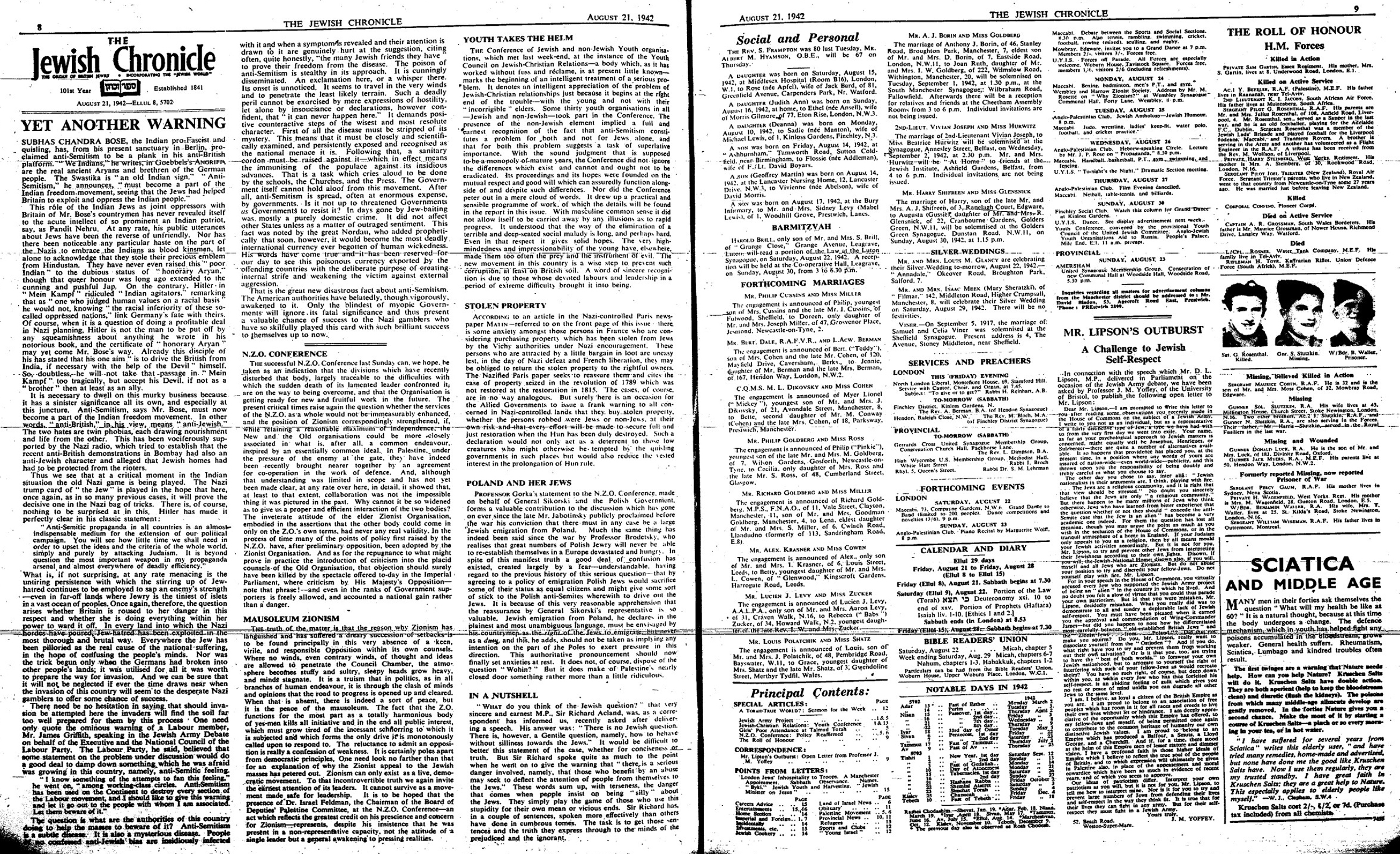
[Above: Pages from The Jewish Chronicle (August 21, 1942). See below for the text!]
'THE Jewish Chronicle
AUGUST 21, 1942
YET ANOTHER WARNING
SUBHAS CHANDRA BOSE, the Indian pro-Fascist and Quisling, has, from his present sanctuary in Berlin, pro-claimed anti-Semitism to be a plank in his anti-British platform. We Indians," he writes, in Goebbels's Angriff are the real ancient Aryans and brethren of the German people. The Swastika is "an old Indian sign." "Anti-Semitism," he announces, "must become a part of the Indian freedom movement, seeing that the Jews had helped Britain to exploit and oppress the Indian people."
This role of the Indian Jews as joint oppressors with Britain of Mr. Bose's countrymen has never revealed itself to the acute intellect of so prominent an Indian patriot, say, as Pandit Nehru. At any rate, his public utterances about Jews have been the reverse of unfriendly. Nor has there been noticeable any particular haste on the part of the Nazis to embrace the Indians as blood kinsmen, let alone to acknowledge that they stole their precious emblem from Hindustan. They have never even raised this "poor Indian" to the dubious status of "honorary Aryan," though that queer honor was long ago extended to the cunning and pushful Jap. On the contrary, Hitler in Mein Kampf ridiculed "Indian agitators," remarking that as "one who judged human values on a racial basis he would not, knowing "the racial inferiority of these so-called oppressed nations," link Germany's fate with theirs. Of course, when it is a question of doing a profitable deal in Nazi planning, Hitler is not the man to be put off by any squeamishness about anything he wrote in his notorious book, and the certificate of honorary Aryan may yet come Mr. Bose's way. Already this disciple of his has stated that his one aim "is to drive the British from India, if necessary with the help of the Devil" himself. So, doubtless, he will not take that passage in "Mein Kampf" too tragically, but accept his Devil, if not as "brother" then at least as an ally.
It is necessary to dwell on this murky business because it has a sinister significance all its own, and especially at this juncture. Anti-Semitism, says Mr. Bose, must now become a part of the Indian freedom movement. In other words, "anti-British," in his view, means "anti-Jewish" The two hates are twin phobias, each drawing nourishment and life from the other. This has been vociferously supported by the Nazi radio, which tried to establish that the recent anti-British demonstrations in Bombay had also anti-Jewish character and alleged that Jewish homes had had to be protected from the rioters.
Thus we see that at a critical moment in the Indian situation the old Nazi game is being played. The Nazi trump card of "the Jew" is played in the hope that here, once again, as in so many previous cases, it will prove the decisive one in the Nazi bag of tricks. There is, of course, nothing to be surprised at in this, Hitler has made it perfectly clear in his classic statement:
"Anti-Semitic propaganda in all countries is an almost indispensable medium for the extension of our political campaign. You will see how little time we shall need in order to upset the ideas and the criteria of the whole world, simply and purely by attacking Judaism. It is beyond question the most important weapon in my propaganda arsenal and almost everywhere of deadly efficiency."
What is, if not surprising, at any rate menacing is the untiring persistence with which the stirring up of Jew-hatred continues to be employed to sap an enemy's strength even in far-off lands where Jewry is the tiniest of islets in a vast ocean of peoples. Once again, therefore, the question arises whether Britain is roused to her danger in this respect and whether she is doing everything within her power to ward it off. In every land into which the Nazi hordes have poured, Jew-hatred has been exploited in the most thorough and brutal way. Everywhere the Jew has been pilloried as the real cause of the national suffering, in the hope of confusing the people's minds. Nor was the trick begun only when the Germans had broken into other people's lands; it was utilized for all it was worth to prepare the way for invasion. And we can be sure that it will not be neglected if ever the time draws near when the invasion of this country will seem to the desperate Nazi gamblers to offer some chance of success.
There need be no hesitation in saying that should invasion be attempted here the invaders will find the soil far too well prepared for them by this process. One need only quote the ominous warning of a Labor member, Mr. James Griffith, speaking in the Jewish Army Debate on behalf of the Executive and the National Council of the Labor Party. The Labor Party, he said, believed that some statement on the problem under discussion would do a good deal to damp down something which he was afraid was growing in this country, namely, anti-Semitic feeling.
"I know something of the attempts to fan this feeling," he went on, "among working-class circles. Anti-Semitism has been used on the Continent to destroy every section of the Labor movement, and I should like to give this warning and let it go out to the people with whom I am associated. Let them beware of it."
The question is what are the authorities of this country doing to help the masses to beware of it? Anti-Semitism is a subtle disease. It is also a mysterious disease. People if so confessed anti-Jewish bias are insidiously infected with it and when a symptom is revealed and their attention is drawn to it are genuinely hurt at the suggestion, citing often, quite honestly, "the many Jewish friends they have" to prove their freedom from the disease. The poison of anti-Semitism is stealthy in its approach. It is cunningly disseminated. An exclamation here, or a whisper there. Its onset is unnoticed. It seems to travel in the very winds and to penetrate the least likely terrain. Such a deadly peril cannot be exorcised by mere expressions of hostility, let alone by insouciance or declarations, however confident, that "it can never happen here." It demands positive counteractive steps of the wisest and most resolute character. First of all the disease must be stripped of its mystery. This means that it must be closely and scientifically examined, and persistently exposed and recognized as the national menace it is. Following that, a sanitary cordon must be raised against it--which in effect means the immunizing of the populace against its insidious advances. That is a task which cries aloud to be done by the schools, the Churches, and the Press. The Government itself cannot hold aloof from this movement. After all, anti-Semitism is spread, often at enormous expense, by governments. Is it not up to threatened Governments as Governments to resist it? In days gone by Jew-baiting was, mostly a purely domestic crime. It did not affect other States unless as a matter of outraged sentiment. This fact was noted by the great Nordau, who added prophetically that soon, however, it would become the most deadly international currency ever begotten of human wickedness. His words have come true and it has been reserved for our day to see this poisonous currency exported by the offending countries with the deliberate purpose of creating internal strife and weakening the victim against external aggression.
That is the great new disastrous fact about anti-Semitism. The American authorities have belatedly, though, vigorously, awakened to it. Only the blindest of myopic Governments will ignore its fatal significance and thus present a valuable chance of success to the Nazi gamblers who have so skillfully played this card with such brilliant success to themselves up to now.'